
1. Solar Energy Did Not Start as an Industry
When solar power is discussed today, the conversation is dominated by scale—gigawatts installed, record-low tariffs, domestic manufacturing capacity, and grid integration challenges. But solar photovoltaics did not originate in boardrooms or policy corridors. It began quietly, in laboratories, as a scientific puzzle.
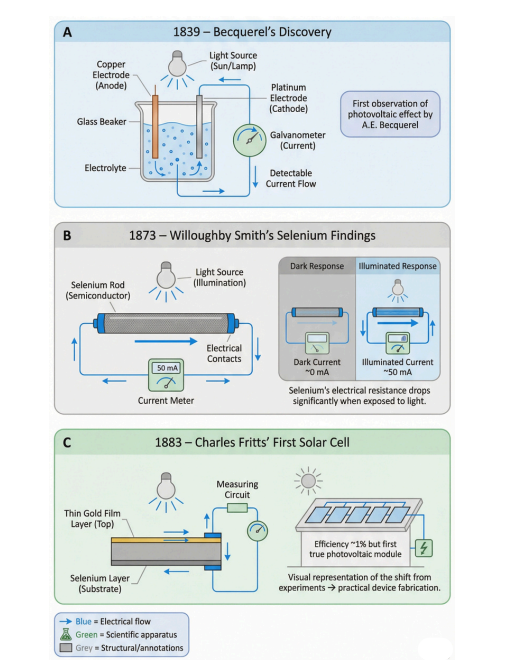
Figure 1.1 captures this forgotten phase of solar history: a sequence of experiments that proved, step by step, that light itself could be converted into electricity.
This origin story matters because it reminds us that solar energy is not a policy construct. It is a physical phenomenon—rooted in material science and governed by immutable laws of physics.
2. 1839: Edmond Becquerel and the Birth of the Photovoltaic Effect
The story begins in 1839, when a 19-year-old French physicist, Edmond Becquerel, observed something unusual. While experimenting with metal electrodes immersed in an electrolyte, he noticed that exposing the system to light produced a small electric current.
At the time, electricity itself was poorly understood. Becquerel did not speak of “solar power” or “renewable energy.” What he discovered was later named the photovoltaic effect—the ability of certain materials to generate electric charge when illuminated.
This was not an energy solution. It was a scientific anomaly.
Yet, this single observation established the most important idea in solar energy: electricity can be produced without heat, motion, or fuel. No turbine. No combustion. No mechanical conversion losses.
3. Selenium, Telegraphs, and the First Practical Hints
Fast forward to the late 19th century.
In the 1870s, Willoughby Smith discovered that selenium’s electrical resistance changed when exposed to light. This property made selenium useful in early light sensors—and briefly, in telegraph systems.
These selenium cells were extremely inefficient, converting less than 1% of sunlight into electricity. They could not power cities or factories. But they proved something essential: solid materials could respond electrically to light in a predictable way.
This was the first hint that solar electricity might one day escape the laboratory.
4. 1883: Charles Fritts Builds the First Solar Cell
The next leap came in 1883, when Charles Fritts created what is widely regarded as the world’s first true solar cell. He coated selenium with a thin layer of gold to form a junction that produced continuous electric current under sunlight.
From today’s perspective, Fritts’ cell was a failure—bulky, fragile, and barely functional. But from a systems perspective, it was extraordinary.
For the first time:
- Sunlight was converted directly into usable electricity
- No moving parts were involved
- Power generation occurred silently and continuously
This architecture—light → semiconductor → electricity—remains unchanged in modern PV modules.
5. Why Early Solar Failed (and Why That Was Inevitable)
If solar power was discovered in the 19th century, why did it take over a century to become mainstream?
The answer lies in materials and manufacturing, not in physics.
Early solar cells suffered from:
- Extremely low efficiencies (<1%)
- Poor material purity
- No understanding of semiconductor band gaps
- High costs with no scalable manufacturing pathway
Coal, oil, and later gas succeeded not because they were cleaner or smarter—but because they were easier to scale with the technologies of the time.
Solar had to wait for the semiconductor revolution.
6. The Long Pause Before the Breakthrough
For nearly 70 years after Fritts, solar PV remained a scientific curiosity. It was studied, refined, and occasionally demonstrated—but never commercialised.
This pause is instructive.
Energy transitions do not move at the speed of discovery. They move at the speed of infrastructure, materials science, and cost curves.
Solar power was waiting for:
- High-purity silicon
- Controlled doping techniques
- Industrial semiconductor fabrication
- Demand for compact, reliable power
That demand would finally arrive—from an unexpected place.
7. Why This History Matters for India Today
India today stands at a similar inflection point.
We are not questioning whether solar works. That debate is over. The real questions are:
- How does solar integrate with grids?
- How do we ensure reliability and firm power?
- How do DISCOMs adapt?
- How do storage, digitalisation, and markets evolve?
Understanding solar’s origin helps ground these discussions in reality.
Solar is not a policy experiment. It is a physics-validated technology whose limitations and strengths are well understood. What changes over time are costs, architectures, and system integration—not the fundamental principle discovered in 1839.
8. From Laboratory Curiosity to Grid Backbone
Every modern solar plant—whether a 3 kW rooftop system or a 2 GW solar park—traces its lineage back to those early experiments in Figure 1.1.
The lesson is clear:
Energy transitions are slow at first, then sudden—and finally unstoppable.
Solar’s early history was slow. Its present is exponential. Its future will be systemic.
And it all began with a beaker, two electrodes, and sunlight.