
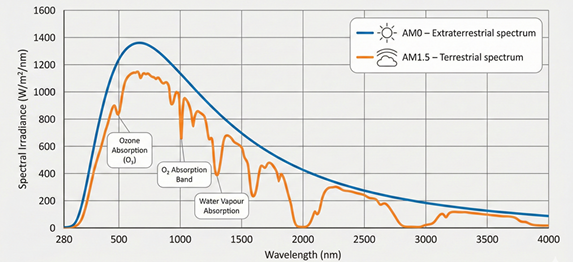
Solar energy begins its journey far beyond the Earth’s surface, originating as electromagnetic radiation emitted by the sun. While photovoltaic (PV) modules are installed on rooftops, fields, and facades, the quality and quantity of the sunlight they receive is shaped long before it reaches the module glass. Figure —Extraterrestrial vs Terrestrial Spectrum—captures one of the most fundamental realities of solar power generation: not all sunlight is created equal by the time it reaches the ground.
Outside Earth’s atmosphere, solar radiation is remarkably consistent. This is known as the extraterrestrial solar spectrum, governed by the solar constant of approximately 1367 W/m². In space, sunlight travels unobstructed, carrying a full range of wavelengths. However, photovoltaic systems never operate under these ideal conditions. As sunlight enters Earth’s atmosphere, it encounters gases, aerosols, water vapor, and particulate matter that selectively absorb, scatter, and reflect portions of the spectrum.
This transformation produces what we call the terrestrial solar spectrum, which is significantly altered compared to its extraterrestrial counterpart. Certain wavelengths—particularly in the ultraviolet and infrared regions—are partially or fully absorbed by ozone, carbon dioxide, and water vapor. The result is a reduced and reshaped spectrum at ground level, directly influencing PV module performance.
To standardize testing and ensure consistency across manufacturers, the industry adopted the Air Mass 1.5 (AM1.5) standard. Air mass describes the relative path length sunlight travels through the atmosphere before reaching the Earth’s surface. At AM1.5, the sun is approximately 48 degrees above the horizon, representing a realistic mid-latitude operating condition. This standard forms the basis for module nameplate ratings and performance comparisons.
Understanding this distinction is not merely academic—it has direct field implications. Early morning and late afternoon sunlight travels through a greater thickness of atmosphere, increasing air mass and reducing effective irradiance. This explains why modules may appear intact yet produce low power during certain times of day, even under clear skies. For technicians troubleshooting underperformance, recognizing spectral losses is a critical diagnostic skill.
Figure also reinforces the importance of site-specific solar resource assessment. Locations with high humidity, pollution, or frequent cloud cover experience more diffuse radiation and altered spectral content. Thin-film technologies, for example, often perform better under diffuse light conditions due to their spectral response characteristics, while crystalline silicon modules excel under strong direct irradiance.
In practical terms, the solar spectrum governs current generation. Since current (Isc) is directly proportional to irradiance, any spectral loss translates into reduced power output. Voltage, while more temperature-sensitive, is indirectly affected as well. Engineers and designers must therefore account for spectral conditions when sizing systems, selecting technologies, and predicting yield.
Ultimately, Figure reminds us that solar power is not just about installing panels—it is about understanding the physics that governs every photon’s journey. For professionals seeking reliable performance, mastering the relationship between extraterrestrial and terrestrial spectra is foundational to designing resilient and efficient PV systems.