
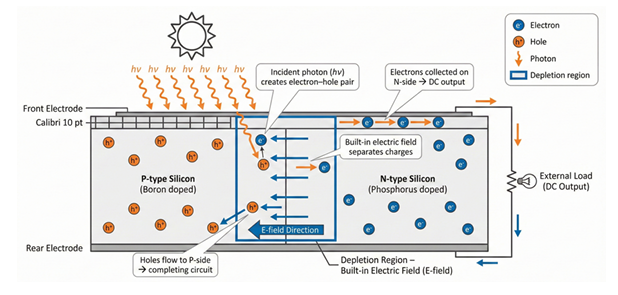
At the heart of every photovoltaic module lies a deceptively simple yet powerful device: the solar cell. Figure —the PN Junction Diagram—illustrates the core mechanism that enables sunlight to become usable electrical energy. For technicians and engineers alike, understanding this process is essential to effective installation, diagnostics, and troubleshooting.
A solar cell is fundamentally a semiconductor diode, formed by joining two types of silicon: p-type and n-type. P-type silicon is doped with elements that create positive charge carriers (holes), while n-type silicon contains extra electrons. When these layers are joined, an internal electric field forms at the junction, creating a depletion region.
This built-in electric field is the silent workhorse of solar energy conversion. When photons strike the cell with sufficient energy—greater than silicon’s bandgap of approximately 1.12 eV—they excite electrons, freeing them from atomic bonds. Without the PN junction, these electrons would quickly recombine with holes, producing heat instead of electricity.
The junction’s electric field forces charge separation. Electrons are driven toward the n-side, while holes move toward the p-side, establishing a voltage potential. When an external circuit is connected, this potential difference drives current flow. This is the photovoltaic effect in action.
Figure helps technicians visualize why polarity matters during installation and testing. Reverse polarity readings on a multimeter often indicate mislabelled connectors or wiring errors rather than defective modules. It also explains why shading, cracks, or PID can disrupt current flow—anything that interferes with charge separation reduces output.
From a design perspective, the PN junction defines key electrical parameters: open-circuit voltage (Voc), short-circuit current (Isc), and maximum power point (Pmp). These values are not abstract numbers on a datasheet; they are direct consequences of junction physics and material quality.
Failures at the cell level—such as micro-cracks—often preserve voltage while reducing current, leading to underperformance that is difficult to detect without proper testing. Electroluminescence and I-V curve tracing are modern diagnostic tools rooted in this same physical principle.
Ultimately, Figure underscores a critical truth: solar modules are not passive glass plates. They are active semiconductor devices, governed by the same physics as diodes and transistors. For solar professionals, mastering the PN junction is mastering the foundation of the entire PV system.