
Following the Sun: How the Daily Solar Path Determines Optimal PV Panel Orientation
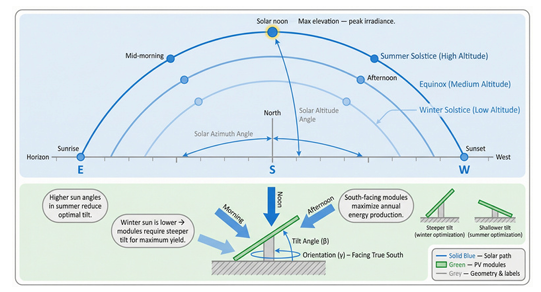
The performance of a solar photovoltaic (PV) system depends not only on the quality of its components, but also on how effectively those components are oriented toward the sun. Figure illustrates the daily solar path—the apparent movement of the sun across the sky—and its direct influence on optimal panel orientation. Understanding this relationship is fundamental to maximizing energy yield, improving system economics, and ensuring predictable performance.
The daily solar path describes how the sun rises in the east, reaches its highest point around solar noon, and sets in the west. This path is not fixed; it varies with geographic latitude and season. Near the equator, the sun’s path is relatively high and symmetrical throughout the year. At higher latitudes, the sun follows a lower arc in winter and a higher arc in summer, resulting in significant seasonal variation in irradiance and day length.
Solar PV modules generate the highest power when sunlight strikes their surface at a perpendicular angle. As the angle of incidence increases, a portion of the sunlight is reflected rather than absorbed, reducing effective irradiance. Optimal panel orientation therefore aims to minimize the average angle of incidence over the course of the day and year.
For fixed-tilt systems, orientation is defined by two parameters: azimuth (the compass direction the panels face) and tilt angle (the angle between the panel and the horizontal plane). In the northern hemisphere, panels are typically oriented toward true south, while in the southern hemisphere they face true north. This orientation aligns the array with the sun’s dominant daily path.
The tilt angle is often selected based on latitude, with common rules of thumb suggesting a tilt close to the site’s latitude for year-round optimization. Shallower tilts favor summer generation, while steeper tilts improve winter performance. Designers may intentionally bias the tilt to match seasonal load profiles or tariff structures.
Figure also highlights the dynamic mismatch between the sun’s movement and fixed panel orientation. Even a well-oriented fixed array only achieves optimal alignment for a limited period around solar noon. During morning and evening hours, the angle of incidence increases, reducing instantaneous power output. This limitation explains why PV power peaks sharply around midday rather than remaining constant throughout daylight hours.
Tracking systems address this challenge by mechanically adjusting panel orientation to follow the sun’s path. Single-axis trackers rotate panels east to west, increasing energy yield by 15–25% compared to fixed systems. Dual-axis trackers further adjust tilt, capturing even more energy, though at higher cost and complexity. These systems are particularly effective in utility-scale installations where incremental yield gains justify additional investment.
Orientation also has implications beyond energy yield. Incorrect azimuth or tilt can exacerbate soiling, increase wind loads, or create shading between rows. Rooftop constraints often require compromises, making accurate assessment of orientation losses essential during the design phase.
From a grid perspective, orientation influences generation profiles. East–west oriented arrays produce flatter daily output curves, reducing midday peaks and extending generation into morning and evening hours. This configuration is increasingly attractive in high-penetration solar markets seeking to align generation with demand and mitigate grid stress.
For technicians and system owners, understanding the solar path helps set realistic expectations. Deviations from “optimal” orientation do not necessarily imply poor system performance; rather, they reflect trade-offs between energy yield, site constraints, and economic objectives.
Figure reinforces a central principle of solar engineering: sunlight is abundant, but capturing it efficiently requires alignment with natural rhythms. By understanding the daily solar path, designers can make informed orientation decisions that maximize value, reliability, and long-term performance.