Choosing the Right Solar PV System: Grid-Tied vs. Off-Grid vs. Hybrid Configurations
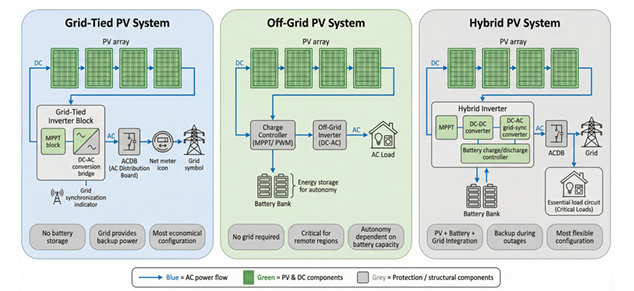
Not all solar photovoltaic (PV) systems are designed to operate in the same way. While they may use similar components—modules, inverters, and mounting structures—their interaction with the electrical grid and energy storage differs significantly. Figure compares the three primary PV system configurations: grid-tied, off-grid, and hybrid systems. Understanding these architectures is essential for selecting the right solution based on reliability needs, economics, and site conditions.
A grid-tied PV system is the most common configuration for residential, commercial, and industrial rooftops. In this setup, the PV array is directly connected to the utility grid through a grid-synchronised inverter. During daylight hours, solar power supplies on-site loads first, with surplus energy exported to the grid through a net meter. When solar generation is insufficient—such as at night or during cloudy periods—the grid supplies the remaining demand.
The primary advantage of grid-tied systems is simplicity and cost-effectiveness. Because they do not require batteries, capital costs are lower, maintenance requirements are minimal, and system efficiency is high. However, grid-tied systems are dependent on grid availability. For safety reasons, they automatically shut down during grid outages, meaning they cannot provide backup power unless paired with energy storage.
Off-grid PV systems, by contrast, operate independently of the utility grid. These systems are typically deployed in remote locations where grid access is unavailable or unreliable. An off-grid system relies on batteries to store energy generated during the day for use at night and during periods of low irradiance. A charge controller manages battery charging, while an inverter supplies AC power to loads.
The design of off-grid systems is driven by reliability rather than cost minimisation. Battery sizing, autonomy days, and load management are critical considerations. While off-grid systems offer energy independence, they come with higher capital costs, increased maintenance, and efficiency losses associated with energy storage. Poorly sized systems can lead to battery degradation or power shortages.
Hybrid PV systems combine elements of both grid-tied and off-grid configurations. These systems are connected to the grid but also include battery storage. Under normal conditions, they operate similarly to grid-tied systems, exporting excess energy and importing power as needed. During grid outages, however, the hybrid inverter isolates the system and supplies selected loads using solar and stored energy.
Hybrid systems are increasingly popular in regions with unreliable grids or high outage costs. They provide backup power without requiring full off-grid autonomy. From a design perspective, hybrid systems are more complex, requiring careful coordination between PV generation, battery management, load prioritisation, and grid interaction.
Figure highlights that no single configuration is universally “best.” The optimal choice depends on factors such as grid reliability, energy tariffs, critical load requirements, site accessibility, and budget constraints. For example, an urban commercial building with stable grid supply may benefit most from a grid-tied system, while a remote telecom tower or village electrification project may require an off-grid solution.
From a policy and planning standpoint, these distinctions are also significant. Grid-tied systems support decarbonisation at scale, off-grid systems expand energy access, and hybrid systems enhance resilience. Each plays a complementary role in the broader energy transition.
Understanding these configurations enables informed decision-making, realistic performance expectations, and effective system design. Figure serves as a clear framework for comparing PV system architectures and aligning technology choices with real-world needs.