
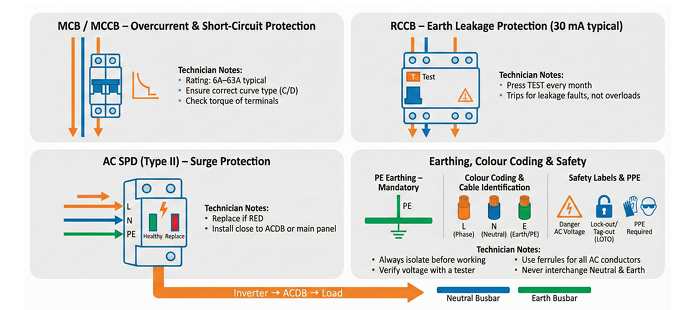
While much attention in solar PV systems is given to the DC side, the AC side is equally critical for ensuring safe, reliable, and compliant operation. Once power is converted from DC to AC by the inverter, it must pass through a structured protection and earthing framework before supplying loads or interfacing with the utility grid. The illustrated diagram highlights key AC-side components: MCB/MCCB, RCCB, AC Surge Protection Devices (SPD Type II), and proper earthing with color coding and safety practices.
This article explains the purpose of each component, their correct application, and why they are mandatory in high-quality solar installations.
Overview of the AC Power Path
The AC output from the inverter typically follows this sequence: Inverter → AC Distribution Board (ACDB) → Loads / Grid. Along this path, multiple protection layers are installed to manage overcurrent, earth leakage, surges, and grounding. These devices collectively protect people, equipment, and infrastructure from electrical hazards.
1. MCB / MCCB – Overcurrent and Short-Circuit Protection
Purpose and Function
Miniature Circuit Breakers (MCB) and Molded Case Circuit Breakers (MCCB) protect AC circuits from overcurrent and short-circuit faults. When current exceeds the rated threshold, the breaker trips and isolates the faulty circuit.
- MCBs are commonly used for lower current circuits.
- MCCBs are used where higher current ratings and adjustable protection settings are required.
Key Characteristics
- Typical ratings range from 6A to 63A (MCBs)
- Must be selected with the correct trip curve (Type C or D) for inverter-fed loads
- Installed on inverter output and outgoing feeders
Technician Notes
- Ensure proper torque on terminals
- Select breaker rating based on inverter output current
- Regularly inspect for thermal discoloration
Importance
MCB/MCCB devices protect cables, loads, and inverter outputs from damage caused by excessive current, reducing the risk of fire and equipment failure.
2. RCCB – Earth Leakage Protection
Purpose and Function
A Residual Current Circuit Breaker (RCCB) detects earth leakage currents that can occur due to insulation failure or accidental contact with live parts. When leakage exceeds a safe threshold—typically 30 mA—the RCCB trips, disconnecting the circuit to prevent electric shock.
Key Characteristics
- Sensitive to leakage current, not overload
- Typical residential sensitivity: 30 mA
- Includes a test button for periodic verification
Technician Notes
- Test RCCB operation monthly using the test button
- Do not use RCCB for overload protection
- Ensure proper neutral and earth separation
Importance
RCCBs are critical for human safety, providing protection against potentially fatal electric shocks, especially in residential and commercial installations.
3. AC SPD (Type II) – Surge Protection
Purpose and Function
AC Surge Protection Devices (Type II) protect AC circuits from transient overvoltages caused by lightning strikes, grid switching operations, or nearby electrical disturbances. These surges can damage inverters, meters, and sensitive loads.
Key Characteristics
- Installed between Phase, Neutral, and Earth
- Visual status indicator (Healthy / Replace)
- Installed close to ACDB or main distribution panel
Technician Notes
- Replace SPD immediately if the indicator turns red
- Ensure low-resistance earthing for effective surge diversion
- Install as close as possible to protected equipment
Importance
AC SPDs significantly reduce downtime and repair costs by preventing surge-induced failures in both solar and non-solar electrical equipment.
4. Earthing, Color Coding, and Safety Practices
Purpose and Function
Proper earthing ensures fault currents are safely diverted to ground, allowing protective devices to operate correctly. Standard color coding simplifies identification and reduces wiring errors during installation and maintenance.
Standard Color Coding
- Phase (L): Brown / Red
- Neutral (N): Blue
- Earth (PE): Green or Green-Yellow
Key Safety Practices
- Earthing (PE) connection is mandatory
- Always isolate circuits before working
- Verify absence of voltage using a tester
- Use ferrules for all AC conductors
- Never interchange Neutral and Earth
Importance
Correct earthing and color coding are fundamental to system safety, regulatory compliance, and long-term reliability. Improper grounding can render protective devices ineffective.
Integration of AC Protection Components
Each AC-side device serves a specific protective function:
- MCB/MCCB: Overcurrent and short-circuit protection
- RCCB: Earth leakage and shock protection
- AC SPD: Surge and transient protection
- Earthing: Fault current dissipation and safety
Together, they form a layered defense system that ensures safe delivery of AC power from the inverter to loads and the grid.
Regulatory and Inspection Considerations
- Devices must comply with IEC / IS standards
- Clear labeling inside ACDB is mandatory
- Earth resistance values should meet local code requirements
- Routine testing and maintenance are essential
Non-compliance can result in failed inspections, safety hazards, and system downtime.
Conclusion
AC-side protection and earthing are indispensable elements of a compliant and reliable solar PV system. By correctly implementing MCBs, RCCBs, AC SPDs, and standardized earthing practices, solar installations can safely deliver power while protecting people, equipment, and infrastructure. A robust AC protection scheme is the final and critical safeguard in the solar power chain.