
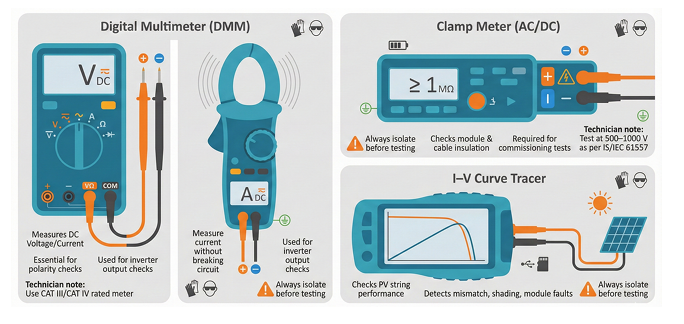
Accurate testing and verification are fundamental to the safe installation, commissioning, and maintenance of solar PV systems. Electrical test instruments enable technicians to confirm correct wiring, verify performance, detect faults early, and ensure compliance with applicable standards. The illustrated tools—Digital Multimeter (DMM), Clamp Meter (AC/DC), and I-V Curve Tracer—represent the core diagnostic equipment used across the lifecycle of a PV system.
This section explains the purpose, application, and safety considerations for each instrument.
1. Digital Multimeter (DMM)
Purpose and Function
A Digital Multimeter is a versatile instrument used to measure DC voltage, AC voltage, resistance, and continuity. In solar PV installations, it is primarily used for DC-side checks.
Typical Applications
- Measuring PV string open-circuit voltage (Voc)
- Verifying polarity before inverter connection
- Continuity checks of cables and earthing conductors
- Confirming voltage presence or absence during maintenance
Key Characteristics
- Measures DC voltage directly across test points
- Used with test leads (red for positive, black for negative)
- Essential for inverter input verification
Technician Notes
- Always use a CAT III / CAT IV rated meter suitable for PV systems
- Verify meter functionality before use
- Ensure correct range selection to avoid meter damage
Importance
The DMM is the most basic yet critical tool for ensuring correct wiring and preventing polarity-related inverter failures.
2. Clamp Meter (AC/DC)
Purpose and Function
A Clamp Meter measures current by clamping around a conductor without breaking the circuit. In solar PV systems, AC/DC clamp meters are used to measure both DC string currents and AC output currents.
Typical Applications
- Measuring DC current from PV strings
- Verifying inverter AC output current
- Detecting current imbalance between strings
- Confirming operational performance during commissioning
Key Characteristics
- Measures current inductively (non-intrusive)
- High insulation resistance (≥ 1 MΩ)
- Required for commissioning and routine inspections
Technician Notes
- Always isolate circuits where required before testing
- Ensure correct clamp orientation for DC measurements
- Test instruments should comply with IEC 61557
Importance
Clamp meters allow safe, real-time current measurement, enabling technicians to identify underperforming strings or abnormal inverter behavior.
3. I–V Curve Tracer
Purpose and Function
An I–V Curve Tracer evaluates the electrical performance of PV strings by plotting the current–voltage (I–V) curve and power–voltage (P–V) curve. This advanced diagnostic tool provides a detailed assessment of module and string health.
Typical Applications
- Verifying PV string performance against design values
- Detecting module mismatch, shading, degradation, or faults
- Acceptance testing for large or utility-scale projects
- Performance benchmarking during audits
Key Characteristics
- Measures full electrical behavior of PV strings
- Identifies deviations from expected performance curves
- Used during commissioning and performance testing
Technician Notes
- Always isolate strings before connecting the tracer
- Perform tests under suitable irradiance conditions
- Compare results with manufacturer datasheets
Importance
The I–V Curve Tracer is indispensable for in-depth performance analysis and root-cause identification of energy yield losses.
Safety and Best Practices
- Always isolate circuits before testing unless live measurement is required
- Use appropriate PPE, including insulated gloves and eye protection
- Confirm instrument ratings match system voltage levels (e.g., 1,000 V DC)
- Follow lockout–tagout procedures where applicable
Failure to follow safe testing practices can result in electric shock, equipment damage, or inaccurate measurements.
Conclusion
Digital Multimeters, Clamp Meters, and I–V Curve Tracers form the backbone of electrical testing in solar PV systems. From basic voltage verification to advanced performance diagnostics, these instruments ensure systems are installed correctly, operate safely, and deliver expected energy output. Proper selection, correct usage, and adherence to safety protocols are essential for reliable and compliant solar installations.