
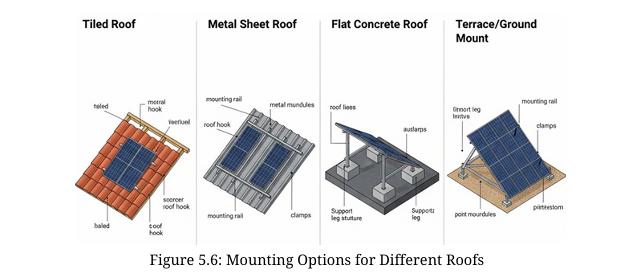
The effectiveness and longevity of a solar photovoltaic (PV) system depend not only on the quality of the modules and inverters but also on how well the system is integrated with the supporting structure. Roof type plays a decisive role in determining the most appropriate mounting solution. The illustrated figure presents four common installation scenarios—tiled roofs, metal sheet roofs, flat concrete roofs, and terrace or ground-mounted systems—each requiring a distinct mounting approach to ensure safety, durability, and optimal performance.
For tiled roofs, mounting systems are designed to preserve the integrity of the tiles while providing secure anchorage to the underlying structure. Specialized roof hooks are fixed to the rafters beneath the tiles, allowing mounting rails to be installed without excessive tile penetration. This method minimizes the risk of tile breakage and water leakage while maintaining the aesthetic appearance of the roof. Mortar or weatherproof sealing is often applied around the hook interface to enhance waterproofing and structural stability.
Metal sheet roofs typically use mounting rails secured through roof hooks or clamps that are directly fastened to the metal purlins below. This approach offers a strong and lightweight solution, ideal for industrial and warehouse buildings. Rubber gaskets and sealing washers are essential at penetration points to prevent corrosion and water ingress. Due to the smooth surface of metal roofs, precise alignment of rails is critical to avoid slippage and uneven load distribution.
In the case of flat concrete roofs, the mounting system usually consists of elevated support legs or ballast-based structures. These systems raise the PV modules to an optimal tilt angle while minimizing roof penetration. Support legs are anchored or ballasted depending on structural constraints and wind load requirements. This method is commonly used in commercial buildings, where roof space is ample and structural load calculations are carefully verified.
Terrace and ground-mounted systems offer maximum flexibility in orientation and tilt. Mounted on dedicated support structures or pedestals, these systems are ideal where roof installation is not feasible or where larger system capacities are required. Ground-mounted arrays allow easier maintenance access and can be optimized for maximum solar exposure.
Selecting the right mounting option ensures structural safety, prevents long-term roof damage, and enhances system performance. Proper alignment between roof type and mounting technology is a fundamental aspect of successful solar project execution.