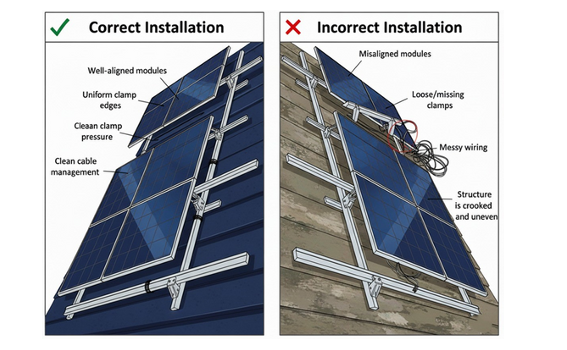
In solar photovoltaic (PV) projects, the difference between a high-performing system and a problematic one often comes down to installation quality. While component selection and system design are critical, improper installation practices can undermine even the best-engineered solar solutions. The illustrated comparison between correct and incorrect installations clearly demonstrates how attention to detail during execution directly impacts performance, safety, and long-term reliability.
A correct installation is characterized by well-aligned modules mounted on a straight and level structure. Proper alignment ensures uniform load distribution across mounting rails and minimizes mechanical stress on modules. When modules sit flush with the mounting system, they are less susceptible to vibration, wind uplift, and long-term structural fatigue. Uniform clamp spacing and consistent clamp pressure further enhance module stability, preventing micro-cracks in cells that could otherwise degrade energy output over time.
Equally important is clean cable management. In a well-installed system, DC cables are neatly routed, securely fastened, and protected from sharp edges and environmental exposure. Organized wiring not only improves aesthetics but also reduces the risk of insulation damage, electrical faults, and fire hazards. Proper cable routing also simplifies maintenance and fault detection during system operation.
In contrast, the incorrect installation shown highlights several common but critical errors. Misaligned modules create uneven load paths and expose panels to higher mechanical stress, increasing the likelihood of damage under wind or thermal expansion. Loose or missing clamps compromise the structural integrity of the array, making it vulnerable to movement or even detachment during extreme weather conditions.
Messy and unsecured wiring poses serious electrical and safety risks. Cables hanging loosely are more prone to abrasion, UV degradation, and accidental disconnection. Additionally, a crooked and uneven support structure indicates poor workmanship and inadequate quality control, which can lead to premature system failure and costly repairs.
Ultimately, installation quality is not a cosmetic concern—it is a core performance parameter. Adhering to best installation practices ensures optimal energy generation, enhances system safety, and extends the operational lifespan of the solar PV system, protecting both the investment and the building it serves.