
Rooftop Solar Mounting Systems: Structural Integration, Waterproofing, and Wind Resistance
While solar modules and inverters often receive the most attention, the mounting system is the structural backbone of any rooftop photovoltaic (PV) installation. A well-designed mounting system ensures that solar panels are securely anchored, properly aligned, and protected against environmental loads — all while preserving the integrity and waterproofing of the building envelope.
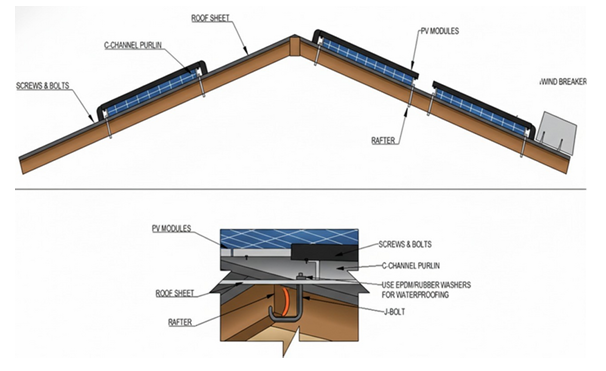
The attached diagram illustrates a typical pitched-roof solar PV mounting configuration, showing how PV modules are supported by structural members such as rafters and purlins, and how fasteners, waterproofing elements, and wind protection features are integrated. This visual highlights the critical interface between the solar system and the building structure — an area where good engineering practice directly impacts safety, durability, and long-term performance.
This article explains each element of the diagram and outlines best practices for rooftop solar mounting system design and installation.
1. The Role of the Mounting System in Rooftop Solar
The mounting system serves multiple essential functions:
- Transfers dead loads and live loads from PV modules to the building structure
- Resists wind uplift, suction, and lateral loads
- Maintains correct tilt and azimuth angles
- Preserves roof waterproofing and prevents leaks
- Accommodates thermal expansion and contraction
- Provides long-term corrosion resistance
Failures in mounting system design can lead to:
- Water ingress and roof damage
- Structural overstress
- Module misalignment
- Increased wind vulnerability
- Costly repairs and downtime
As shown in the diagram, mounting is not just a mechanical task — it is a building integration exercise.
2. Structural Load Path: From Module to Rafter
The diagram shows a clear load path, which is fundamental in structural engineering:
PV Modules → Mounting Rails / Channel Purlins → Fasteners → Rafters → Building Structure
Each interface in this chain must be properly designed to safely transfer loads.
PV Modules
The modules are clamped or bolted to mounting rails or channel purlins. These attachment points must:
- Comply with module manufacturer load ratings
- Be placed at approved clamp zones
- Accommodate wind and snow loads
- Avoid inducing stress on module frames
Incorrect clamping can void warranties and reduce mechanical strength.
Channel Purlins
The C-channel purlins shown in the diagram act as horizontal structural members that:
- Distribute loads across multiple rafters
- Maintain module alignment
- Provide rigidity against bending and torsion
Purlin spacing and section size are selected based on:
- Wind zone and design wind speed
- Roof geometry
- Module size and weight
- Applicable structural codes
3. Fasteners, Screws, and Bolts: Small Components, Big Responsibility
The diagram highlights screws and bolts as key elements. Although they are small, fasteners are often the most highly stressed components in the system.
Critical design considerations include:
- Pull-out and pull-over resistance
- Shear capacity
- Corrosion resistance (hot-dip galvanized or stainless steel)
- Compatibility with roof and structural materials
Fasteners must be anchored into structural members such as:
- Rafters
- Trusses
- Structural purlins
Fastening only into roof sheets without engaging structural members is a common and serious installation error.
4. Roof Sheet Interface and Waterproofing
One of the most sensitive aspects of rooftop PV is the roof penetration. The lower detail view in the diagram clearly shows how penetrations are sealed.
Roof Sheet
The roof sheet (metal, tile, or other roofing material) is penetrated to allow structural attachment. This creates a potential leak path if not properly detailed.
EPDM Rubber Washers and Sealing
The diagram shows EPDM rubber washers used at fastener penetrations. These serve critical waterproofing functions:
- Create a compression seal around the fastener
- Accommodate thermal movement
- Resist UV and weathering
- Prevent capillary water ingress
In addition to washers, best practice often includes:
- Flashings or mounting feet with integrated seals
- Compatible roofing sealants
- Proper torque to avoid over-compression
Waterproofing failures are among the most common causes of long-term rooftop PV issues.
5. J-Bolt and Structural Anchorage
The detail section shows a J-bolt anchoring into the rafter. This type of anchorage:
- Provides strong mechanical engagement with timber or steel members
- Transfers uplift and shear forces effectively
- Allows secure clamping of mounting hardware
Proper J-bolt design must consider:
- Embedment depth
- Edge distances
- Rafter material and condition
- Load combinations (dead, wind, seismic, maintenance loads)
Engineering calculations or standardized mounting system certifications are typically used to verify capacity.
6. Wind Breakers and Wind Load Management
The diagram includes a wind breaker at the edge of the array. Wind effects are one of the dominant design drivers for rooftop solar systems, especially in:
- Cyclone-prone regions
- Coastal areas
- High-rise buildings
- Open, exposed rooftops
Wind breakers and aerodynamic design features help to:
- Reduce wind uplift
- Minimize turbulence under modules
- Improve overall array stability
Other wind mitigation strategies include:
- Optimized array edge detailing
- Reduced gap between roof and modules
- Proper perimeter anchoring
- Wind tunnel–based mounting system design
7. Thermal Movement and Long-Term Durability
PV systems experience daily and seasonal temperature variations. The mounting system must accommodate:
- Thermal expansion and contraction of rails and modules
- Differential movement between roof and PV structure
- Creep and relaxation in fasteners over time
Good mounting designs include:
- Slotted holes where appropriate
- Floating connections for long rail runs
- Specified torque values and re-torque procedures
- Materials with compatible thermal expansion coefficients
Ignoring thermal effects can lead to:
- Loose connections
- Rail bowing
- Increased stress on modules and fasteners
8. Corrosion Protection and Material Selection
Rooftop solar systems are exposed to harsh environments for 20–30 years. Material selection is therefore critical.
Typical best practices include:
- Hot-dip galvanized steel for structural members
- Anodized aluminum for rails
- Stainless steel fasteners (A2/A4 grades)
- UV-resistant polymer components
In coastal or industrial environments, enhanced corrosion protection is often required due to:
- Salt spray
- High humidity
- Airborne pollutants
Corrosion can compromise structural integrity and lead to premature system failure if not properly addressed.
9. Compliance with Codes and Manufacturer Guidelines
Mounting systems must comply with:
- Local building and structural codes
- Wind load standards (e.g., IS codes, ASCE, Eurocodes)
- Roofing manufacturer requirements
- PV mounting system manufacturer installation manuals
- Module manufacturer mechanical load specifications
Many bankable mounting systems are pre-engineered and certified, simplifying compliance and reducing project risk.
Conclusion
The attached diagram demonstrates that rooftop solar mounting is far more than simply “fixing panels to a roof.” It is a carefully engineered interface between renewable energy technology and the building structure. Structural load paths, waterproofing, wind resistance, and long-term durability must all be addressed to ensure system safety and performance over its full design life.
A robust mounting system protects both the solar investment and the building asset beneath it. When designed and installed correctly, it enables decades of reliable, leak-free, and structurally sound solar energy generation.
In rooftop solar, good mounting design is not optional — it is fundamental.