
Preventive maintenance is one of the most effective strategies for ensuring long-term plant reliability, safety, and performance. Rather than reacting to failures after they occur, preventive maintenance focuses on planned, systematic activities that keep equipment operating within designed limits. A well-defined preventive maintenance workflow transforms routine checks into a structured process that reduces downtime, extends asset life, and improves overall operational efficiency.
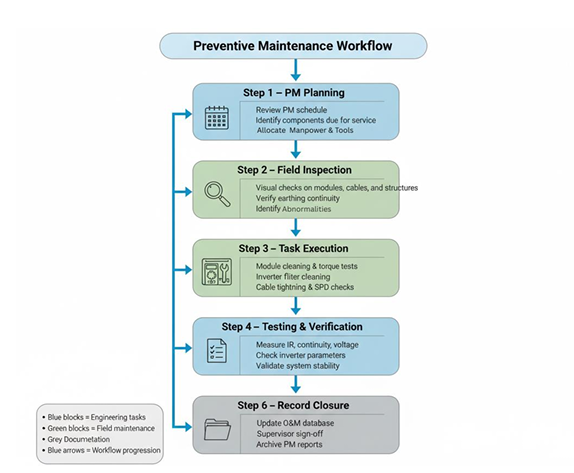
The illustrated Preventive Maintenance Workflow clearly demonstrates how maintenance activities should progress from planning to closure. Each step builds on the previous one, ensuring that field execution is organized, verified, and properly documented. This structured approach is especially critical in power plants, renewable energy facilities, and industrial installations where equipment availability directly impacts performance and revenue.
Step 1: Preventive Maintenance Planning
The workflow begins with preventive maintenance planning, which lays the foundation for all subsequent activities. In this step, maintenance schedules are reviewed to identify components that are due for servicing based on time, operating hours, or manufacturer recommendations. Proper planning ensures that maintenance activities are neither skipped nor performed too frequently.
Equally important is the allocation of manpower, tools, and spares. Assigning the right personnel with the appropriate skills reduces errors and improves task efficiency. Planning also helps coordinate maintenance activities with plant operations, minimizing disruptions and ensuring safety. When planning is done effectively, maintenance shifts from being a reactive burden to a predictable and controlled process.
Step 2: Field Inspection
Once planning is complete, the workflow moves into field inspection. This step focuses on identifying early signs of degradation before they lead to failures. Visual inspections of modules, cables, structures, and equipment help detect issues such as corrosion, loose connections, physical damage, or environmental impacts.
Verifying earthing continuity is another critical activity during field inspection. Proper earthing protects both equipment and personnel from electrical faults and surges. Identifying abnormalities at this stage allows maintenance teams to prioritize corrective actions and prevents minor issues from escalating into major outages.
Field inspections also provide valuable feedback to improve future maintenance planning. Repeated observations of similar issues may indicate design gaps, environmental challenges, or operational practices that need adjustment.
Step 3: Task Execution
Task execution is the core of preventive maintenance, where planned activities are physically carried out on-site. Typical tasks include module cleaning, torque testing of electrical connections, inverter filter cleaning, cable tightening, and surge protection device (SPD) checks.
These activities directly influence system performance and safety. For example, module cleaning improves energy output, while torque testing reduces the risk of overheating and electrical faults. Inverter filter cleaning ensures proper cooling and operational stability, and SPD checks protect equipment from transient overvoltage events.
Executing tasks according to defined procedures ensures consistency and quality across maintenance cycles. Clear instructions, proper tools, and trained technicians are essential to ensure that maintenance activities deliver the intended results.
Step 4: Testing and Verification
Maintenance work is incomplete without testing and verification. This step confirms that the executed tasks have restored or improved system health. Key activities include measuring insulation resistance (IR), checking voltage levels, verifying inverter parameters, and validating overall system stability.
Testing serves as a quality control mechanism, ensuring that no new issues were introduced during maintenance. It also provides measurable data that can be compared against baseline values to assess equipment condition over time. Consistent testing and verification increase confidence in system reliability and reduce the likelihood of post-maintenance failures.
Step 5: Record Closure and Documentation
The final step in the workflow is record closure, which ensures traceability and accountability. Maintenance data is updated in the O&M database, supervisors review and sign off completed tasks, and preventive maintenance reports are archived for future reference.
Accurate documentation supports audits, compliance requirements, and performance analysis. It also enables trend analysis, helping organizations identify recurring issues and refine maintenance strategies. Without proper record closure, valuable operational insights are lost, weakening long-term asset management.
Why a Structured Workflow Matters
A structured preventive maintenance workflow ensures that maintenance activities are repeatable, auditable, and continuously improving. By clearly defining responsibilities and sequence, it reduces dependency on individual judgment and improves consistency across teams and sites.
This workflow also bridges the gap between engineering tasks, field execution, and documentation. Blue blocks represent engineering and planning functions, green blocks focus on field maintenance, and grey blocks emphasize documentation and control. Together, they create a closed-loop system where lessons learned feed back into planning and scheduling.
Conclusion
Preventive maintenance is not just about routine inspections—it is a strategic process that protects assets, enhances safety, and supports sustained performance. By following a structured workflow from planning to record closure, organizations can move from reactive maintenance to proactive asset management. This approach minimizes unplanned downtime, improves reliability, and ensures that maintenance efforts consistently deliver value across the plant lifecycle