
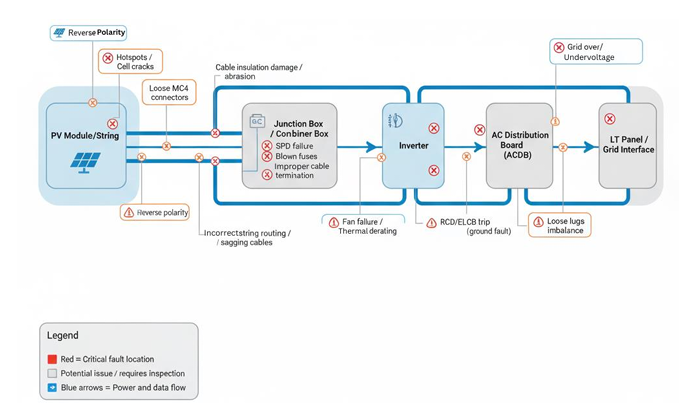
Modern solar photovoltaic (PV) systems are complex electrical and mechanical ecosystems that extend far beyond simply installing panels on a roof or ground structure. From the moment sunlight strikes a PV module to the point where electricity is exported to the grid, power flows through multiple components, each with its own operational risks and failure modes. The image illustrates the most common fault locations across a typical PV system, highlighting why a systematic, end-to-end approach to design, installation, and maintenance is essential for long-term performance, safety, and reliability.
Understanding where faults typically occur allows project developers, EPC contractors, O&M teams, and asset owners to move from reactive maintenance to proactive risk management. By identifying critical control points and implementing best practices, solar projects can significantly reduce downtime, fire risk, energy losses, and costly equipment failures.
PV Module and String-Level Faults
The first and most exposed layer of the PV system is the module and DC string network. At this level, common issues include reverse polarity, hotspots caused by cell cracks, and loose MC4 connectors. Reverse polarity during string connections can lead to immediate inverter faults or protection trips, but more dangerously, it can create conditions for arcing and component damage if not detected early.
Hotspots, often resulting from microcracks, shading, or manufacturing defects, cause localized overheating within a module. Over time, this degrades encapsulation materials and can permanently reduce module output. Loose or incompatible MC4 connectors increase contact resistance, leading to heat buildup and, in worst cases, connector melting or DC arc faults.
Cable insulation damage and abrasion are also frequent at the string level. Poor routing, sharp metal edges, UV exposure, and inadequate cable management can compromise insulation integrity. This raises the risk of ground faults, insulation resistance failures, and nuisance tripping of protection devices.
Junction Boxes and Combiner Box Risks
As DC strings converge, junction boxes and combiner boxes become critical aggregation and protection points. Typical failure modes here include blown string fuses, surge protection device (SPD) failures, and improper cable terminations. Blown fuses may indicate short circuits, reverse current conditions, or incorrect fuse sizing. Repeated fuse failures often point to deeper system design or wiring issues.
SPDs protect sensitive inverter electronics from lightning-induced surges and transient overvoltages. If SPDs fail or are improperly rated, the inverter and downstream electronics become vulnerable to surge damage. Improper cable termination—such as under-crimped lugs, loose gland fittings, or incorrect conductor sizing—creates high-resistance connections that generate heat and increase fire risk.
Incorrect string routing and sagging cables add mechanical stress and make inspection and maintenance more difficult. Over time, this can lead to insulation wear, conductor fatigue, and hidden faults that only appear under load or environmental stress.
Inverter-Level Failure Modes
The inverter is the heart of the PV system, converting DC power into grid-compatible AC power. Because of its complexity and sensitivity, it is also one of the most common points of failure. The image highlights fan failures and thermal derating as key inverter-level issues.
Inverters rely on internal cooling systems to manage heat generated by power electronics. If cooling fans fail, filters clog, or ventilation is inadequate, internal temperatures rise. This triggers thermal derating, reducing power output to protect components. Chronic overheating shortens inverter lifespan and increases the probability of catastrophic electronic failures.
Electrical faults at the inverter, such as DC overvoltage, DC insulation faults, or internal component degradation, can cause intermittent shutdowns or permanent inverter trips. Without proper monitoring and diagnostics, these issues may go unnoticed, resulting in extended energy losses.
AC Distribution and Protection Challenges
Once DC power is converted to AC, it flows through the AC Distribution Board (ACDB) and associated protection systems. Here, residual current devices (RCDs), earth leakage circuit breakers (ELCBs), and overcurrent protection devices play a critical role in ensuring safety.
Ground faults, insulation breakdown, and moisture ingress can cause RCDs and ELCBs to trip. While this protects personnel and equipment, frequent nuisance tripping can also indicate deteriorating insulation, improper earthing, or coordination issues between protection devices. Poor protection coordination may result in delayed fault clearing, allowing higher fault energy to flow and increasing equipment damage.
Loose terminals and poor busbar connections within the ACDB create imbalance, overheating, and voltage drop. Over time, this degrades power quality and can affect both inverter performance and downstream loads.
Grid Interface and LT Panel Faults
At the grid interface and low-tension (LT) panel, voltage quality and connection integrity become critical. The image highlights grid overvoltage and undervoltage conditions, as well as loose lugs and phase imbalance.
Grid voltage excursions can cause inverters to trip frequently, reducing system availability. Chronic overvoltage accelerates insulation aging and stresses inverter components, while undervoltage can reduce inverter output and increase current draw.
Loose lugs and poor terminations at the LT panel increase contact resistance, leading to localized heating and potential phase imbalance. Phase imbalance affects transformer loading, increases losses, and can cause protective devices to operate unpredictably.
Why End-to-End Fault Awareness Matters
What makes these fault points particularly dangerous is that many are interrelated. A minor issue at the string level, such as a loose connector, can escalate into inverter faults, AC protection trips, or even fire incidents. Similarly, poor earthing or insulation degradation can create cascading failures across DC and AC systems.
An end-to-end fault awareness strategy enables teams to view the PV system as an integrated electrical plant rather than a collection of isolated components. This mindset is essential for utility-scale plants, commercial rooftops, and even residential systems where safety and performance expectations are high.
Best Practices to Reduce Fault Risk
To minimize fault occurrence and impact, several best practices should be standard across all solar projects:
- Implement strict polarity and string verification before inverter energization.
- Use compatible, certified connectors and enforce proper crimping procedures.
- Apply robust cable management to prevent abrasion, UV damage, and mechanical stress.
- Ensure correct fuse sizing and SPD selection based on system voltage and exposure risk.
- Maintain proper inverter ventilation and schedule periodic internal inspections.
- Conduct regular insulation resistance, earth resistance, and thermographic testing.
- Tighten and torque all AC and DC terminations to manufacturer specifications.
- Monitor grid voltage quality and coordinate with utilities to address chronic issues.
Conclusion
The visual mapping of fault locations from PV modules to the grid interface underscores a critical reality: solar PV reliability is only as strong as its weakest connection. By understanding where faults are most likely to occur and why, project stakeholders can design more robust systems, train installation teams more effectively, and implement O&M strategies that prevent small issues from becoming major failures.
Proactive fault identification is not just about protecting equipment—it is about safeguarding people, maximizing energy yield, and ensuring that solar assets deliver predictable, long-term returns. A disciplined, system-wide approach to fault management is one of the most powerful tools available to improve both safety and performance in modern solar PV systems.