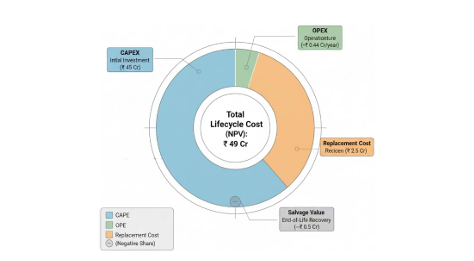
When evaluating a solar photovoltaic (PV) project, many stakeholders focus almost exclusively on capital expenditure (CAPEX). While CAPEX is a critical decision factor, it represents only a portion of the total financial picture. The lifecycle cost diagram clearly illustrates that a solar asset’s true cost is distributed across multiple phases, including operations, maintenance, component replacements, and end-of-life considerations.
To make informed investment, procurement, and asset management decisions, project owners and developers must shift from a CAPEX-only mindset to a full lifecycle cost (LCC) or net present value (NPV) approach. This ensures that financial planning reflects the real long-term economic performance of the solar plant.
What Is Lifecycle Cost in Solar PV?
Lifecycle cost refers to the total cost of owning and operating a solar PV system over its entire useful life. This includes:
- Initial system purchase and installation (CAPEX)
- Annual operation and maintenance expenses (OPEX)
- Replacement of major components during the system life
- End-of-life costs or salvage value recovery
- The time value of money, represented through NPV
The diagram highlights how these elements combine to form the total lifecycle cost, providing a more accurate measure of project economics than upfront cost alone.
CAPEX: The Largest but Not the Only Cost
CAPEX typically includes modules, inverters, mounting structures, cabling, balance of system components, engineering, procurement, construction, and commissioning. In most solar projects, CAPEX represents the single largest cost component at the beginning of the project.
However, while CAPEX is highly visible and often aggressively optimized, reducing CAPEX at the expense of quality can lead to higher long-term costs. Lower-quality components, poor installation practices, and inadequate design margins may reduce upfront cost but significantly increase OPEX, failure rates, and replacement expenses over time.
Smart CAPEX decisions prioritize long-term value rather than lowest initial price.
OPEX: The Hidden Long-Term Commitment
Operating expenditure (OPEX) includes all recurring costs required to keep the solar plant operating efficiently and safely. These typically include:
- Preventive and corrective maintenance
- Cleaning of PV modules
- Monitoring and data management
- Site security and administration
- Insurance and compliance costs
While OPEX appears small on an annual basis, over a 20–25 year project life, it becomes a substantial portion of the total lifecycle cost. Poor maintenance strategies can also accelerate component degradation, indirectly increasing replacement costs and reducing energy yield.
Effective O&M programs optimize both performance and cost by preventing failures before they escalate.
Replacement Costs: Planning for the Inevitable
One of the most critical insights from the lifecycle cost model is the significance of replacement costs. Certain components, particularly inverters, have shorter lifespans than PV modules.
Common replacement items include:
- Inverters (typically replaced once or more over project life)
- DC and AC switchgear
- Surge protection devices
- Monitoring hardware
- Fans, filters, and internal inverter components
Failure to plan for these replacements leads to unexpected capital injections, cash flow disruptions, and potential downtime. By modeling replacement cycles upfront, project owners can create realistic financial projections and avoid unpleasant surprises.
Salvage Value and End-of-Life Recovery
At the end of a solar plant’s useful life, there may be recoverable value from certain components and materials. This is shown in the diagram as salvage value, which offsets part of the total lifecycle cost.
Salvage value may include:
- Recyclable metals from mounting structures and cabling
- Recoverable materials from inverters and electrical panels
- Residual value of land improvements or civil works
While salvage value is often smaller compared to CAPEX and OPEX, it still plays a role in reducing the net lifecycle cost and improving long-term project economics.
Why NPV Matters in Solar Project Evaluation
Net Present Value (NPV) adjusts future costs and savings to their present-day value using a discount rate. This reflects the reality that money today is worth more than money in the future.
Using NPV allows decision-makers to:
- Compare projects with different lifespans and cost profiles
- Evaluate trade-offs between higher CAPEX and lower OPEX
- Quantify the long-term impact of quality and reliability
- Align financial models with investor and lender expectations
Projects with slightly higher upfront costs often show superior NPV if they deliver lower OPEX, fewer replacements, and higher energy yield over time.
The Strategic Impact of Lifecycle Cost Thinking
Adopting a lifecycle cost mindset changes how solar projects are designed, procured, and operated. Instead of optimizing only for installation cost, stakeholders begin to prioritize:
- Higher-quality components with longer warranties
- Proven inverter platforms with strong service support
- Robust mounting systems that reduce long-term structural issues
- Better cable management to reduce fault rates
- Advanced monitoring to detect issues early
These decisions may marginally increase CAPEX but often reduce total lifecycle cost and improve project bankability.
Risk, Reliability, and Financial Performance
Lifecycle cost is tightly linked to risk management. Equipment failures, excessive downtime, and safety incidents all carry financial consequences that extend beyond direct repair costs. Lost generation, contractual penalties, insurance claims, and reputational damage can significantly impact project returns.
By investing in reliability upfront and planning for long-term asset health, owners reduce operational risk and stabilize cash flows.
Using Lifecycle Cost for Smarter Procurement
For EPCs and asset owners, lifecycle cost analysis supports better procurement strategies. Instead of awarding contracts purely on lowest bid, evaluation criteria can include:
- Expected component lifespan
- Warranty terms and service response times
- Spare parts availability
- Historical failure rates
- O&M requirements and complexity
This leads to more sustainable project outcomes and fewer disputes over performance and maintenance responsibilities.
Conclusion
The lifecycle cost diagram makes one thing clear: solar project economics do not end at commissioning. CAPEX, OPEX, replacements, and salvage value all contribute to the true cost of ownership. When evaluated through an NPV-based lifecycle lens, decisions become more strategic, more resilient, and more aligned with long-term performance.
For serious investors, developers, and asset managers, lifecycle cost analysis is no longer optional. It is a core discipline for maximizing return on investment, reducing risk, and ensuring that solar assets deliver consistent value over their full operational life.