The way electricity is generated and delivered is changing rapidly. For more than a century, centralized grids powered cities, industries, and economies through large power plants and long transmission networks. Today, however, the global energy landscape is expanding beyond this traditional model. Decentralised energy systems are reshaping how electricity is produced, shared, and consumed—creating a flexible ecosystem that ranges from small standalone systems to massive national grids.
This evolution is not about replacing centralized systems but building a layered, interconnected energy framework that can meet growing demand while improving sustainability, resilience, and access.
Understanding the Energy Spectrum
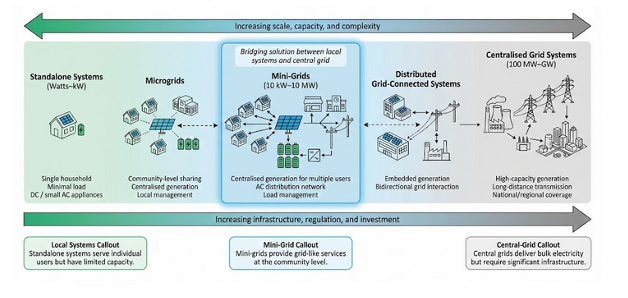
Energy systems can now be viewed as a spectrum that increases in scale, capacity, and complexity. On one end are small standalone systems that power individual homes. On the other end are large centralized grids capable of supporting entire countries. Between these extremes lies a range of intermediate solutions that bridge local generation and national infrastructure.
This layered approach allows energy solutions to be tailored to specific geographic, economic, and social needs.
Standalone Systems: Power at the Household Level
Standalone systems represent the simplest form of decentralised energy. These systems typically serve a single home or small facility using technologies such as rooftop solar panels, small wind turbines, or battery storage.
They are particularly valuable in remote or rural regions where extending the main grid is expensive or impractical. Standalone systems can power lighting, mobile charging, refrigeration, and basic appliances, dramatically improving quality of life.
While they are limited in capacity, standalone solutions play a critical role in delivering first-time electricity access to millions of people worldwide. They offer independence, affordability, and quick deployment—making them a powerful entry point into the modern energy ecosystem.
Microgrids: Community-Level Energy Sharing
As energy demand grows beyond individual households, microgrids provide the next step in the evolution. A microgrid connects multiple users—homes, businesses, schools, and healthcare facilities—within a localized network.
Microgrids enable community-level sharing of energy resources. A centralized local generation source, such as a solar farm or small wind installation, can supply electricity to multiple users. Energy storage systems help balance supply and demand, ensuring reliable power even during fluctuations in renewable generation.
Local management and control allow microgrids to operate independently or connect to the main grid when available. This flexibility improves resilience and reduces dependence on distant infrastructure.
Microgrids are especially valuable in campuses, industrial parks, remote communities, and island regions where energy reliability is critical.
Mini-Grids: Bridging Local and National Systems
Mini-grids represent a major milestone in decentralised energy development. These systems operate at a larger scale than microgrids and can serve entire towns or rural districts.
Mini-grids function as a bridge between local energy solutions and centralized grid systems. They provide centralized generation for multiple users while integrating AC distribution networks and advanced load management.
In many developing regions, mini-grids are accelerating electrification. They enable businesses to operate, healthcare facilities to store vaccines, and schools to provide digital education. Reliable electricity stimulates economic growth and improves living standards.
Mini-grids are often designed to eventually connect to national grids, ensuring long-term integration and scalability.
Distributed Grid-Connected Systems: A Two-Way Energy Flow
The next stage in the energy evolution introduces distributed grid-connected systems. In this model, decentralized energy sources—such as rooftop solar installations, commercial solar farms, and battery storage—are connected to the central grid.
Unlike traditional systems where electricity flows in one direction, distributed systems enable bidirectional energy flow. Consumers can generate their own electricity and export surplus energy back to the grid.
This transformation creates a new category of energy participants known as “prosumers”—individuals and businesses who both produce and consume electricity.
Bidirectional energy flow improves efficiency, reduces transmission losses, and increases grid stability. It also supports the integration of renewable energy on a large scale.
Centralised Grid Systems: Power at National Scale
Despite the rise of decentralised energy, centralized grids remain essential. Large power plants provide the high-capacity generation required for industries, urban centers, and national infrastructure.
Centralized systems ensure long-distance transmission and nationwide coverage. They serve as the backbone of modern economies, supporting heavy manufacturing, transportation networks, and large-scale commercial operations.
The key difference today is that centralized grids are evolving to work alongside decentralized systems. Instead of a single-direction power network, the future grid is becoming a hybrid system combining local and large-scale generation.
Increasing Infrastructure, Regulation, and Investment
As energy systems grow in scale and complexity, infrastructure, regulation, and investment must evolve accordingly.
Standalone systems require minimal infrastructure and can be deployed quickly. Microgrids and mini-grids require greater planning, technical expertise, and financial investment. Distributed grid-connected systems demand advanced regulatory frameworks and smart grid technologies.
Centralized grids require significant long-term investment and policy support to maintain stability and expand capacity.
Governments, utilities, and private investors are increasingly recognizing the importance of supporting this entire energy spectrum.
Benefits of a Hybrid Energy Ecosystem
A layered energy ecosystem offers several advantages:
1. Improved Energy Access
Decentralised systems bring electricity to remote and underserved regions, supporting social and economic development.
2. Enhanced Resilience
Distributed generation reduces vulnerability to power outages and infrastructure failures.
3. Environmental Sustainability
Renewable energy integration reduces emissions and dependence on fossil fuels.
4. Economic Opportunities
Local energy generation creates jobs and stimulates regional economies.
5. Consumer Empowerment
Individuals and communities gain greater control over energy production and consumption.
Challenges and Opportunities
The transition to a hybrid energy system is not without challenges. Regulatory frameworks must adapt to support decentralized generation and fair grid access. Financing models need to evolve to support community energy projects and small-scale installations.
Technical challenges, including grid stability and energy storage, must also be addressed. However, ongoing technological innovation continues to provide solutions.
The opportunities far outweigh the challenges. As renewable technologies become more affordable and digital tools improve energy management, decentralized systems will continue to grow.
The Future of Energy Integration
The future of energy lies in integration, not competition. Standalone systems, microgrids, mini-grids, distributed generation, and centralized grids will coexist and complement each other.
This integrated approach creates a resilient, flexible, and sustainable energy network capable of meeting the needs of a growing global population.
The transition is already underway. Communities, businesses, and governments are embracing decentralized energy solutions at an unprecedented pace.
The question is no longer whether decentralized energy will play a role in the future—it is how quickly the world can scale these solutions to create a more inclusive and sustainable energy system.
Conclusion
From powering individual homes to supporting entire nations, the evolution of decentralized energy represents one of the most important transformations of the 21st century.
By combining local innovation with national infrastructure, the world is building a smarter, cleaner, and more resilient energy future—one layer at a time.