Access to reliable electricity is one of the strongest drivers of social and economic development. From powering homes and schools to enabling businesses and healthcare, energy access transforms communities. However, delivering electricity to every corner of the world remains a complex challenge. Traditional grid expansion is expensive and slow, especially in remote and rural regions. This is where modern decentralized solutions like Solar Home Systems (SHS) and Solar Mini-Grids are reshaping the future of electrification.
This article explores the three major electrification models — Solar Home Systems, Solar Mini-Grids, and Centralised Grids — and explains how they work together to create a flexible and sustainable energy ecosystem.
Understanding Solar Home Systems (SHS)
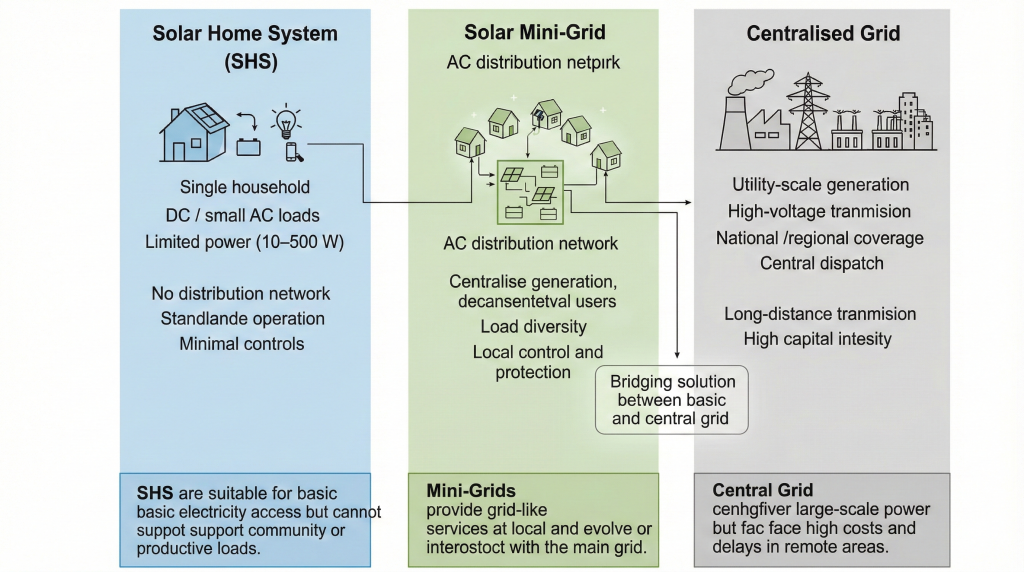
Solar Home Systems are small, standalone solar setups designed to power individual households. They typically consist of solar panels, a battery, a charge controller, and small appliances like LED lights, fans, or phone chargers.
These systems usually generate between 10–500 watts, making them ideal for providing basic electricity access in areas without grid connectivity.
SHS solutions are particularly valuable in remote locations because they:
• Do not require a distribution network
• Are quick and easy to install
• Operate independently of large infrastructure
• Require minimal maintenance and control
For families who previously relied on kerosene lamps or diesel generators, SHS represents a major upgrade in safety, affordability, and quality of life.
However, Solar Home Systems also have limitations. They are designed for basic energy needs and cannot power high-energy appliances such as refrigerators, water pumps, or machinery. This means they are excellent for initial electrification but not enough to support community growth or productive economic activities.
In simple terms, SHS is the first step toward electrification.
The Rise of Solar Mini-Grids
As communities grow and energy demand increases, Solar Mini-Grids become the next logical step. Mini-grids are localized energy networks that distribute electricity to multiple households and businesses within a village or small town.
Unlike Solar Home Systems, mini-grids operate using an AC distribution network, similar to the national grid but on a smaller scale.
Key advantages of solar mini-grids include:
• Centralized energy generation for a community
• Shared infrastructure that lowers cost per user
• Ability to power businesses and productive loads
• Improved reliability through load diversity
• Local control and protection systems
Mini-grids can support schools, clinics, irrigation pumps, workshops, and small industries — unlocking real economic development.
One of the most powerful aspects of mini-grids is their flexibility. They can operate independently for years and later connect to the national grid when it arrives. This makes them a perfect bridge between basic electrification and full grid integration.
In many developing regions, mini-grids are now seen as the fastest way to bring reliable electricity to rural communities while avoiding the long delays of traditional grid expansion.
Centralised Grid Power — The Traditional Backbone
Centralised grids are the large-scale national electricity networks most people are familiar with. They rely on utility-scale power plants and high-voltage transmission lines to deliver electricity across cities, states, and entire countries.
Their strengths include:
• Massive power generation capacity
• National and regional coverage
• Centralized dispatch and control
• Ability to support heavy industries and cities
However, centralised grids also come with major challenges:
• Extremely high infrastructure costs
• Long-distance transmission losses
• Slow deployment in remote areas
• Complex maintenance requirements
Extending transmission lines to isolated villages can be financially unviable, which is why millions of people globally still lack reliable electricity access.
This is not because central grids are ineffective — but because they are not always the most practical first solution.
Why Mini-Grids Are the Perfect Bridge
The electrification journey is no longer a single path. Instead, it is becoming a layered energy transition:
- Solar Home Systems provide immediate access.
- Mini-Grids enable community growth and productivity.
- Central Grids deliver large-scale, long-term power.
Solar Mini-Grids sit right in the middle of this transition.
They provide grid-like services locally while remaining adaptable for future integration. When the national grid eventually arrives, a mini-grid can either connect and become part of the larger network or continue operating as a reliable backup.
This hybrid approach reduces investment risk and ensures communities receive electricity years earlier than waiting for grid expansion alone.
Economic and Social Impact
Electrification is not just about lights — it is about opportunity.
When communities move from SHS to Mini-Grids, they unlock:
• New small businesses
• Refrigeration for food and medicine
• Irrigation and agriculture improvements
• Digital connectivity and education
• Job creation and income growth
Reliable electricity enables entire ecosystems of development.
For governments and energy planners, mini-grids represent a cost-effective solution that accelerates rural electrification without overwhelming national budgets.
The Role of Renewable Energy
Solar energy plays a central role in all three electrification models.
It is:
• Abundant
• Clean
• Scalable
• Cost-effective
Solar-powered SHS and Mini-Grids reduce reliance on fossil fuels and diesel generators, lowering emissions while improving energy security.
As battery technology continues to improve and costs continue to fall, decentralized solar solutions are becoming more powerful and more affordable every year.
This makes them not just an alternative — but a core component of the global energy future.
The Future of Smart Electrification
The future of energy will not be defined by a single system. Instead, it will be a smart combination of centralized and decentralized solutions working together.
Cities will rely heavily on national grids.
Rural communities will grow through mini-grids.
Remote households will start with solar home systems.
This layered strategy ensures no community is left behind.
Electrification is evolving from a slow infrastructure project into a flexible, scalable ecosystem powered by innovation.
Conclusion
Solar Home Systems, Solar Mini-Grids, and Centralised Grids are not competing solutions — they are complementary pieces of the same puzzle.
SHS provides the first spark.
Mini-Grids power community growth.
Central Grids support large-scale development.
Together, they form a powerful roadmap toward universal energy access and a sustainable future.
The world is moving toward smarter electrification — and solar-powered solutions are leading the way.