
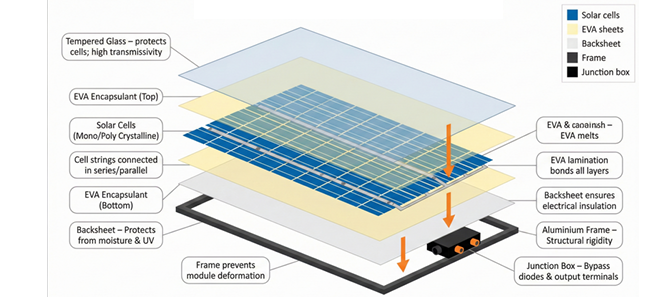
A photovoltaic module is not a single component but a laminated system designed to protect delicate solar cells while ensuring decades of reliable power generation. The exploded view of a PV module reveals how each layer contributes to performance, durability, and safety.
At the top is tempered glass, engineered for high transmissivity and mechanical strength. It allows sunlight to pass through while protecting the cells from hail, wind, and mechanical impact. Beneath the glass lies the EVA encapsulant, which bonds the glass to the solar cells and cushions them against vibration and thermal stress.
The solar cells themselves are electrically connected in series and parallel to achieve the desired voltage and current. Another layer of EVA sits below the cells, bonding them to the backsheet. The backsheet provides electrical insulation and protects the module from moisture, UV radiation, and environmental exposure.
The aluminum frame gives the module structural rigidity and allows secure mounting. Finally, the junction box on the rear houses bypass diodes and provides output terminals for electrical connection.
Failures often originate at interfaces between layers—EVA browning, backsheet cracking, or moisture ingress. Understanding module construction helps technicians identify degradation early and prevents long-term performance loss.