
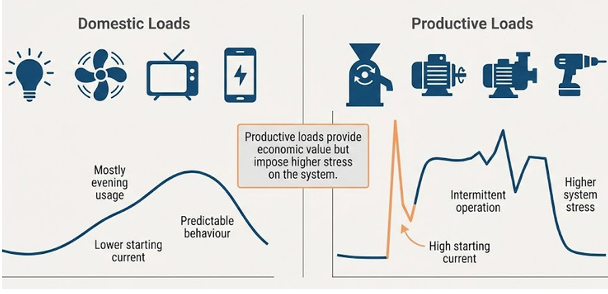
In decentralized energy systems, not all loads are created equal. The image contrasts two fundamental load categories within mini-grids: Domestic Loads and Productive Loads. While domestic consumption tends to be predictable and moderate in electrical stress, productive loads introduce variability, high starting currents, and elevated system strain.
For engineers, mini-grid developers, and policymakers, understanding the behavioral and electrical characteristics of these load types is essential for system stability, financial sustainability, and long-term community impact.
1. Domestic Loads: Predictable and Lower Electrical Stress
Domestic loads typically include:
- LED lighting
- Ceiling or pedestal fans
- Televisions
- Mobile phone charging
- Small appliances
Usage Pattern: Mostly Evening
Household electricity demand peaks in the evening hours. Lighting, entertainment, and cooling devices operate simultaneously after sunset. While this creates coincident demand, the electrical characteristics remain relatively stable.
Lower Starting Current
Most domestic appliances are resistive or low-power inductive loads. They exhibit:
- Modest inrush current
- Predictable load profile
- Stable power factor (with efficient appliances)
This predictability simplifies system design and inverter sizing.
Engineering Implication
Domestic load behavior allows planners to model demand using diversity factors and historical consumption trends. Voltage fluctuations are generally manageable, provided feeder sizing is adequate.
However, domestic demand alone rarely drives significant economic transformation.
2. Productive Loads: Economic Value with Technical Complexity
Productive loads include:
- Agro-processing machinery
- Grain mills
- Water pumps
- Welding equipment
- Small industrial motors
These loads are economically transformative but technically demanding.
High Starting Current
Electric motors typically draw 3–7 times their rated current during startup. This inrush current causes:
- Temporary voltage dips
- Inverter overload stress
- Disturbance to nearby domestic users
Repeated high inrush cycles accelerate inverter and battery wear.
Intermittent Operation
Unlike domestic loads, productive machinery often operates intermittently. Demand spikes occur when equipment starts, then stabilizes, and may shut down abruptly.
This dynamic behavior increases system stress and complicates load forecasting.
3. Economic Multiplier vs Technical Stress
The diagram highlights a critical tension:
Productive loads provide economic value but impose higher stress on the system.
This is the central trade-off in mini-grid design.
Without productive loads:
- Revenue remains limited to household tariffs
- Load factor remains low
- System capacity is underutilized during daylight hours
With productive loads:
- Revenue increases
- Local businesses grow
- Employment expands
But technical risks intensify.
The goal is not to avoid productive loads—but to integrate them intelligently.
4. Electrical Stress Mechanisms
Productive loads influence mini-grids in multiple ways:
1. Voltage Fluctuations
Motor startup draws high current, causing temporary voltage sag.
2. Frequency Instability
If inverters are undersized, sudden load addition can disturb frequency regulation.
3. Battery Stress
High instantaneous discharge rates reduce battery lifespan.
4. Thermal Overload
Repeated peak loading increases heat stress in inverters and conductors.
Mini-grids designed solely around domestic load assumptions often struggle when productive activity expands.
5. Engineering Solutions for Productive Load Integration
To balance economic growth with technical stability, developers implement:
Soft Starters
Reduce inrush current during motor startup.
Variable Frequency Drives (VFDs)
Control motor acceleration and reduce starting stress.
Dedicated Feeders
Isolate productive loads from domestic circuits to minimize voltage disturbance.
Load Scheduling Agreements
Encourage staggered machinery operation.
Oversized Inverter Capacity
Provide headroom for transient load spikes.
While these solutions increase CAPEX, they improve reliability and reduce long-term maintenance costs.
6. System Design Philosophy: Separate but Integrated
An effective mini-grid architecture recognizes load segmentation.
Domestic circuits require:
- Stable voltage
- Predictable distribution design
- Evening peak management
Productive circuits require:
- High surge tolerance
- Robust conductor sizing
- Dedicated protection systems
By separating these load classes electrically while integrating them economically, systems achieve both resilience and productivity.
7. Financial Implications
Productive loads significantly enhance:
- Revenue per connection
- Load factor
- Daytime energy utilization
- Internal rate of return (IRR)
However, failure to account for technical stress leads to:
- Increased maintenance cost
- Asset degradation
- System downtime
- Revenue instability
Financial sustainability depends on engineering foresight.
8. Planning for Growth
As communities develop:
- Appliance ownership increases
- Machinery capacity expands
- Starting currents rise
Mini-grids must be designed with modular scalability and surge capacity margin.
Underestimating productive load growth is one of the most common reasons for early system saturation.
Conclusion
Domestic loads provide stability and predictable consumption. Productive loads drive economic transformation but introduce higher electrical stress.
Mini-grid success depends on balancing these forces.
Effective systems:
- Model load behavior accurately
- Design for high starting currents
- Segment circuits intelligently
- Promote productive use responsibly
- Plan for growth
Energy access alone does not create prosperity. Productive integration does.
But prosperity must be engineered—not assumed.