
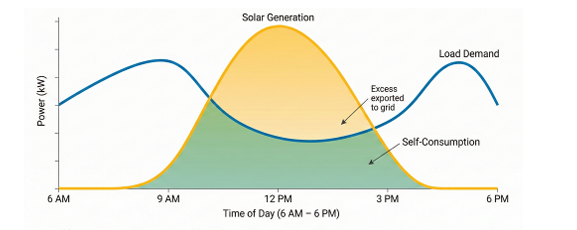
One of the most important concepts in modern solar PV systems is the relationship between solar power generation and building load demand over the course of a day. The illustrated graph provides a clear, intuitive view of how energy is produced, consumed, and exported in a typical grid-connected or hybrid solar installation. Understanding this daily power profile is essential for system sizing, battery planning, and maximizing financial returns.
The horizontal axis of the graph represents time of day, typically from early morning (6 AM) to evening (6 PM), while the vertical axis shows power in kilowatts (kW). The solar generation curve rises gradually in the morning as sunlight increases, peaks around midday when solar irradiance is highest, and then declines toward sunset. This bell-shaped curve is characteristic of all solar PV systems and varies slightly based on location, season, and weather conditions.
In contrast, the load demand curve reflects how electricity consumption changes throughout the day. Residential and commercial loads often peak in the morning and evening due to lighting, appliances, HVAC usage, and human activity patterns. Midday demand may be lower, especially in residential buildings, even though solar production is at its maximum during this time.
The overlapping region between solar generation and load demand represents self-consumption. This is the portion of solar energy that is directly used by the building at the moment it is generated. High self-consumption is desirable because it reduces reliance on grid electricity and improves the economic value of the solar system, particularly where net metering or feed-in tariffs are limited.
The shaded area where solar generation exceeds load demand is labeled excess energy exported to the grid. In grid-tied systems, this surplus electricity flows back to the utility network through a bidirectional meter. Depending on local regulations, this exported energy may be credited through net metering, net billing, or avoided-cost tariffs. While export provides some financial benefit, it is often less valuable than direct self-consumption.
This mismatch between peak solar generation and peak load demand is commonly referred to as the duck curve challenge. To address this, many systems integrate battery energy storage, which allows excess midday solar energy to be stored and used later during evening peak demand. Batteries significantly increase self-consumption and provide backup power during outages in hybrid systems.
System designers use graphs like this to optimize PV capacity, inverter sizing, and battery selection. Oversizing a PV system without sufficient load or storage may lead to high export and lower returns, while undersizing limits potential savings. Smart energy management systems, time-of-use tariffs, and load shifting strategies—such as running water heaters or EV chargers during midday—also help align consumption with generation.
In summary, the daily interaction between solar generation and load demand defines the real-world performance of a solar PV system. By analyzing these curves, stakeholders can make informed decisions that improve energy efficiency, reduce electricity costs, and enhance grid stability. This understanding is fundamental for anyone involved in solar design, installation, or energy management.