Introduction: The Hidden Backbone of Rooftop Solar
When people think about rooftop solar, they usually imagine shining panels generating clean electricity. But behind every successful solar installation lies an unsung hero — the mounting structure. This structural foundation determines how safely, efficiently, and sustainably solar panels operate for decades.
Two major mounting approaches dominate rooftop solar installations:
- Ballasted Mounting (Non-penetrating)
- Anchor-Based Mounting (Penetrating)
Choosing the right system isn’t just a technical decision. It affects building safety, maintenance, cost, waterproofing, and long-term performance. Let’s explore both approaches in depth and understand when each method shines.
Why Mounting Systems Matter More Than You Think
Solar panels must withstand wind, rain, heat, and time. A mounting system ensures:
- Structural stability during storms
- Correct tilt angle for energy generation
- Roof protection and waterproofing
- Long-term reliability and safety
Poor mounting decisions can lead to water leakage, structural damage, or reduced energy output. That’s why the mounting method is a critical design decision in rooftop solar engineering.
Option A: Ballasted Mounting (Non-Penetrating)
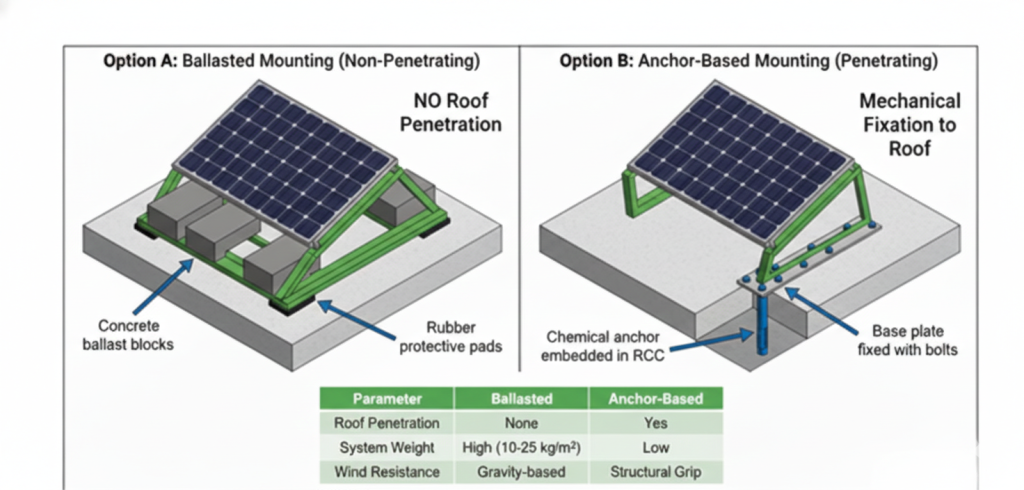
Ballasted systems are designed to sit on top of the roof without drilling into the structure. Instead of mechanical fixing, they rely on weight to hold panels in place.
How Ballasted Systems Work
The mounting frame is placed on the roof and secured using concrete ballast blocks. Rubber pads sit between the structure and roof surface to protect waterproofing layers.
Key Characteristics
Roof Penetration: None
System Weight: High (due to ballast blocks)
Wind Resistance: Gravity-based stability
Advantages of Ballasted Mounting
1. No Roof Damage or Leakage Risk
Since no drilling is required, the roof’s waterproofing remains intact. This makes ballasted systems ideal for buildings where roof penetration is not allowed.
2. Faster Installation
Installation is quicker and less invasive. There is no need for civil work or roof reinforcement in most cases.
3. Easy Removal and Relocation
Ballasted systems can be dismantled and moved if the building undergoes renovation or relocation.
4. Ideal for Large Commercial Roofs
Flat industrial rooftops often have sufficient load-bearing capacity, making them perfect for ballast systems.
Challenges of Ballasted Mounting
- Adds significant dead load to the roof
- Requires structural assessment to confirm load capacity
- Slightly lower wind resistance in extreme climates
Ballasted mounting is often the preferred choice for commercial and industrial facilities with flat roofs and strong structural capacity.
Option B: Anchor-Based Mounting (Penetrating)
Anchor-based systems are mechanically fixed into the roof structure using bolts and chemical anchors embedded in RCC (reinforced concrete).
How Anchor Systems Work
The mounting structure is bolted directly to the roof slab using:
- Chemical anchors embedded into RCC
- Base plates fixed with bolts
This creates a strong structural grip capable of withstanding high wind loads.
Key Characteristics
Roof Penetration: Yes
System Weight: Low
Wind Resistance: High structural grip
Advantages of Anchor-Based Mounting
1. Superior Wind Resistance
This system provides strong structural anchoring, making it ideal for high-wind zones and tall buildings.
2. Lower Roof Load
Because it does not rely on concrete blocks, the system is lighter and suitable for roofs with limited load capacity.
3. Space Efficiency
Without ballast blocks, installations can fit into tighter roof spaces and accommodate higher panel density.
4. Long-Term Stability
Mechanical fixation ensures long-term structural integrity and minimal movement.
Challenges of Anchor-Based Mounting
- Requires roof drilling and waterproof sealing
- Needs professional installation and civil expertise
- Slightly longer installation time
Anchor-based systems are often chosen for residential buildings, high-rise structures, and windy regions.
Head-to-Head Comparison
| Parameter | Ballasted Mounting | Anchor-Based Mounting |
|---|---|---|
| Roof Penetration | None | Yes |
| Installation Speed | Faster | Moderate |
| System Weight | High | Low |
| Wind Resistance | Gravity-based | Structural grip |
| Roof Waterproofing Risk | Very Low | Needs sealing |
| Best For | Large flat roofs | Residential & high-rise |
Choosing the Right System: Decision Factors
1. Roof Type and Strength
If the roof can handle additional load → Ballasted works well.
If load capacity is limited → Anchor-based is safer.
2. Wind Zone and Building Height
High wind region or tall building → Anchor-based preferred.
Low wind region → Ballasted is sufficient.
3. Waterproofing Sensitivity
If roof leakage is a major concern → Ballasted system wins.
4. Project Timeline
Need quick installation → Ballasted is faster.
5. Future Flexibility
If relocation may be needed → Ballasted provides flexibility.
Real-World Applications
Commercial Buildings
Large office complexes and malls often use ballasted systems due to flat roofs and strong structures.
Residential Rooftops
Homes typically use anchor-based systems due to limited roof load capacity.
High-Rise Buildings
Anchor-based mounting ensures maximum safety against wind uplift.
Sustainability Perspective
Both systems contribute to sustainability, but each has unique benefits:
- Ballasted systems avoid structural drilling and preserve building integrity.
- Anchor systems use less material and reduce structural load.
The best solution balances safety, durability, and efficiency.
The Future of Rooftop Solar Mounting
As solar adoption grows, mounting technology continues evolving with:
- Lightweight materials
- Hybrid mounting solutions
- Improved waterproof sealing systems
- Faster installation methods
Mounting structures may not generate electricity, but they make solar power possible.
Conclusion
Selecting the right solar mounting system is not just an engineering decision — it’s a long-term investment in safety, efficiency, and reliability.
- Choose ballasted mounting when roof penetration must be avoided and load capacity is high.
- Choose anchor-based mounting when wind resistance, structural grip, and lightweight installation are priorities.
Understanding these options ensures that rooftop solar systems remain secure, efficient, and sustainable for decades to come.
0 Comments