
The Evolution of the Solar Brain: Central vs. String vs. Microinverters
If solar panels are the heart of a PV system, pumping out raw energy, the inverter is the brain. It directs the flow, translates the language of electricity from DC to AC, and ensures the system operates efficiently.
Just as computers shifted from massive mainframes to personal desktops and now to powerful handheld devices, solar inverter technology has undergone a similar evolution. The way we connect our panels to these “brains” has shifted dramatically over the years, moving from centralized monoliths to highly distributed, granular systems.
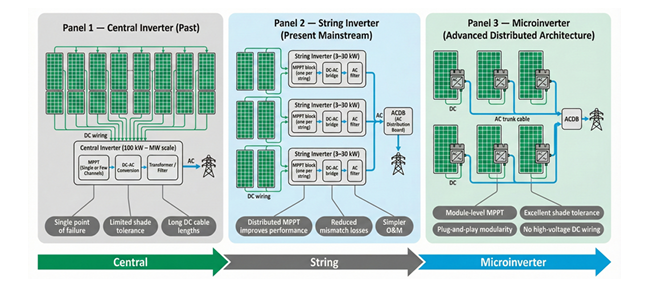
Based on the detailed architectural diagram provided, let’s explore the three major stages of inverter evolution: Central, String, and Microinverters.
The Past: The Era of the Central Inverter
Look at Panel 1 on the left. This represents the “Past” approach, often reserved for massive commercial or utility-scale projects ranging from 100 kW to MW scale.
The Architecture: Imagine a vast field of solar panels. In this setup, hundreds or thousands of panels are wired together in long series, funneling massive amounts of high-voltage DC electricity into a single, enormous Central Inverter unit. This single unit handles all the Maximum Power Point Tracking (MPPT), conversion, and filtering for the entire array.
The Drawbacks: While cost-effective for huge scales, this architecture has significant downsides, as noted in the diagram:
- Single point of failure: If that one central inverter goes down, the entire solar farm stops producing power instantly.
- Limited shade tolerance: Because so many panels are linked, a shadow falling on just a few panels can disproportionately drag down the performance of a massive section of the array.
The Present Mainstream: The String Inverter
Move to Panel 2 in the center. This is the “Present Mainstream” approach for most residential and commercial rooftops today.
The Architecture: Instead of feeding everything into one giant box, the solar array is broken down into smaller groups called “strings.” Each string is connected to its own medium-sized String Inverter, typically rated between 3–30 kW.
The Advantages: This “divide and conquer” approach offers major improvements:
- Distributed MPPT improves performance: Each inverter manages its own string independently. If one part of the roof gets cloudy, it doesn’t drag down the performance of strings in full sun.
- Reduced mismatch losses: Panels wear at different rates. Grouping them into smaller strings minimizes the energy lost when panels perform slightly differently.
- Simpler O&M (Operations & Maintenance): If one inverter fails, you only lose power from that one string, not the whole system, making repairs easier and less disruptive.
The Advanced Future: The Microinverter
Finally, look at Panel 3 on the right. This is the “Advanced Distributed Architecture,” representing the ultimate shift towards granularity.
The Architecture: Here, the inverter has shrunk down so much that it fits directly onto the back of every single solar panel. The DC-to-AC conversion happens instantly at the source. Instead of high-voltage DC wires running across the roof, a standard AC trunk cable connects all the panels directly to the distribution board.
The Advantages: This topology solves the biggest headaches of solar design:
- Excellent shade tolerance: Because it uses Module-level MPPT, shading on one panel has zero effect on its neighbors. Every panel always performs at its absolute individual maximum.
- No high-voltage DC wiring: Converting to AC immediately on the roof makes the system inherently safer for installers and firefighters, eliminating dangerous high-voltage DC runs.
- Plug-and-play modularity: Expanding the system later is as easy as adding another panel and plugging it into the AC trunk cable.
Summary of the Evolution
As the green arrow at the bottom of the diagram indicates, the industry trend is moving rapidly from centralized systems toward distributed ones.
While central inverters still hold court in massive desert solar farms, the superior performance, safety, and shade tolerance of string and microinverters have made them the standard for modern rooftop installations. Understanding this architecture helps explain why two solar quotes might have very different prices—you aren’t just buying panels; you are buying the intelligence network that manages them.