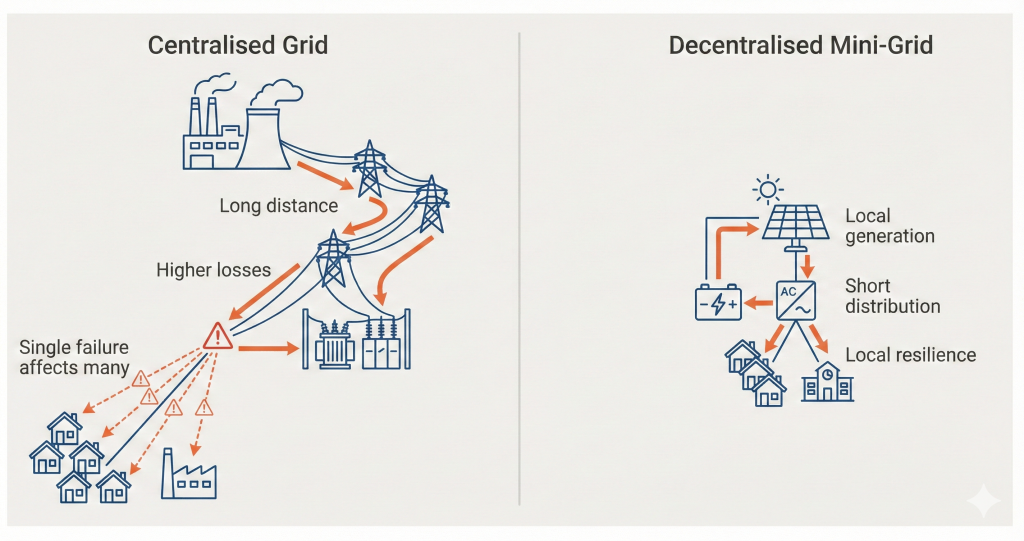
The energy transition is not solely about shifting from fossil fuels to renewables; it is equally about transforming grid architecture. The image presents a structural comparison between two fundamentally different power system models: the Centralised Grid and the Decentralised Mini-Grid. Each represents a distinct philosophy of generation, transmission, distribution, and resilience.
For energy planners, renewable developers, policymakers, and infrastructure financiers, understanding this distinction is critical for designing reliable and future-ready systems.
1. Centralised Grid: Scale with Structural Vulnerabilities
The centralised grid model is built around large-scale power plants—thermal, hydro, nuclear, or utility-scale renewable—feeding electricity into high-voltage transmission networks.
Long-Distance Transmission
Electricity generated at a central plant travels long distances through transmission towers and substations before reaching end users. This introduces:
- Transmission losses (I²R losses)
- Voltage regulation challenges
- High infrastructure capital requirements
- Dependency on complex grid balancing
In geographically large or topographically complex regions, transmission expansion becomes capital-intensive and slow.
Higher Technical Losses
Long distribution feeders increase aggregate system losses. Even with high-voltage transmission, step-down substations and low-voltage networks contribute to cumulative inefficiencies.
Technical and commercial losses (AT&C losses in many developing markets) significantly affect utility financial health.
Single Point of Failure
One of the most critical weaknesses is systemic vulnerability. A fault at a substation, transmission corridor, or generation plant can cascade across large service territories.
Blackouts in centralised systems can affect:
- Residential clusters
- Industrial zones
- Healthcare facilities
- Communication infrastructure
Centralised systems require extensive redundancy planning and grid protection mechanisms to mitigate cascading failures.
2. Decentralised Mini-Grid: Distributed and Resilient
The decentralised mini-grid architecture places generation close to consumption. Typically powered by solar PV (often hybridized with battery storage and optional backup), it distributes electricity over short, localized networks.
Local Generation
Energy is produced near the load center. This reduces dependence on long transmission corridors and improves:
- Voltage stability
- Power quality
- Real-time load management
Local solar generation aligns particularly well with daytime commercial and productive demand.
Short Distribution Network
Mini-grids operate over short feeder lengths. This significantly reduces technical losses and infrastructure complexity.
Lower distribution losses translate into improved energy efficiency and stronger project economics.
Local Resilience
Perhaps the most strategic advantage is resilience. A fault within one mini-grid typically affects only that localized network.
Unlike centralised systems, decentralised architectures:
- Prevent large-scale cascading failures
- Enable islanding capability
- Support disaster recovery
- Enhance community-level energy security
In regions vulnerable to extreme weather events, decentralised systems often restore power faster.
3. Engineering Trade-Offs
While decentralised systems offer resilience and reduced losses, centralised grids provide economies of scale and load diversity benefits.
Key comparative dimensions include:
| Parameter | Centralised Grid | Decentralised Mini-Grid |
|---|---|---|
| Transmission Distance | Long | Short |
| Technical Losses | Higher | Lower |
| Failure Impact | Wide-scale | Localised |
| Capital Structure | High transmission CAPEX | Higher distributed CAPEX |
| Resilience | System-wide dependency | Modular resilience |
In mature economies, hybrid models are emerging—centralised grids complemented by distributed generation and microgrid islanding capabilities.
4. Financial and Policy Implications
For investors and policymakers, decentralisation introduces new financing paradigms:
- Community-based energy ownership
- Pay-as-you-go tariff models
- Productive-use driven revenue enhancement
- Modular expansion strategies
Mini-grids reduce fuel exposure and long-term OPEX volatility compared to diesel-dependent remote grids.
However, regulatory clarity is essential. Policies must address:
- Grid interconnection rules
- Tariff rationalisation
- Asset compensation frameworks if main grid arrives
- Licensing and private participation
Without supportive policy environments, decentralised systems may struggle to scale despite technical merit.
5. The Hybrid Future
The global energy transition increasingly favors distributed architectures integrated with centralised backbone grids.
Future-ready power systems will likely combine:
- Utility-scale renewable generation
- Distributed rooftop solar
- Battery storage systems
- Smart grid technologies
- Islandable microgrids
The objective is not to replace centralised grids entirely but to reduce structural fragility while enhancing local reliability.
Digital monitoring, advanced metering infrastructure (AMI), and AI-driven load forecasting are accelerating this convergence.
6. Strategic Perspective for Renewable Deployment
For sustainability consultants and renewable energy developers, the choice between centralised expansion and decentralised mini-grids should be based on:
- Population density
- Load clustering
- Transmission feasibility
- Economic productivity potential
- Climate vulnerability exposure
In remote rural regions, mini-grids frequently outperform grid extension in lifecycle cost-benefit analysis.
In urban centers, distributed generation enhances resilience when integrated with centralised networks.
Conclusion
The contrast between centralised grids and decentralised mini-grids reflects more than infrastructure design—it represents a shift in resilience philosophy.
Centralised systems prioritize scale but introduce systemic vulnerability. Decentralised mini-grids prioritize proximity, modularity, and local resilience.
As renewable energy penetration increases and climate risks intensify, distributed architectures will play an increasingly central role in energy security.
The future of power systems lies not in choosing one model exclusively—but in intelligently integrating both.
Because resilience is no longer optional—it is fundamental to sustainable energy planning.
0 Comments