
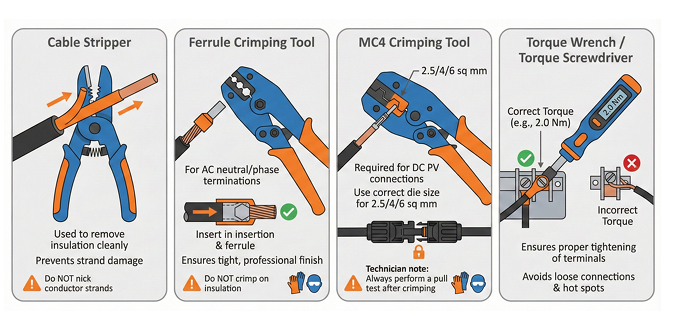
Correct termination and mechanical tightening of conductors are critical to the safety, reliability, and long-term performance of solar PV systems. The illustrated tools—Cable Stripper, Ferrule Crimping Tool, MC4 Crimping Tool, and Torque Wrench / Torque Screwdriver—are standard instruments used to ensure high-quality electrical connections on both DC and AC sides of a PV installation.
This section explains the function, application, and best-practice guidance for each tool.
1. Cable Stripper
Purpose and Function
A cable stripper is used to remove insulation from electrical cables without damaging the conductor strands.
Typical Applications
- Stripping DC solar cables prior to MC4 connector termination
- Preparing AC cables for ferrule crimping or terminal insertion
Key Characteristics
- Adjustable stripping depth for different cable sizes
- Ensures clean, uniform insulation removal
Technician Notes
- Do not nick or cut conductor strands
- Strip only the required insulation length
Importance
Improper stripping can weaken conductors, increase resistance, and lead to overheating or failure.
2. Ferrule Crimping Tool
Purpose and Function
A ferrule crimping tool is used to crimp ferrules onto stranded copper conductors, primarily for AC neutral and phase terminations.
Typical Applications
- Terminating AC conductors at MCBs, MCCBs, RCCBs, and terminal blocks
- Ensuring firm and vibration-resistant connections
Key Characteristics
- Produces tight, uniform crimps
- Provides a professional, compliant finish
Technician Notes
- Insert the conductor fully into the ferrule before crimping
- Do not crimp directly on bare insulation
Importance
Ferrules prevent strand splaying, improve contact quality, and reduce the risk of loose connections and arcing.
3. MC4 Crimping Tool
Purpose and Function
An MC4 crimping tool is specifically designed for crimping DC PV connectors used in solar string connections.
Typical Applications
- Crimping MC4 male and female connectors for PV strings
- Ensuring low-resistance, weatherproof DC connections
Key Characteristics
- Compatible with common PV cable sizes (2.5 / 4 / 6 sq mm)
- Produces manufacturer-approved crimps
Technician Notes
- Always perform a pull test after crimping
- Use the correct die size for the cable cross-section
Importance
Incorrect MC4 crimping is a leading cause of DC faults, hot spots, and connector failures in PV systems.
4. Torque Wrench / Torque Screwdriver
Purpose and Function
A torque wrench or torque screwdriver ensures terminals are tightened to the manufacturer-specified torque value.
Typical Applications
- Tightening DC and AC terminals in inverters, DCDBs, and ACDBs
- Securing earthing connections and busbar terminals
Key Characteristics
- Adjustable torque settings (e.g., 2.0 Nm typical)
- Prevents under-tightening and over-tightening
Technician Notes
- Always follow manufacturer torque specifications
- Re-check torque during commissioning and maintenance
Importance
Correct torque prevents loose connections, overheating, and long-term degradation of electrical joints.
Best-Practice Summary
- Use dedicated, purpose-built tools for PV installations
- Match tool size and settings to cable and connector specifications
- Perform visual inspection and mechanical checks after termination
- Maintain tools in good condition and calibrate torque tools periodically
Conclusion
Proper electrical terminations are foundational to the safety and durability of solar PV systems. Cable strippers ensure clean conductor preparation, ferrule and MC4 crimping tools provide secure electrical joints, and torque tools guarantee correct mechanical tightening. When used correctly, these tools minimize failures, enhance system reliability, and ensure compliance with industry standards and manufacturer requirements.