
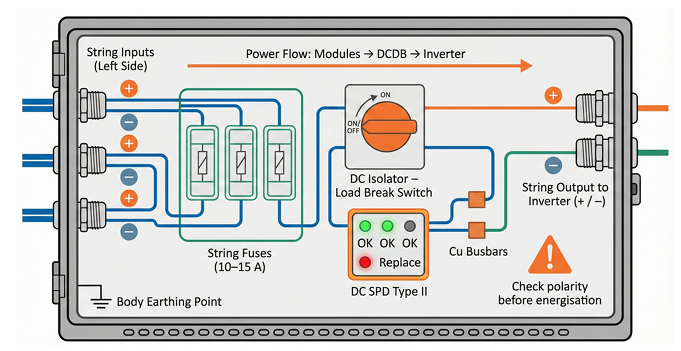
In a grid-connected solar photovoltaic (PV) system, the DC Distribution Board (DCDB) serves as a critical interface between the PV module strings and the inverter. While often perceived as a simple combiner box, the DCDB performs multiple essential functions related to protection, isolation, fault management, and system safety. The image illustrates a typical DCDB layout, showing the internal power flow, protection devices, and safety checkpoints that ensure reliable operation of the solar plant.
Understanding the role and configuration of a DCDB is vital for designers, EPC contractors, commissioning engineers, and O&M teams.
1. Purpose of the DCDB
The primary function of the DCDB is to:
- Combine multiple DC strings from PV modules
- Protect each string from electrical faults
- Provide safe isolation of DC power
- Route controlled DC output to the inverter
By centralizing these functions, the DCDB improves system reliability and simplifies maintenance and troubleshooting.
2. String Inputs and Polarity Management
As shown in the image, string inputs enter the DCDB from the left side. Each string consists of positive (+) and negative (–) DC conductors.
Correct polarity is critical in DC systems. A polarity reversal can cause inverter damage or trigger protection shutdowns. That is why the DCDB layout clearly marks positive and negative terminals and includes warning indicators to check polarity before energization.
3. String Fuses: First Line of Protection
Each incoming string is protected by a string fuse, typically rated between 10–15 A, depending on module short-circuit current and design standards.
String fuses serve two key purposes:
- Protect against reverse current flow from parallel strings
- Isolate a faulty string without shutting down the entire array
In the event of a short circuit or insulation failure in one string, the corresponding fuse blows, allowing the remaining strings to continue operating safely.
4. DC Isolator (Load Break Switch)
The DC isolator, prominently shown at the center of the DCDB, is a manually operated load break switch. It allows operators to disconnect the DC side of the system safely during:
- Maintenance activities
- Emergency shutdowns
- Inverter replacement or inspection
The isolator is designed to interrupt DC current under load conditions, which is significantly more challenging than AC interruption due to the absence of natural zero crossing.
5. Surge Protection Device (SPD) Type II – DC
Solar PV systems are particularly vulnerable to voltage surges caused by lightning strikes and grid switching events. To mitigate this risk, the DCDB includes a Type II DC Surge Protection Device (SPD).
Key features of DC SPDs include:
- Diverting transient overvoltages to earth
- Protecting sensitive inverter electronics
- Visual status indicators (OK / Replace) for maintenance teams
As illustrated, the SPD is connected to the copper busbars and bonded to the earthing system to ensure effective surge diversion.
6. Copper Busbars and Power Flow
After protection and isolation, DC power is collected through copper busbars. These busbars provide a low-resistance path for high DC currents and ensure uniform current distribution to the inverter output terminals.
The diagram clearly shows the power flow sequence:
PV Modules → DCDB → Inverter
Proper busbar sizing is essential to prevent overheating, voltage drop, and long-term degradation.
7. DC Output to Inverter
The combined and protected DC output exits the DCDB from the right side and is fed into the inverter’s DC input terminals. At this point, all strings are electrically consolidated, and the inverter’s MPPT begins optimizing power extraction.
A final polarity check and insulation resistance verification are mandatory before energizing the inverter.
8. Earthing and Safety Compliance
The DCDB includes a dedicated body earthing point, ensuring:
- Effective dissipation of fault currents
- Safe operation of surge protection devices
- Compliance with electrical safety standards
Proper earthing is non-negotiable in solar PV systems, as it directly impacts personnel safety and equipment protection.
Why the DCDB Is a Critical Safety Component
A well-designed DCDB:
- Prevents cascading faults
- Enables safe maintenance
- Protects high-value equipment
- Improves system uptime and reliability
Neglecting DCDB quality or incorrect component selection can expose the entire solar plant to electrical hazards and costly failures.