From Sunlight to Socket: How Inverters Transform DC Solar Power into Usable AC Electricity
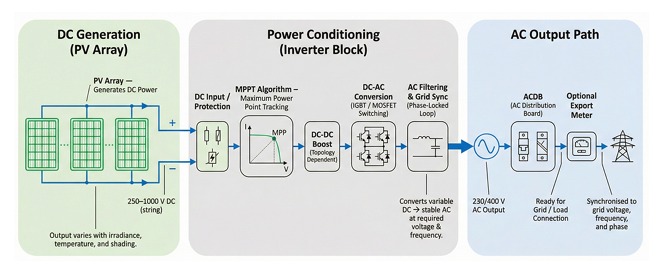
Solar photovoltaic modules generate electricity in the form of direct current (DC). However, almost all modern electrical grids, appliances, and industrial equipment operate on alternating current (AC). Bridging this fundamental mismatch is the role of the inverter—one of the most critical components in any PV system. Figure illustrates the pathway from DC generation at the module level to AC power delivery through an inverter, highlighting the central role this device plays in solar energy systems.
At the module level, photovoltaic cells produce DC electricity when exposed to sunlight. Electrons flow in a single direction, and the output voltage varies with irradiance and temperature. While this DC power is suitable for charging batteries or powering certain DC loads, it cannot be directly fed into the grid or most household devices. Conversion is therefore essential.
The inverter performs three core functions. First, it converts DC electricity into AC by rapidly switching electronic components—typically insulated-gate bipolar transistors (IGBTs) or MOSFETs—to create an alternating waveform. Second, it conditions the power to ensure that voltage, frequency, and waveform quality meet grid or load requirements. Third, in grid-connected systems, it synchronizes the output with the utility grid, ensuring safe and stable power injection.
Early solar inverters were relatively simple devices focused solely on DC-to-AC conversion. Modern inverters, by contrast, are highly sophisticated power electronics platforms. They incorporate maximum power point tracking (MPPT) algorithms that continuously adjust operating conditions to extract the maximum possible power from the PV array under varying irradiance and temperature.
Figure also reflects the architectural placement of inverters within PV systems. In small rooftop installations, string inverters are commonly used, with multiple series-connected modules feeding a single inverter. In larger plants, central inverters handle megawatt-scale power, while micro-inverters and DC optimizers provide module-level control in systems with shading or complex layouts.
Beyond conversion efficiency, inverters play a crucial role in system safety. They provide isolation, ground fault detection, anti-islanding protection, and rapid shutdown capabilities. These functions protect both personnel and grid infrastructure, and they are mandated by electrical codes in most jurisdictions.
Thermal management is another critical consideration. Inverters operate under high electrical stress and generate significant heat. Efficient cooling—whether passive or active—is essential to maintain performance and longevity. Poor thermal design can lead to derating, reduced energy yield, and premature failure.
At the grid level, inverters have evolved into active participants in power system operation. Modern grid-tied inverters can support voltage regulation, provide reactive power, and ride through grid disturbances. As solar penetration increases, these capabilities are essential for maintaining grid stability. In many regions, grid codes now require inverters to behave more like conventional power plants in terms of controllability and response.
In off-grid and hybrid systems, inverters take on additional responsibilities. They manage battery charging and discharging, balance loads, and sometimes form the grid itself by establishing voltage and frequency. In these applications, the inverter is effectively the heart of the power system.
Understanding the inverter’s role is critical for system design, operation, and maintenance. Mismatched inverter sizing can lead to clipping losses or underutilized capacity. Incorrect placement can increase DC losses or thermal stress. Effective system performance depends on aligning inverter characteristics with array design and site conditions.
Figure encapsulates this transformation—from sunlight striking a semiconductor to usable AC power flowing into homes, businesses, and grids. While PV modules capture energy, inverters make that energy usable. As solar systems continue to scale and integrate with storage and smart grids, the inverter’s role will only become more central to the future of electricity.
0 Comments