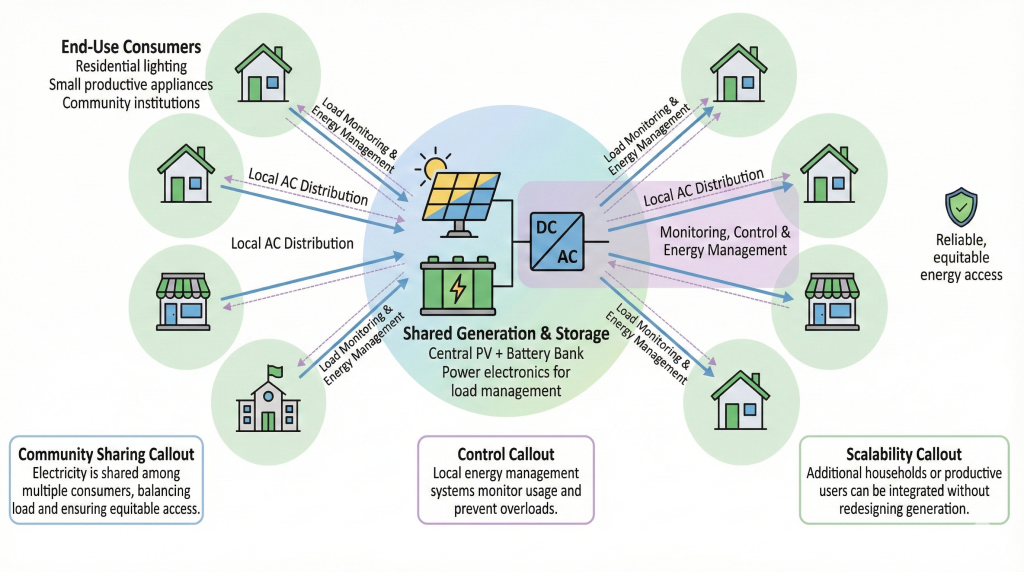
The global transition toward renewable energy is no longer limited to large utility-scale solar parks or rooftop installations feeding individual homes. A new paradigm is emerging—decentralized solar generation with shared storage and intelligent energy management. The image illustrates a structured architecture where distributed consumers are interconnected through local AC distribution, centralized DC conversion, shared battery storage, and a monitoring and control system. This model represents the future of reliable, equitable, and scalable clean energy access.
Understanding the Architecture
At the core of the system lies a shared generation and storage unit, consisting of:
- Central PV + Battery Bank
- Power electronics for load management
- DC–AC conversion system
- Monitoring, control, and energy management platform
Electricity generated from solar photovoltaic panels is converted and distributed through local AC networks to multiple end users. These users include residential lighting loads, small productive appliances, and community institutions. Instead of operating as isolated systems, consumers are connected in a coordinated micro-grid structure.
This configuration is neither a fully centralized grid nor a standalone off-grid system. It is a community-based distributed energy ecosystem designed to optimize generation, storage, and consumption.
Key Components of the System
1. Shared Solar PV Generation
A central photovoltaic array serves as the primary energy source. Instead of each household investing in separate solar panels and inverters, the community benefits from a consolidated installation. This reduces:
- Capital expenditure per household
- Maintenance complexity
- System redundancy
Centralized generation also allows better design optimization, including proper tilt, orientation, and shading analysis, which improves overall energy yield.
2. Central Battery Storage
Energy storage is integrated into the system to:
- Store excess solar generation during peak sunlight
- Supply power during evening and low-irradiation periods
- Stabilize voltage and frequency fluctuations
A shared battery bank ensures higher utilization compared to individual small batteries. It also enables load diversity benefits—while some users consume energy, others may not, allowing optimized storage cycles.
3. Power Electronics and DC–AC Conversion
The system includes advanced power electronics that regulate:
- Load balancing
- Voltage stability
- Overload protection
- Power quality management
The DC power generated from solar panels is converted to AC for local distribution. Smart inverters enable bi-directional power flow if future grid interconnection is planned.
4. Monitoring, Control & Energy Management
This is arguably the most critical element. The monitoring platform:
- Tracks real-time generation and consumption
- Prevents overloads
- Manages demand peaks
- Enables predictive maintenance
- Provides performance analytics
By collecting usage data, the system ensures fairness in distribution and helps avoid overconsumption by individual users. It also supports energy audits and community-level optimization strategies.
Community Sharing Model
The diagram emphasizes a community sharing callout—electricity is shared among multiple end-use consumers. This approach brings several structural advantages:
Equitable Access
Instead of uneven distribution where wealthier households can afford larger systems, energy is allocated based on defined load parameters. Community institutions, such as schools or health centers, can receive prioritized access when necessary.
Load Balancing
Different users have varying consumption patterns:
- Residential lighting peaks in the evening
- Small enterprises operate during daytime
- Community facilities have intermittent loads
Diversity in demand improves system efficiency and reduces storage strain.
Reduced Infrastructure Cost
A shared distribution backbone eliminates the need for redundant wiring and multiple standalone inverters.
Control Callout: Preventing System Overload
One major risk in micro-grid systems is overloading. The integrated control system mitigates this by:
- Setting maximum permissible load limits
- Disconnecting non-critical loads during peak stress
- Monitoring voltage drop across distribution lines
This ensures system longevity and protects battery health.
Scalability and Future Integration
The diagram also highlights scalability. Additional households or productive users can be connected without redesigning the entire generation system—provided capacity planning was done properly.
Scalability considerations include:
- Modular battery expansion
- Parallel inverter configuration
- Smart metering integration
- Tiered load categories
This modularity makes the system adaptable for rural electrification, peri-urban communities, industrial clusters, and institutional campuses.
Productive Use of Energy (PUE)
Beyond residential lighting, the system supports small productive appliances. This is crucial for economic development. Productive loads may include:
- Water pumping
- Agro-processing equipment
- Sewing machines
- Refrigeration for micro-enterprises
When energy enables income generation, the sustainability of the system improves significantly because users are able to contribute to maintenance and operational costs.
Reliability and Energy Security
Traditional grid systems in many regions suffer from outages, voltage fluctuations, and infrastructure constraints. A decentralized shared solar system offers:
- Reduced transmission losses
- Localized fault isolation
- Improved resilience during grid failure
- Reduced dependency on fossil fuels
With battery backup, communities gain predictable access to power, which improves quality of life and economic stability.
Environmental and Social Impact
Such systems contribute directly to:
- Reduction in diesel generator use
- Lower carbon emissions
- Reduced noise pollution
- Improved indoor air quality
Socially, they foster community collaboration. Energy becomes a shared asset rather than an individual commodity.
Implementation Considerations
To successfully deploy such a system, planners must address:
- Load Assessment
Conduct detailed energy audits to determine peak and average demand. - Battery Sizing
Design for autonomy days and depth-of-discharge optimization. - Distribution Network Design
Minimize voltage drop and ensure proper cable sizing. - Governance Model
Define usage policies, tariff structures, and maintenance responsibility. - Technical Training
Equip local technicians with skills for troubleshooting and preventive maintenance.
Applications of This Model
This architecture is particularly suitable for:
- Rural electrification projects
- Educational campuses
- Industrial parks
- Housing societies
- Agricultural clusters
- Remote tourism facilities
It bridges the gap between individual rooftop solar and centralized utility grids.
The Future of Decentralized Energy
As battery prices decline and smart energy management systems become more affordable, decentralized shared solar systems will become increasingly viable. Integration with digital metering, mobile-based payment systems, and remote diagnostics will further enhance operational efficiency.
The model shown in the image is more than a schematic—it represents a shift toward community-centric energy ecosystems. It combines technological efficiency with social equity and economic sustainability.
Decentralized solar sharing is not merely an engineering solution. It is a structural rethinking of how energy can be generated, stored, managed, and equitably distributed at the community level.