Choosing the Right Solar Mounting System for Different Roof Types
Not all rooftops are created equal. The structural design, waterproofing approach, and mounting hardware required for a solar photovoltaic (PV) system vary significantly depending on roof type. Selecting the correct mounting solution is critical to ensure structural safety, long-term durability, and leak-free performance — while also maximizing energy yield and minimizing installation risk.
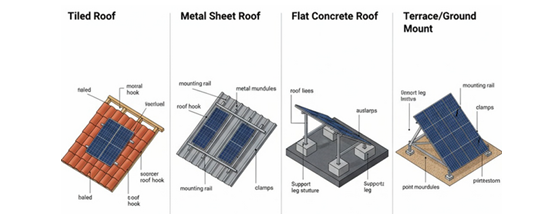
The attached diagram compares four common installation scenarios: tiled roofs, metal sheet roofs, flat concrete roofs, and terrace or ground-mounted systems. Each configuration presents unique engineering challenges and opportunities. Understanding these differences allows designers, EPC contractors, and building owners to choose mounting systems that are compatible with the building envelope and optimized for performance.
This article explains each mounting type shown in the diagram and outlines best practices for safe and effective solar installations across different roof structures.
1. Tiled Roof Systems
Typical Characteristics
Tiled roofs, commonly found in residential and institutional buildings, use clay, concrete, or slate tiles installed over battens and rafters. These roofs are visually sensitive and highly dependent on proper waterproofing.
Mounting Method
The diagram shows a tiled roof hook system, which includes:
- Roof hooks anchored into rafters
- Flashing or waterproof sleeves
- Rails mounted above the tile surface
- Modules clamped to rails
In this system, individual tiles are locally lifted or notched to allow the hook to pass through while maintaining the original roof profile.
Key Engineering Considerations
- Anchoring must be into structural rafters, not just battens
- Waterproof flashing is essential to prevent leaks
- Tiles must not be cracked or stressed during installation
- Proper load distribution is required to avoid point loading
Advantages and Challenges
Advantages:
- Preserves roof aesthetics
- Minimal removal of roof materials
- Suitable for pitched residential roofs
Challenges:
- Labor-intensive installation
- Higher risk of water ingress if flashing is improper
- Fragility of tiles during installation and maintenance
2. Metal Sheet Roof Systems
Typical Characteristics
Metal sheet roofs are widely used in commercial, industrial, and warehouse buildings. They typically consist of trapezoidal or standing-seam metal profiles mounted on steel purlins.
Mounting Method
The diagram shows a metal roof mounting rail system, including:
- Roof hooks or clamps fixed to metal sheets
- Rails mounted on the roof profile
- Module clamps securing PV modules
For standing seam roofs, non-penetrating seam clamps are often used, while for trapezoidal sheets, self-drilling fasteners with sealing washers are common.
Key Engineering Considerations
- Pull-out capacity of fasteners in thin metal sheets
- Corrosion protection of fasteners
- EPDM washers and sealants for waterproofing
- Load transfer to structural purlins
Advantages and Challenges
Advantages:
- Fast and cost-effective installation
- Lightweight roof structure
- Suitable for large commercial arrays
Challenges:
- Risk of leaks if penetrations are not sealed properly
- Potential corrosion in coastal or industrial environments
- Limited load capacity of thin-gauge sheets
3. Flat Concrete Roof Systems
Typical Characteristics
Flat concrete roofs are common in commercial, institutional, and multi-story residential buildings. These roofs often use waterproof membranes and are designed to carry live loads.
Mounting Method
The diagram shows a support leg structure, often used for flat roofs. These systems typically include:
- Tilted support frames
- Base plates resting on the roof surface
- Anchored or ballasted foundations
- Modules mounted on inclined racks
These systems allow designers to set the optimal tilt and azimuth independent of roof slope.
Key Engineering Considerations
- Waterproofing membrane protection
- Structural load capacity of slab
- Wind uplift resistance
- Drainage and ponding avoidance
Advantages and Challenges
Advantages:
- Flexible tilt and orientation
- Suitable for large, optimized arrays
- Easy access for maintenance
Challenges:
- Higher wind loads
- Risk of membrane damage
- Structural verification required for ballast or anchors
4. Terrace and Ground-Mounted Systems
Typical Characteristics
Terrace and ground-mounted systems are typically used where roof space is limited or where open land is available. These systems use dedicated support structures installed on concrete pedestals or foundations.
Mounting Method
The diagram shows a ground/terrace mounting structure, including:
- Concrete pedestals or foundations
- Inclined mounting frames
- Mounting rails and clamps
- Point modules attached to frames
These systems allow full control over tilt, azimuth, and row spacing.
Key Engineering Considerations
- Foundation design and soil bearing capacity
- Wind and seismic loads
- Corrosion protection
- Cable routing and trenching
Advantages and Challenges
Advantages:
- Maximum design flexibility
- Optimal energy yield
- Easy access for cleaning and maintenance
Challenges:
- Higher civil and structural costs
- Land or terrace space requirements
- Potential shading between rows
5. Matching Mounting Systems to Structural and Climatic Conditions
The diagram highlights that there is no one-size-fits-all solution. The optimal mounting system depends on:
- Roof material and construction
- Wind zone and exposure category
- Seismic zone
- Rainfall and drainage patterns
- Corrosive environment (coastal/industrial)
- Building usage and access constraints
A proper site assessment and structural review are essential before selecting a mounting approach.
6. Waterproofing and Roof Warranty Implications
Across all roof types, waterproofing is a top priority. Improper mounting can:
- Void roof warranties
- Lead to chronic leaks
- Cause structural deterioration
- Increase long-term maintenance costs
Best practices include:
- Using manufacturer-approved mounting accessories
- Maintaining proper flashing and sealing
- Documenting all penetrations
- Coordinating with roofing contractors
7. Impact on Energy Yield and System Economics
Mounting systems also influence:
- Available tilt and azimuth
- Row spacing and shading
- Array density
- Installation and O&M costs
Flat and ground-mounted systems offer more freedom to optimize energy yield, while pitched roofs are constrained by existing building geometry. These trade-offs should be reflected in energy modeling and financial analysis.
Conclusion
The attached diagram clearly shows that rooftop and ground-mounted solar installations require different engineering solutions based on roof type and structural configuration. From delicate tiled roofs to industrial metal sheets, from flat concrete slabs to open-ground installations, each scenario demands tailored mounting strategies to ensure safety, waterproofing, and long-term reliability.
Choosing the right mounting system is not just an installation decision — it is a structural, waterproofing, and performance decision that directly affects the lifetime success of the solar PV project.
In solar PV, matching the mounting system to the roof type is a fundamental step toward building durable, high-performing renewable energy assets.