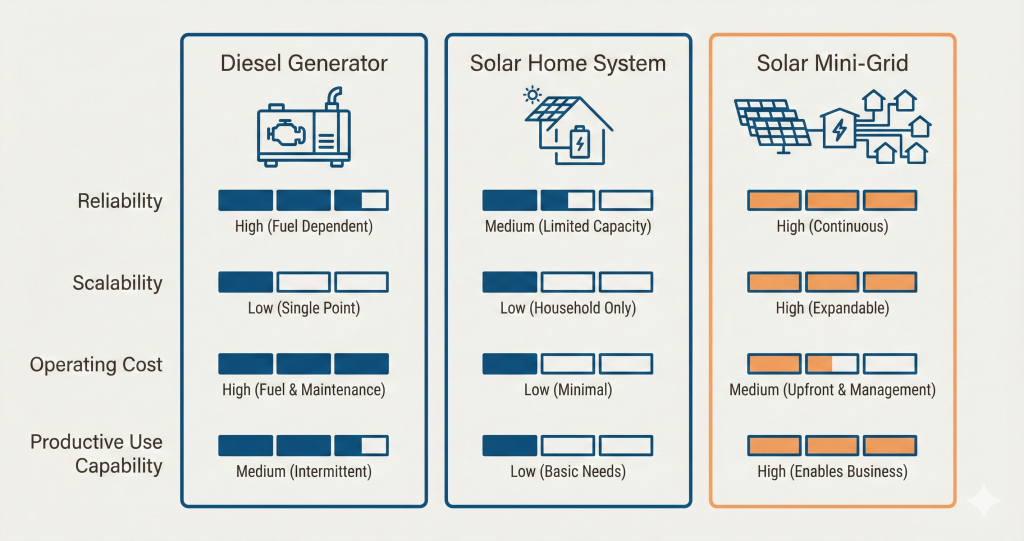
Energy infrastructure decisions shape not only technical performance but also long-term economic viability and development outcomes. The third image presents a structured comparison across three widely deployed energy solutions: Diesel Generators, Solar Home Systems (SHS), and Solar Mini-Grids. It evaluates them across four critical dimensions—Reliability, Scalability, Operating Cost, and Productive Use Capability.
This comparative framework is particularly relevant for sustainability consultants, renewable energy developers, infrastructure financiers, and policymakers evaluating decentralized energy models.
1. Diesel Generators: Reliability at a Cost
Diesel generators have historically been the default solution for backup and off-grid power.
Reliability: High (Fuel Dependent)
Diesel systems can provide stable output when fuel is available. However, their reliability is conditional. Fuel supply chain disruptions, price volatility, and maintenance gaps directly affect performance continuity.
In remote or rural geographies, logistics risks can significantly compromise uptime.
Scalability: Low (Single Point)
Diesel systems are typically standalone installations. Scaling requires additional generators, increasing capital expenditure and operational complexity. There is no inherent modular expansion logic.
Operating Cost: High (Fuel & Maintenance)
Diesel systems are OPEX-intensive. Fuel procurement, engine wear, oil changes, and spare parts create sustained financial burden. Over a project lifecycle, fuel cost dominates total expenditure.
Productive Use Capability: Medium (Intermittent)
Diesel can support productive loads, but fuel economics often restrict operating hours. High marginal cost discourages continuous business operations.
From a climate perspective, diesel solutions also carry carbon emission and air quality implications.
2. Solar Home Systems (SHS): Affordable but Limited
Solar Home Systems are decentralized, household-level photovoltaic solutions typically comprising panels, charge controllers, batteries, and small inverters.
Reliability: Medium (Limited Capacity)
SHS systems are reliable within their designed load profile. However, their capacity constraints limit service diversity. High-load appliances often exceed system capability.
Battery storage sizing determines evening reliability, but depth-of-discharge limits constrain scalability.
Scalability: Low (Household Only)
SHS is inherently non-networked. Each installation serves a single household. Expanding capacity requires individual upgrades rather than system-wide integration.
Operating Cost: Low (Minimal)
SHS systems have low ongoing operational expenses. With no fuel requirement and minimal maintenance, lifecycle cost per household remains relatively predictable.
Productive Use Capability: Low (Basic Needs)
SHS primarily supports lighting, phone charging, and small appliances. It does not typically enable machinery, irrigation pumps, or commercial-scale activity.
Thus, while SHS improves energy access metrics, it rarely drives local economic transformation.
3. Solar Mini-Grids: Integrated and Expandable
Solar Mini-Grids represent a distributed generation and distribution architecture supplying multiple users through a localized network.
Reliability: High (Continuous)
With proper system design—adequate PV sizing, battery management systems, smart inverters, and load management—mini-grids provide stable, continuous supply.
Hybrid configurations (solar + battery + optional backup) enhance resilience.
Scalability: High (Expandable)
Mini-grids are modular. Additional panels, storage, and distribution lines can be integrated as demand grows. This scalability supports phased capital deployment and adaptive planning.
Operating Cost: Medium (Upfront & Management)
Mini-grids have higher initial CAPEX compared to SHS but significantly lower OPEX than diesel. Operating cost includes asset management, monitoring systems, and governance structures.
Lifecycle economics are favorable due to fuel independence.
Productive Use Capability: High (Enables Business)
This is the decisive advantage. Mini-grids can power:
- Agro-processing units
- Irrigation pumps
- Workshops
- Cold storage
- Small industries
By supporting productive loads, mini-grids generate income streams that strengthen tariff recovery and financial sustainability.
4. Technical and Financial Implications
From a techno-economic standpoint, the comparison highlights key strategic insights:
- Diesel is operationally simple but financially and environmentally unsustainable long-term.
- Solar Home Systems improve basic access but do not scale into economic development.
- Solar Mini-Grids balance reliability, scalability, and productive capacity.
In financial modeling, mini-grids typically demonstrate stronger long-term internal rates of return (IRR) when productive loads are integrated. Revenue stability improves when electricity supports income-generating activities.
For climate-aligned investment portfolios, mini-grids align with decarbonization objectives while enabling inclusive growth.
5. Policy and Development Considerations
For governments and development institutions:
- Diesel should be treated as transitional or emergency backup.
- SHS deployment is suitable for highly dispersed, low-demand populations.
- Mini-grids are optimal for clustered rural communities and peri-urban growth zones.
Regulatory frameworks must support mini-grid interconnection, tariff rationalization, and capital subsidies where necessary.
Data-driven load forecasting and community engagement are essential for long-term viability.
Conclusion
The choice between diesel, SHS, and solar mini-grids is not merely technical—it is strategic.
Diesel offers short-term reliability at high recurring cost. Solar Home Systems provide affordable access but limited growth potential. Solar Mini-Grids offer scalable, reliable, and economically transformative power infrastructure.
For sustainable development objectives, mini-grids represent the most balanced pathway—combining resilience, affordability, and productive empowerment.
Energy planning must therefore move beyond access statistics and toward infrastructure that enables durable economic activity.
Because real progress is measured not just by electrification—but by prosperity enabled.
0 Comments