
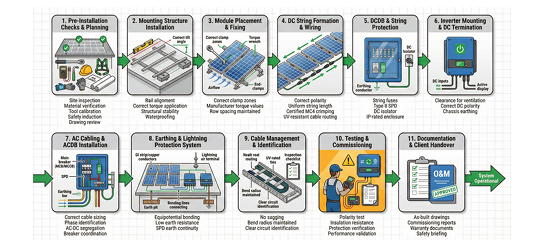
The successful execution of a solar photovoltaic (PV) project depends on a structured installation and commissioning process. Each stage—from initial planning to final handover—plays a critical role in ensuring system safety, performance, and long-term reliability. The illustrated workflow presents a comprehensive, industry-aligned sequence of activities that guide installers, engineers, and project managers through a standard solar PV installation lifecycle.
The process begins with pre-installation checks and planning. This stage includes site inspection, structural assessment, electrical feasibility checks, and safety planning. Verifying roof condition, load-bearing capacity, shading, and access points at this stage helps prevent execution delays and rework. Proper planning also ensures compliance with technical standards and statutory requirements.
Next is mounting structure installation, where rails and supports are installed and aligned according to approved drawings. Accurate leveling, secure anchoring, and corrosion protection are essential, as the mounting structure forms the mechanical backbone of the system. Any error here directly affects module alignment and long-term durability.
This is followed by module placement and fixing. PV modules are carefully lifted, positioned, and clamped onto the mounting rails with correct torque settings. Uniform spacing and alignment are crucial to avoid mechanical stress and shading issues. Proper handling during this stage minimizes the risk of micro-cracks and damage.
The workflow then moves to DC string formation and wiring. Modules are interconnected into strings as per the electrical design. Correct polarity, standardized cable routing, and secure connectors are vital to ensure electrical safety and minimize losses.
Once DC strings are formed, DCDB installation and string protection is carried out. DC distribution boards, fuses, isolators, and surge protection devices are installed to safeguard the system against faults and overvoltage events.
The next critical step is inverter mounting and DC termination. Inverters are installed at designated locations with adequate ventilation and clearance. DC and AC terminations are completed following manufacturer guidelines and safety standards.
Subsequently, AC cabling and ACDB installation connect the inverter output to the load or grid. Proper cable sizing, breaker coordination, and labeling ensure safe and efficient power delivery.
Earthing and lightning protection systems are then installed to protect both equipment and personnel. Low earth resistance values and continuity checks are mandatory at this stage.
Before energization, cable management and identification ensure all cables are neatly dressed, secured, and clearly labeled, improving safety and maintainability.
The project then enters testing and commissioning, where insulation resistance tests, polarity checks, protection verification, and inverter configuration are performed. Only after all parameters are validated is the system energized.
Finally, documentation and client handover completes the process. As-built drawings, test reports, warranties, and O&M manuals are handed over, and the system is declared operational.
This structured workflow ensures that solar PV systems are installed safely, perform as designed, and deliver reliable energy over their intended lifespan.