
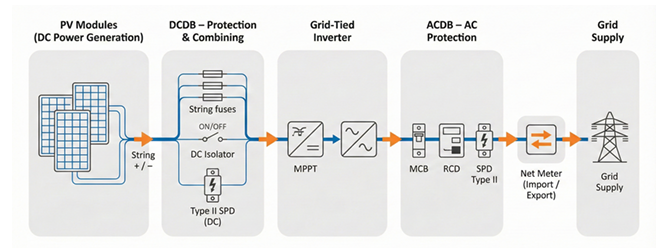
A grid-tied solar photovoltaic (PV) system is one of the most widely adopted solar configurations for commercial buildings, malls, offices, and institutional facilities. Its popularity stems from its efficiency, cost-effectiveness, and seamless integration with the utility grid. The image provided illustrates the complete electrical flow of a grid-connected solar PV system—from power generation at the module level to energy export into the grid. This article explains each component in detail, highlighting its role, importance, and contribution to system safety and performance.
1. PV Modules – DC Power Generation
The process begins with PV modules, which convert sunlight into direct current (DC) electricity through the photovoltaic effect. When solar radiation strikes the semiconductor cells (typically crystalline silicon), electrons are excited and generate DC power.
Modules are connected in strings to achieve the required voltage level. The string configuration depends on inverter design, site conditions, and module electrical characteristics. Proper string sizing is critical to ensure maximum energy yield while staying within inverter voltage limits.
High-quality modules are designed to withstand environmental stresses such as high temperatures, humidity, and dust—conditions especially relevant in tropical and semi-arid regions. Since modules are the only power-generating component, their performance directly influences overall plant output.
2. DCDB – Protection and Combining
The DC electricity generated by multiple strings is routed to the DC Distribution Board (DCDB). This is a critical safety and aggregation point in the system.
Key components inside the DCDB include:
- String fuses: These protect individual strings from reverse current and short-circuit conditions. If a fault occurs in one string, the fuse isolates it without affecting others.
- DC Isolator (ON/OFF switch): Allows safe manual disconnection of DC power for maintenance, inspection, or emergency shutdown.
- Type II Surge Protection Device (SPD – DC): Protects the system from voltage surges caused by lightning or switching transients, which are common in exposed rooftop installations.
The DCDB ensures that all DC power entering the inverter is safe, controlled, and compliant with electrical standards.
3. Grid-Tied Inverter – The System Brain
The grid-tied inverter is the heart of the solar PV system. Its primary function is to convert DC power into alternating current (AC) that matches the grid’s voltage, frequency, and phase.
Modern inverters perform several advanced functions:
- Maximum Power Point Tracking (MPPT): Continuously optimizes voltage and current to extract the maximum possible power from the PV modules under varying irradiance and temperature conditions.
- Grid synchronization: Ensures that the output AC power aligns precisely with the grid waveform.
- Protection and monitoring: Detects grid faults, voltage fluctuations, and abnormal operating conditions.
Inverters also provide real-time performance data, fault alerts, and energy analytics, making them indispensable for system monitoring and O&M teams.
4. ACDB – AC Protection
Once DC power is converted to AC, it flows into the AC Distribution Board (ACDB). This panel safeguards the downstream electrical network and ensures compliance with grid interconnection requirements.
The ACDB typically includes:
- MCB (Miniature Circuit Breaker): Protects against overloads and short circuits on the AC side.
- RCD (Residual Current Device): Detects earth leakage currents and prevents electric shock hazards.
- Type II SPD (AC): Shields the system and connected loads from surge events on the AC network.
The ACDB acts as a buffer between the inverter and the building/grid infrastructure, ensuring stable and safe power delivery.
5. Net Meter – Import and Export Measurement
The net meter plays a pivotal role in grid-tied systems. It records both:
- Imported energy (electricity drawn from the grid when solar generation is insufficient), and
- Exported energy (excess solar power fed into the grid).
This bidirectional metering enables net metering or gross metering mechanisms, depending on local utility regulations. Accurate net metering ensures transparent billing, regulatory compliance, and financial viability of the solar installation.
6. Grid Supply – Seamless Integration
Finally, the AC power connects to the utility grid. During the daytime, solar energy supplies on-site loads first. Any surplus is exported to the grid. At night or during low solar generation, power is automatically imported from the grid—ensuring uninterrupted electricity supply without the need for batteries.
This seamless integration is the defining advantage of grid-tied systems. It eliminates energy storage costs while maximizing solar utilization.
Why This Architecture Matters
Each component shown in the diagram serves a specific purpose—generation, protection, conversion, measurement, or distribution. Together, they create a system that is:
- Safe: Multiple layers of protection on DC and AC sides
- Efficient: MPPT and optimized string design
- Compliant: Meets electrical codes and utility standards
- Scalable: Easily expandable for future capacity additions
Understanding this flow is essential for engineers, facility managers, and sustainability professionals responsible for design approvals, audits, and long-term performance optimization.