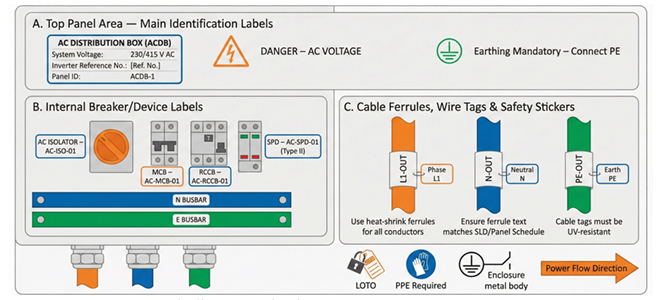
In solar photovoltaic (PV) systems, electrical safety is achieved not only through correct design and protection devices but also through clear, durable, and standardized labeling. The image illustrates best practices for identification labels, internal device marking, cable ferrules, wire tags, and safety stickers in an AC Distribution Box (ACDB). Proper labeling is a mandatory requirement under electrical standards and plays a decisive role during inspection, operation, maintenance, and emergency response.
1. Importance of Labeling in Solar ACDBs
An ACDB interfaces directly with the inverter output and the building or grid electrical system. Misidentification at this level can lead to:
- Accidental exposure to live AC voltage
- Incorrect isolation during maintenance
- Delayed fault response
- Non-compliance during statutory inspections
Clear labeling ensures that any technician—whether part of the EPC, O&M team, or facility electrical staff—can immediately understand the function and status of each component.
2. Top Panel Area: Main Identification Labels
The top section of the ACDB carries the most critical information, including:
- AC Distribution Box (ACDB) Nameplate
This typically includes:- System voltage (e.g., 230/415 V AC)
- System rating
- Inverter reference number
- Panel identification number
- Danger – AC Voltage Warning
A high-visibility warning symbol alerts personnel to the presence of live AC power, even when the system is partially energized. - Earthing Mandatory Label
This confirms that protective earthing (PE) connection is compulsory and must never be disconnected.
These labels are essential for compliance with IEC, IS, and local electrical inspectorate requirements.
3. Internal Breaker and Device Labels
Inside the ACDB, each protective and control device must be clearly labeled:
- AC Isolator (Load Break Switch)
Identifies the primary isolation device for the inverter AC output. - MCB / MCCB
Labeled with breaker reference numbers corresponding to drawings and schedules. - RCCB / RCD
Clearly marked to indicate earth leakage protection. - AC SPD (Type II)
Labeled to distinguish surge protection devices from other components.
Additionally, phase, neutral, and earth busbars are clearly identified as:
- L Busbar
- N Busbar
- E Busbar
This internal labeling prevents wiring confusion and improves safety during troubleshooting.
4. Cable Ferrules and Wire Tags
The right section of the image emphasizes conductor-level identification, which is often neglected but critically important:
- Heat-shrink Ferrules
Used at cable terminations to provide permanent, legible identification. - Wire Tags for Phase, Neutral, and Earth
Examples include:- Phase (L1 / L)
- Neutral (N)
- Earth (PE)
Text on ferrules must match:
- Single-line diagrams (SLDs)
- Panel schedules
- As-built drawings
Using UV-resistant materials ensures labels remain readable throughout the system’s service life.
5. Safety Stickers and Operational Icons
Several safety and operational stickers are highlighted:
- LOTO (Lock-Out Tag-Out)
Indicates that proper isolation and locking procedures must be followed before maintenance. - PPE Required
Reminds personnel to wear appropriate personal protective equipment. - Grounding Symbol
Reinforces the importance of earthing continuity. - Enclosure Metal Body Warning
Alerts that the panel enclosure is metallic and must be earthed. - Power Flow Direction Arrow
Clearly shows the direction of power flow from inverter to load/grid.
These visual cues significantly reduce human error, especially during emergency or time-critical operations.
6. Compliance and Inspection Significance
Electrical inspectors and utility representatives closely examine:
- Presence of mandatory labels
- Accuracy of device identification
- Consistency with drawings and schedules
- Durability and legibility of labels
Missing or incorrect labeling is one of the most common reasons for inspection remarks and approval delays in solar projects.
7. O&M and Lifecycle Benefits
From an operations and maintenance perspective, proper labeling:
- Reduces troubleshooting time
- Enables safer isolation procedures
- Facilitates smoother handover between teams
- Minimizes reliance on institutional knowledge
Well-labeled panels remain functional and safe even years after commissioning.
8. Best Practices for Solar ACDB Labeling
To ensure long-term effectiveness:
- Use engraved or printed industrial-grade labels
- Avoid handwritten markings
- Ensure label text matches documentation exactly
- Place labels at eye level and near corresponding devices
These practices reflect professionalism and engineering discipline.
Conclusion
Labeling and identification in solar AC Distribution Boards are not cosmetic details—they are essential safety and compliance elements. From top-panel warnings to internal device tags and cable ferrules, every label plays a role in protecting people, equipment, and energy generation. A properly labeled ACDB reflects a well-engineered solar PV system designed for safe, reliable, and compliant operation throughout its lifecycle.