
The performance, safety, and longevity of a rooftop solar photovoltaic (PV) system depend not only on modules and inverters but also significantly on the mounting structure. Often underestimated, the mounting system is the mechanical backbone of a solar plant—it supports the modules, withstands wind loads, accommodates thermal expansion, and interfaces directly with the building structure.
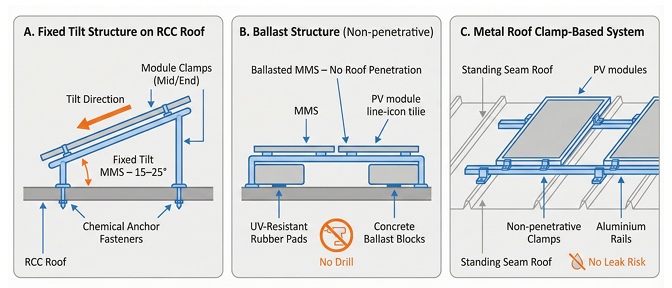
The image illustrates three commonly used rooftop solar mounting solutions:
(A) Fixed Tilt Structure on RCC Roof,
(B) Ballasted Structure (Non-penetrative), and
(C) Metal Roof Clamp-Based System.
Each system is designed for specific roof types, load conditions, and project constraints. This article provides a detailed comparison to help stakeholders make informed design and procurement decisions.
A. Fixed Tilt Structure on RCC Roof
Fixed tilt structures are the most widely used mounting systems for reinforced cement concrete (RCC) roofs, particularly in commercial and institutional buildings.
Design and Components
In this configuration, PV modules are mounted on aluminum or galvanized steel Module Mounting Structures (MMS) set at a fixed tilt angle, typically 15°–25°, depending on latitude and shading constraints. Modules are secured using mid-clamps and end-clamps, ensuring mechanical stability and electrical grounding continuity.
The structure is anchored to the RCC slab using chemical anchor fasteners, which provide high pull-out strength without inducing cracks when properly installed.
Advantages
- High structural stability and wind resistance
- Optimal tilt improves annual energy yield
- Long service life with minimal movement
- Suitable for large-capacity rooftop plants
Considerations
Since this system requires roof penetration, proper waterproofing treatment is essential to prevent leakage. Structural load analysis must also be conducted to ensure the roof can handle both dead loads and wind uplift forces.
B. Ballasted Structure (Non-Penetrative System)
Ballasted mounting systems are specifically designed for projects where roof penetration is not permitted or where maintaining roof warranty is critical.
Design and Components
In this system, PV modules are mounted on a low-tilt MMS that rests on UV-resistant rubber pads placed directly on the roof surface. The structure is held in place using concrete ballast blocks, eliminating the need for drilling.
The layout often uses a landscape-oriented, low-profile arrangement, which helps reduce wind uplift forces.
Advantages
- Completely non-penetrative (“No Drill” solution)
- Preserves roof waterproofing and warranty
- Faster installation and easy dismantling
- Ideal for waterproofed RCC roofs and terraces
Considerations
Ballasted systems add significant dead load to the roof. A detailed structural assessment is mandatory to verify load-bearing capacity. Additionally, lower tilt angles may slightly reduce energy generation compared to fixed tilt systems.
C. Metal Roof Clamp-Based System
Metal roof clamp-based systems are purpose-built for standing seam and metal sheet roofs, commonly found in warehouses, factories, and logistics parks.
Design and Components
This system uses non-penetrative clamps that grip onto the standing seams of the metal roof without drilling. Aluminum rails are mounted onto these clamps, and PV modules are fixed on top.
The absence of roof penetration ensures the roof remains intact and leak-free throughout the system’s lifecycle.
Advantages
- Zero roof penetration and no leakage risk
- Lightweight system suitable for metal roofs
- Rapid installation with minimal site disruption
- Maintains structural and waterproof integrity
Considerations
Clamp compatibility with the specific seam profile is critical. Improper clamp selection or torque application can compromise roof integrity. Wind load calculations are also essential, particularly for large-span industrial roofs.
Choosing the Right Mounting System
Selecting the appropriate mounting structure requires balancing multiple factors:
- Roof type and material
- Structural load capacity
- Wind zone and seismic conditions
- Roof warranty and waterproofing constraints
- Long-term O&M considerations
A well-chosen mounting system not only ensures compliance and safety but also enhances system performance and reduces lifecycle risks.