
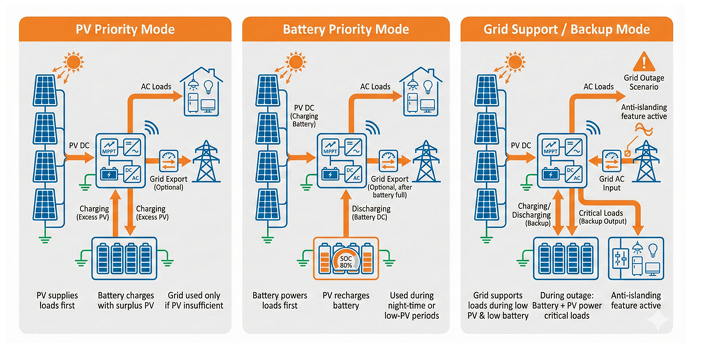
Modern solar power systems are no longer limited to simple generation and consumption. With the integration of smart inverters and energy storage, today’s systems dynamically decide where power should flow at any given moment—to loads, batteries, or the grid. The illustrated diagram explains three fundamental operating strategies used in hybrid and grid-interactive solar systems: PV Priority Mode, Battery Priority Mode, and Grid Support / Backup Mode. Understanding these modes is critical for system designers, facility managers, and end users seeking optimal performance, resilience, and cost savings.
Overview of Smart Solar Energy Flow
At the core of the system is a solar inverter with MPPT control, connected to a PV array, battery bank, loads, and the utility grid. The inverter continuously monitors solar availability, battery state of charge (SOC), load demand, and grid status. Based on predefined logic or user configuration, it selects one of the operating modes to manage energy efficiently while maintaining safety features such as anti-islanding protection.
Each mode serves a distinct operational objective—maximizing solar usage, preserving stored energy, or ensuring uninterrupted power during grid failures.
1. PV Priority Mode (Solar-First Operation)
PV Priority Mode is designed to maximize direct utilization of solar energy.
How It Works
- Solar PV supplies AC loads first through the inverter.
- If PV generation exceeds load demand, surplus energy is used to charge the battery bank.
- Once batteries reach the configured SOC limit, excess power may be exported to the grid (where net metering or export is permitted).
- If solar generation is insufficient, the grid supplements power to meet load demand.
Key Characteristics
- Batteries are charged only from excess PV.
- Grid power is used as a backup, not as a primary source.
- Battery discharge is generally avoided unless configured otherwise.
Benefits
- Maximum self-consumption of renewable energy
- Reduced electricity bills
- Lower dependence on the utility grid during daytime
Typical Applications
- Commercial buildings with high daytime loads
- Educational institutions and offices
- Facilities aiming to maximize solar ROI
PV Priority Mode is ideal where the goal is energy cost reduction through solar-first consumption.
2. Battery Priority Mode (Storage-First Operation)
Battery Priority Mode focuses on maintaining a high battery charge level to ensure energy availability when solar or grid power is unavailable or expensive.
How It Works
- Solar energy is first directed to charge the battery bank.
- After batteries reach the desired SOC, PV power supplies AC loads.
- Any remaining surplus may be exported to the grid.
- During low or zero solar conditions, batteries discharge first to power loads before drawing from the grid.
Key Characteristics
- Batteries play a central role in load supply.
- Grid import is minimized until battery SOC drops below a defined threshold.
- Enables energy shifting from daytime to night-time.
Benefits
- Reliable backup power availability
- Peak shaving and load shifting capability
- Reduced grid usage during high-tariff periods
Typical Applications
- Residential systems with frequent outages
- Sites with time-of-use electricity tariffs
- Critical facilities requiring energy resilience
Battery Priority Mode is especially valuable in regions with unstable grids or high peak tariffs.
3. Grid Support / Backup Mode
Grid Support / Backup Mode ensures uninterrupted power supply during grid failures while maintaining safety and regulatory compliance.
How It Works
- Under normal conditions, the grid remains connected and supports loads along with PV and batteries.
- During a grid outage, the inverter activates anti-islanding protection, isolating the system from the utility.
- Critical loads are powered using available PV generation and battery energy.
- Non-critical loads may be disconnected to conserve stored energy.
- Once grid power is restored, the inverter synchronizes and reconnects automatically.
Key Characteristics
- Seamless transition between grid-connected and off-grid operation
- Dedicated output for critical loads
- Strict compliance with electrical safety standards
Benefits
- Power continuity during outages
- Protection of utility personnel and equipment
- Enhanced system reliability
Typical Applications
- Hospitals and healthcare facilities
- Data centers and IT infrastructure
- Residential backup systems
Grid Support Mode is essential wherever power reliability and safety are non-negotiable.
Role of Batteries and Critical Loads
The battery bank acts as the system’s energy buffer, storing surplus solar power and releasing it when required. Critical loads—such as emergency lighting, communication equipment, and essential appliances—are often connected to a separate backup output. This ensures uninterrupted operation even during prolonged outages.
Proper battery sizing, SOC limits, and discharge depth settings are crucial to maintain battery health and long-term system performance.
Design and Compliance Considerations
- Anti-islanding protection is mandatory for grid-connected systems
- Export limits must comply with local utility regulations
- Clear separation of critical and non-critical loads is recommended
- Mode selection should align with user objectives and tariff structures
Conclusion
PV Priority, Battery Priority, and Grid Support modes collectively define how a modern solar power system responds to changing energy conditions. By intelligently switching between these modes, hybrid solar systems deliver maximum efficiency, resilience, and economic benefit. Selecting and configuring the right operating strategy ensures that solar energy is not only generated—but used in the most effective way possible.