
Introduction
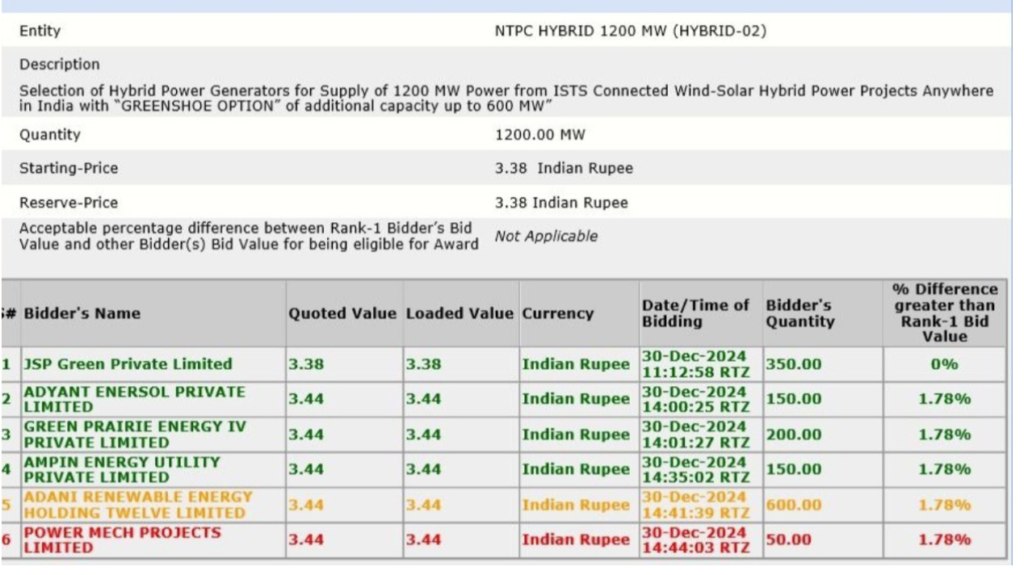
The NTPC tender for 1200 MW hybrid wind-solar projects with an additional greenshoe capacity of 600 MW represents a transformative step in India’s renewable energy transition. The lowest bid, ₹3.38/kWh, submitted by JSP Green Private Limited, underscores the cost competitiveness of hybrid energy systems.
This analysis evaluates the techno-commercial feasibility of the bids, focusing on cost structures, revenue potential, and profitability metrics.
Table 1: Overview of NTPC Hybrid Tender
| Parameter | Value |
|---|---|
| Total Tender Capacity | 1200 MW |
| Greenshoe Option Capacity | 600 MW |
| Lowest Quoted Tariff | ₹3.38/kWh |
| Number of Bidders | 6 |
| Bidder with Lowest Tariff | JSP Green Private Limited |
| % Difference Between Bids | 1.78% |
Bid Details
Table 2: Submitted Bids and Allocated Capacity
| Rank | Bidder’s Name | Quoted Tariff (₹/kWh) | Allocated Capacity (MW) | % Difference from Rank-1 Bid |
|---|---|---|---|---|
| 1 | JSP Green Private Limited | 3.38 | 350 | 0% |
| 2 | Adyant Enersol Private Limited | 3.44 | 150 | 1.78% |
| 3 | Green Prairie Energy IV Private Limited | 3.44 | 200 | 1.78% |
| 4 | Ampin Energy Utility Private Limited | 3.44 | 150 | 1.78% |
| 5 | Adani Renewable Energy Holding Twelve | 3.44 | 600 | 1.78% |
| 6 | Power Mech Projects Limited | 3.44 | 50 | 1.78% |
JSP Green Private Limited’s competitive tariff positions it as the frontrunner in this tender, highlighting efficient cost structures and favorable site conditions.
Assumptions
Capital Expenditure (CapEx)
Assumptions:
- Solar PV Cost: ₹3.0 crore/MW.
- Wind Installation Cost: ₹3.5 crore/MW.
- Hybrid Integration Cost: 20% of the total project cost.
CapEx Formula:CapEx=Solar CapEx+Wind CapEx+Hybrid Integration Cost\text{CapEx} = \text{Solar CapEx} + \text{Wind CapEx} + \text{Hybrid Integration Cost}CapEx=Solar CapEx+Wind CapEx+Hybrid Integration Cost
Table 3: CapEx Breakdown for 350 MW (175 MW Solar + 175 MW Wind)
| Component | Cost (₹ crore) | Calculation |
|---|---|---|
| Solar PV Installation | 525 | 175 MW×3.0 cr/MW175 \, \text{MW} \times 3.0 \, \text{cr/MW}175MW×3.0cr/MW |
| Wind Installation | 612.5 | 175 MW×3.5 cr/MW175 \, \text{MW} \times 3.5 \, \text{cr/MW}175MW×3.5cr/MW |
| Hybrid Integration | 227.5 | 20%×(525+612.5)20\% \times (525 + 612.5)20%×(525+612.5) |
| Total CapEx | 1,365 |
Operational & Maintenance (O&M) Costs
Assumptions:
- O&M cost is 1% of total CapEx per year.
Table 4: O&M Cost for 350 MW Project
| Component | Cost (₹ crore/year) | Calculation |
|---|---|---|
| O&M Costs | 13.65 | 1%×1,3651\% \times 1,3651%×1,365 |
Plant Load Factor (PLF)
Assumptions:
- Solar PLF: 22%.
- Wind PLF: 30%.
- Total operating hours: 8,760 hours/year.
Energy Output Formula:Energy Output (MWh)=Capacity (MW)×PLF×8,760\text{Energy Output (MWh)} = \text{Capacity (MW)} \times \text{PLF} \times 8,760Energy Output (MWh)=Capacity (MW)×PLF×8,760
Table 5: Annual Energy Output
| Source | Capacity (MW) | PLF | Annual Output (GWh) |
|---|---|---|---|
| Solar | 175 | 22% | 337 |
| Wind | 175 | 30% | 459 |
| Total | 350 | – | 796 |
Revenue Estimation
Assumptions:
- Energy tariff: ₹3.38/kWh.
Revenue Formula:Annual Revenue (₹ crore)=Energy Output (GWh)×Tariff (₹/kWh)\text{Annual Revenue (₹ crore)} = \text{Energy Output (GWh)} \times \text{Tariff (₹/kWh)}Annual Revenue (₹ crore)=Energy Output (GWh)×Tariff (₹/kWh)
Table 6: Annual Revenue
| Parameter | Value |
|---|---|
| Annual Energy Output | 796 GWh |
| Tariff | ₹3.38/kWh |
| Annual Revenue | ₹269.4 crore/year |
Economic Feasibility
Cost vs. Revenue Analysis
Table 7: Cost and Revenue Components
| Component | Value (₹ crore/year) | Remarks |
|---|---|---|
| Annual Fixed Costs | 136.5 | CapEx amortized over 20 years |
| O&M Costs | 13.65 | Operational expenses |
| Total Costs | 150.15 | |
| Annual Revenue | 269.4 | Based on ₹3.38/kWh |
| Net Profit | 119.25 | Revenue – Costs |
Payback Period
Payback Period Formula:Payback Period=Total CapExAnnual Net Profit\text{Payback Period} = \frac{\text{Total CapEx}}{\text{Annual Net Profit}}Payback Period=Annual Net ProfitTotal CapEx Payback Period=1,365119.25≈11.4 years\text{Payback Period} = \frac{1,365}{119.25} \approx 11.4 \, \text{years}Payback Period=119.251,365≈11.4years
Internal Rate of Return (IRR)
IRR Estimate:
The IRR is estimated between 12–14%, depending on operational efficiencies and market dynamics.
Sensitivity Analysis
Table 8: Impact of Key Variables on IRR
| Parameter | Base Case | Optimistic Scenario | Pessimistic Scenario |
|---|---|---|---|
| Energy Tariff (₹/kWh) | 3.38 | 3.60 | 3.20 |
| Solar PLF (%) | 22 | 24 | 20 |
| Wind PLF (%) | 30 | 32 | 28 |
| IRR (%) | 12–14% | 14–16% | 10–12% |
Strategic Implications
For Developers
- Aggressive tariffs like ₹3.38/kWh necessitate cost efficiency and high-performance technologies.
- Securing resource-rich sites and optimizing hybrid integration is critical.
For Policymakers
- Policies like Production Linked Incentives (PLI) and Viability Gap Funding (VGF) can improve financial feasibility.
- Strengthening grid infrastructure will support the seamless integration of hybrid systems.
For Investors
- Hybrid systems provide stable revenue streams and align with ESG mandates.
- Competitive returns depend on efficient O&M and favorable market conditions.
Conclusion
The NTPC Hybrid 1200 MW tender demonstrates the maturity and cost competitiveness of hybrid renewable energy projects in India. JSP Green Private Limited’s tariff of ₹3.38/kWh showcases the economic feasibility of hybrid systems, with an estimated payback period of 11.4 years and an IRR of 12–14%. Strategic cost management, favorable site conditions, and continued policy support will be critical to the success of such projects, enabling India to achieve its renewable energy targets.