The global transition toward clean and reliable energy is accelerating, and solar mini-grids are emerging as one of the most powerful solutions for electrifying communities. But how exactly does sunlight turn into usable electricity that powers homes, schools, and businesses day and night?
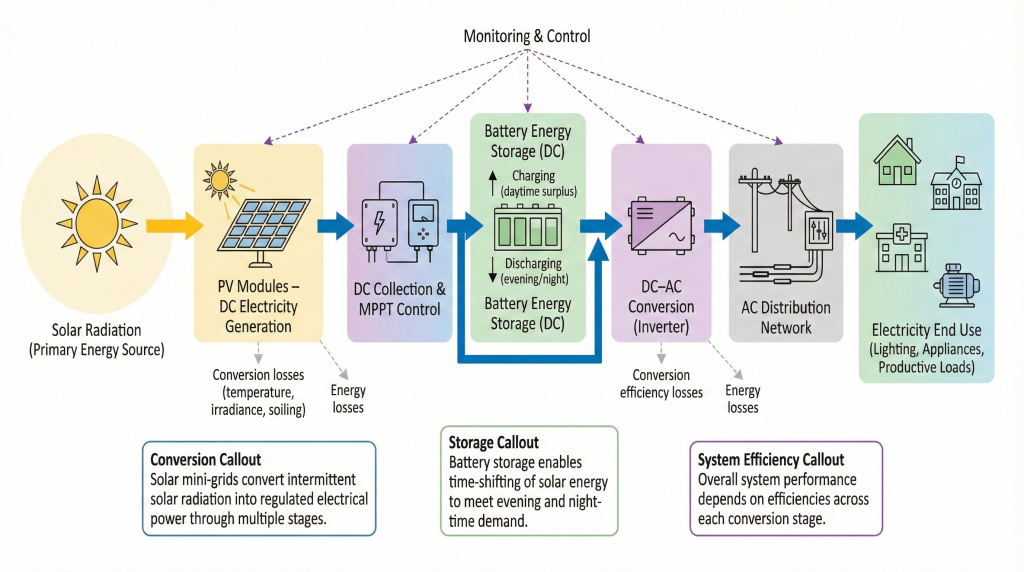
This guide explains the complete journey of energy in a solar mini-grid — from solar radiation to end-use electricity — and why each stage plays a critical role in delivering reliable, round-the-clock power.
The Journey Begins with Solar Radiation
Every solar mini-grid starts with the most abundant energy source available: the sun. Solar radiation is the primary fuel that powers the entire system. Unlike fossil fuels, sunlight is free, renewable, and available in most regions of the world.
When sunlight reaches solar panels, it contains energy in the form of photons. These photons trigger a reaction inside photovoltaic (PV) cells that generates electricity. This process produces direct current (DC) electricity, which becomes the foundation of the entire mini-grid system.
However, the energy captured at this stage is raw and variable. Factors such as temperature, dust, and sunlight intensity affect how much electricity is produced. That is why the next stage of the system is essential for optimizing energy capture.
PV Modules — Generating DC Electricity
Solar panels, also known as PV modules, convert sunlight into electricity. Multiple panels are connected together to create a solar array capable of generating enough power for an entire community.
At this stage, some energy losses naturally occur due to:
• Temperature variations
• Irradiance changes
• Dust or soiling on panels
Despite these losses, solar panels remain one of the most efficient and cost-effective renewable energy technologies available today.
But the electricity produced is still unregulated. To make it usable and efficient, the system must collect and manage this power carefully.
DC Collection & MPPT Control — Optimizing Solar Power
Once electricity is generated, it flows into the DC collection system and Maximum Power Point Tracking (MPPT) controller.
The MPPT controller plays a critical role by continuously adjusting the electrical operating point of the solar panels. Its job is simple but powerful: extract the maximum possible energy from the solar array at any moment.
Without MPPT control, solar panels would rarely operate at their peak efficiency.
This stage ensures the system captures as much energy as possible before sending it to storage.
Battery Energy Storage — Power After Sunset
One of the biggest challenges of solar power is intermittency. The sun does not shine at night, and clouds can reduce energy generation during the day. This is where battery storage becomes the heart of the mini-grid.
During the daytime:
• Solar panels generate excess energy
• Batteries charge using surplus electricity
During the evening and night:
• Batteries discharge stored energy
• Communities continue receiving uninterrupted power
This process is called time-shifting, and it is what allows solar mini-grids to provide reliable 24/7 electricity.
Battery storage transforms solar energy from a daytime resource into an around-the-clock power solution.
DC-AC Conversion — Making Electricity Usable
Most household appliances and equipment run on alternating current (AC) electricity. Since solar panels and batteries produce DC electricity, the system must convert it before distribution.
This conversion happens in the inverter, which transforms DC power into AC power suitable for homes and businesses.
While this step introduces small efficiency losses, modern inverters are highly advanced and operate with impressive efficiency levels.
This stage prepares electricity for safe and standardized distribution across the mini-grid.
AC Distribution Network — Delivering Community Power
Once converted to AC power, electricity enters the local distribution network. This network works similarly to the national grid but on a smaller scale.
Through local power lines and transformers, electricity is distributed to:
• Homes
• Schools
• Clinics
• Shops
• Agricultural equipment
• Small industries
This stage marks the transition from energy generation to real-world impact.
Electricity End Use — Powering Daily Life
At the end of the energy journey, electricity reaches the people and businesses that depend on it every day.
Solar mini-grids support:
• Lighting and household appliances
• Refrigeration for food and medicine
• Irrigation pumps and farming tools
• Healthcare facilities
• Education and digital connectivity
• Small businesses and workshops
Reliable electricity unlocks economic opportunities and improves quality of life across entire communities.
Monitoring & Control — The Smart Brain of the System
Overseeing the entire process is a monitoring and control system. This smart layer continuously tracks performance across all stages, ensuring:
• Efficient energy flow
• Battery health and charging cycles
• Fault detection and protection
• Optimized system performance
Smart monitoring enables operators to manage the mini-grid remotely, reducing downtime and maintenance costs.
Why System Efficiency Matters
Every stage of the solar mini-grid involves small efficiency losses. From panel conversion to inverter performance, overall system success depends on optimizing each step.
When designed correctly, solar mini-grids achieve high reliability and long-term sustainability.
They convert intermittent solar radiation into regulated, dependable electricity for communities that need it most.
Conclusion
Solar mini-grids are engineering ecosystems that combine generation, storage, conversion, and distribution into one smart system.
They transform sunlight into a reliable power supply capable of supporting modern life. As technology continues to improve, solar mini-grids will play a crucial role in delivering clean energy to millions of people worldwide.
The journey from sunlight to electricity is more than a technical process — it is a pathway to empowerment, growth, and sustainable development.
0 Comments