
Beyond Weather-Based Renewable Energy Forecasting
Accurate forecasting is essential for renewable energy plants. However, effective forecasting requires more than analysing weather conditions alone. Actual plant performance can also depend on physical characteristics, weather response, solar tracker behaviour, and measured operating data.
To address these factors, Firstgreen is developing a hybrid forecasting approach through TwinPro Forecasting & Scheduling. The approach combines plant physics, weather response, tracker behaviour, machine learning, and actual operating data to improve forecast accuracy and support operational decision-making.
The objective is to create a continuous process in which forecasts are compared with actual plant performance, deviations are analysed, and the model is calibrated for future forecasting cycles.
How TwinPro Forecasting & Scheduling Works
TwinPro follows a process that connects forecasting with operational learning and scheduling:
Weather Data → Forecast → Reconciliation → Learning → Schedule → Action
Each stage contributes to a more informed approach to renewable energy operations.
1. Weather Data and Plant Forecasting
Weather conditions provide an important input for estimating renewable energy generation. However, the forecasting process also needs to account for how the plant responds to those conditions.
TwinPro combines weather response with plant physics and tracker behaviour to develop a forecast that reflects more than weather data alone.
2. Incorporating Tracker Behaviour
Solar tracking systems adjust panel orientation to follow the sun and improve the capture of solar radiation.
Because tracker behaviour affects the radiation received by solar panels, modelling this response can help establish a more representative baseline for expected plant performance.
TwinPro incorporates tracker-response modelling as part of its hybrid forecasting approach.
3. Comparing Forecasts with Actual Plant Data
A forecast becomes more useful when it can be evaluated against measured operating data.
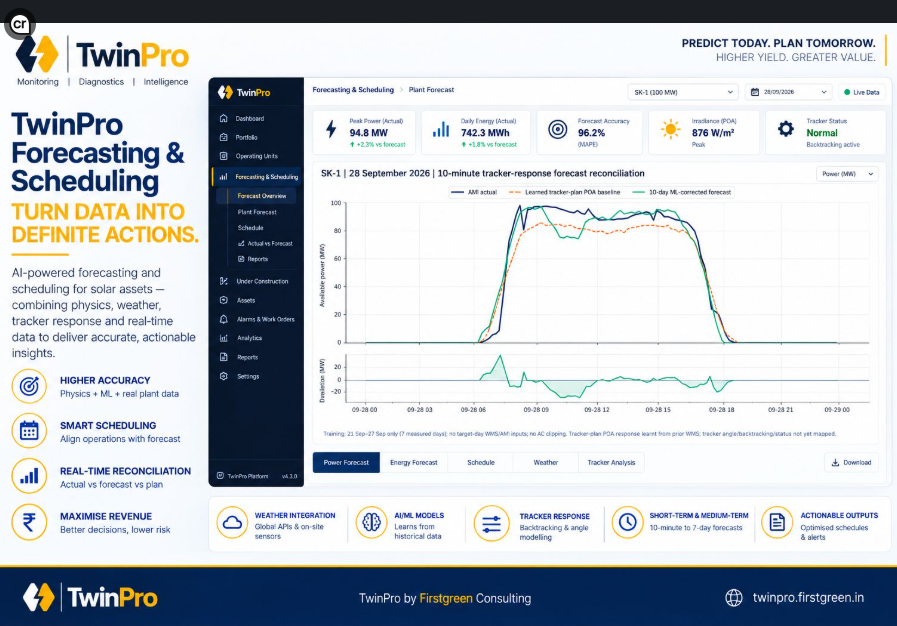
In the example shared by Firstgreen, the engine reconciles a 10-minute solar forecast against actual data from Advanced Metering Infrastructure (AMI).
The comparison includes two forecast components:
- Learned tracker-plane POA baseline: A baseline based on Plane of Array (POA) irradiance and learned tracker-response behaviour.
- ML-corrected forecast: A forecast adjusted using machine learning.
Comparing these components with actual plant performance helps identify where the forecast differs from measured output.
4. Analysing Deviations and Improving Forecasts
Differences between forecast and actual generation can reveal where the model is overpredicting or underpredicting plant output.
TwinPro’s deviation layer makes these differences easier to identify and analyse. The resulting insights can support continuous improvement in subsequent forecasting cycles.
Rather than treating forecasting as a one-time calculation, this approach creates a feedback loop between predictions and real operating conditions.
Key Capabilities of TwinPro
TwinPro Forecasting & Scheduling brings together several capabilities relevant to renewable energy plant operations.
Short-Term Forecasting
Provides short-term estimates of renewable energy generation to support operational planning and scheduling.
Tracker-Response Modelling
Accounts for tracker behaviour as part of the forecasting process for solar plants.
Actual-versus-Forecast Analysis
Compares predicted output with measured plant data to identify deviations and evaluate forecast performance.
Schedule Preparation
Uses forecasting outputs to support the preparation of generation schedules.
Continuous Calibration
Uses measured plant data to help improve the forecasting model over successive operating cycles.
Together, these capabilities connect generation forecasting with practical scheduling and operational decisions.
Why Better Forecasting Matters for Renewable Operators
Renewable energy operators must manage generation variability while meeting scheduling requirements and participating in the electricity grid.
A forecasting process that incorporates actual operating data can provide better visibility into expected generation and deviations from the forecast.
This can support three important operational objectives:
- Better visibility: Understand expected generation and identify differences between predicted and actual output.
- Better scheduling: Use updated generation estimates to support schedule preparation and planning.
- More confident grid participation: Make operational decisions using forecasts that are continuously evaluated against measured plant performance.
Forecasting alone cannot eliminate renewable generation variability, but a systematic approach to reconciliation and calibration can help operators make better-informed decisions.
From Forecasting to Operational Action
The value of renewable forecasting lies not only in predicting generation but also in connecting those predictions to operational processes.
By combining plant physics, weather response, tracker behaviour, machine learning, and actual operating data, TwinPro aims to establish a continuous cycle of forecasting, reconciliation, learning, scheduling, and action.
This approach moves renewable energy forecasting beyond a weather curve towards a more integrated operational process.
Conclusion: Predict Today, Plan Tomorrow, Operate Smarter
As renewable energy capacity grows, forecasting and scheduling will remain important parts of efficient plant operations and grid integration.
TwinPro Forecasting & Scheduling brings together short-term forecasting, tracker-response modelling, actual-versus-forecast analysis, schedule preparation, and continuous calibration using measured plant data.
Predict today. Plan tomorrow. Operate smarter.
See the original Firstgreen LinkedIn post.
Leave a Reply