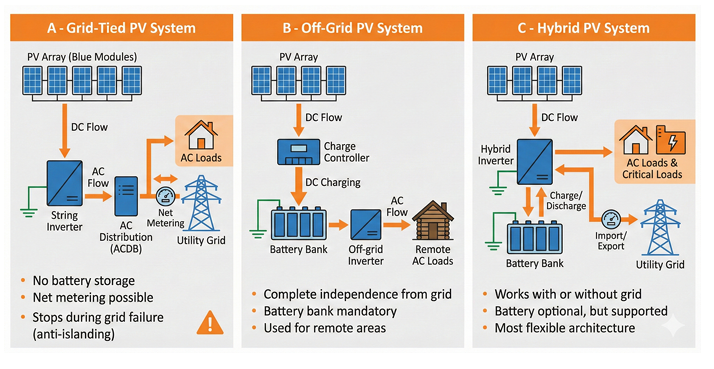
As solar adoption grows across residential, commercial, and industrial sectors, understanding the different types of solar photovoltaic (PV) systems becomes essential. The illustrated comparison highlights three primary system architectures: Grid-Tied PV Systems, Off-Grid PV Systems, and Hybrid PV Systems. Each configuration serves a distinct purpose, based on grid availability, reliability requirements, and energy independence goals.
This article provides a detailed explanation of how each system works, its components, advantages, limitations, and typical use cases—enabling informed decision-making for system selection and design.
Overview of Solar PV System Architectures
All solar PV systems begin with a PV array, which converts sunlight into DC electricity. The key differences between system types lie in how this DC power is converted, stored, and managed in relation to the utility grid and on-site loads.
The choice between grid-tied, off-grid, and hybrid systems depends on factors such as:
- Grid availability and reliability
- Requirement for energy storage
- Budget and lifecycle cost
- Need for backup power
- Regulatory framework and net metering policies
A. Grid-Tied PV System
System Description
A Grid-Tied PV System is directly connected to the utility grid and operates without battery storage. The DC power generated by the PV array is converted into AC power using a string inverter, which synchronizes its output with grid voltage and frequency.
The AC power first supplies on-site loads. Any excess energy is exported to the utility grid through a net metering arrangement, allowing the consumer to receive energy credits.
Key Components
- PV Array
- Grid-tied string inverter
- AC Distribution Board (ACDB)
- Net meter
- Utility grid connection
Operating Principle
- Solar power supplies loads in real time
- Surplus energy is exported to the grid
- When solar is insufficient, power is imported from the grid
- During grid failure, the inverter shuts down automatically due to anti-islanding protection
Advantages
- Lowest system cost among all PV types
- High efficiency with minimal energy losses
- Simple system design and maintenance
- Eligible for net metering benefits
Limitations
- No power supply during grid outages
- Complete dependence on grid availability
Typical Applications
- Urban residential buildings
- Commercial offices
- Industrial facilities with reliable grid supply
Grid-tied systems are ideal where the objective is reducing electricity bills rather than achieving energy independence.
B. Off-Grid PV System
System Description
An Off-Grid PV System operates completely independent of the utility grid. It relies on battery storage to supply power during non-solar hours. Energy generated by the PV array is regulated by a charge controller before charging the battery bank. An off-grid inverter then converts stored DC energy into AC power for loads.
Key Components
- PV Array
- Charge controller (MPPT or PWM)
- Battery bank
- Off-grid inverter
- AC distribution to loads
Operating Principle
- Solar energy charges batteries during the day
- Loads are powered directly from PV or batteries
- At night or during cloudy conditions, batteries supply power
- No interaction with the utility grid
Advantages
- Complete independence from the grid
- Reliable power in remote or inaccessible areas
- Full control over energy generation and consumption
Limitations
- Higher initial cost due to batteries
- Requires careful battery sizing and management
- Limited energy availability if batteries are depleted
Typical Applications
- Remote villages and rural homes
- Telecom towers
- Agricultural pumps
- Remote monitoring stations
Off-grid systems are best suited where grid power is unavailable or extremely unreliable.
C. Hybrid PV System
System Description
A Hybrid PV System combines the benefits of grid-tied and off-grid systems. It integrates a hybrid inverter, battery storage, and grid connectivity in a single architecture. The system can operate with or without the grid, making it the most versatile solution.
Key Components
- PV Array
- Hybrid inverter with MPPT
- Battery bank (optional but supported)
- AC distribution for loads and critical loads
- Utility grid connection
Operating Principle
- Solar power supplies loads first (configurable priority)
- Excess energy charges batteries or exports to the grid
- During grid outages, the system isolates and supplies critical loads
- When the grid is restored, the system reconnects automatically
Advantages
- Backup power during grid outages
- Flexible energy management (PV, battery, grid)
- Reduced electricity bills and improved reliability
- Supports future battery expansion
Limitations
- Higher cost than grid-tied systems
- More complex design and configuration
Typical Applications
- Residential homes with frequent power cuts
- Hospitals and clinics
- Commercial buildings with critical loads
- Smart homes and campuses
Hybrid systems offer the most flexible and future-ready architecture, balancing cost savings with resilience.
Comparative Summary
| Aspect | Grid-Tied | Off-Grid | Hybrid |
|---|---|---|---|
| Grid Connection | Required | Not required | Optional |
| Battery Storage | Not used | Mandatory | Optional |
| Backup Power | No | Yes | Yes |
| Net Metering | Yes | No | Yes (where allowed) |
| System Cost | Low | High | Medium–High |
| Flexibility | Low | Medium | High |
Conclusion
Grid-tied, off-grid, and hybrid solar PV systems each serve a specific purpose. Grid-tied systems maximize cost savings in areas with reliable grids. Off-grid systems deliver complete energy independence where the grid is absent. Hybrid systems provide the best of both worlds—solar savings with backup reliability.
Selecting the right system requires careful evaluation of site conditions, load profile, grid reliability, and long-term energy goals. With the right choice, solar PV becomes not just a power source, but a strategic energy solution.