
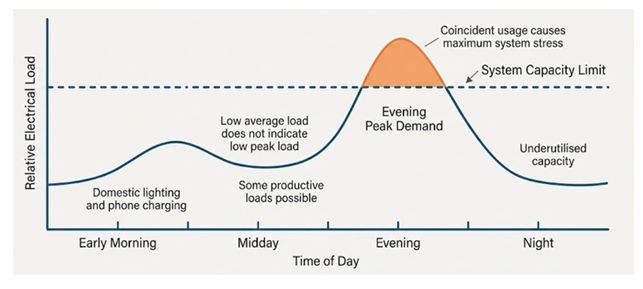
One of the most critical determinants of mini-grid performance is not total energy consumption, but load behavior over time. The image illustrates a typical daily load curve for a decentralized energy system—highlighting early morning usage, midday productive loads, and a pronounced evening peak demand that approaches or exceeds system capacity limits.
For renewable energy engineers, mini-grid developers, and infrastructure financiers, understanding load curves is essential for ensuring reliability, optimizing capital investment, and maintaining long-term system sustainability.
1. Relative Electrical Load vs Time of Day
The graph maps relative electrical load against time of day, revealing a common pattern observed in rural and peri-urban electrification projects:
- Early Morning: Low-level domestic usage (lighting, phone charging)
- Midday: Moderate demand, often including some productive activity
- Evening: Sharp surge in coincident usage
- Night: Rapid drop in demand and underutilized capacity
The most important insight is this: average load does not reflect peak system stress.
Mini-grid systems are sized not for average energy consumption, but for maximum coincident load.
2. Early Morning and Midday: Underutilized Potential
During early morning hours, electricity is typically used for:
- Basic lighting
- Phone charging
- Small appliances
Midday demand may increase if productive loads operate—such as milling, welding, or agro-processing. Importantly, midday load often aligns with peak solar generation, making it ideal for direct PV utilization without heavy battery cycling.
This creates an operational opportunity:
- Incentivize productive use during solar hours
- Reduce battery discharge stress
- Improve asset lifespan
- Increase revenue per kilowatt-hour generated
Systems that fail to stimulate daytime usage often suffer from poor capacity utilization and reduced financial performance.
3. Evening Peak Demand: The Critical Bottleneck
The graph shows a steep rise during evening hours—commonly between 6 PM and 10 PM.
This occurs because:
- All households switch on lighting simultaneously
- Fans, televisions, and entertainment devices operate
- Domestic loads overlap (coincident usage)
Even if each household has modest demand, simultaneous activation pushes the system toward its capacity limit.
This peak stress period determines:
- Inverter sizing
- Battery storage requirements
- Distribution conductor ratings
- Protection settings
If the peak exceeds system capacity:
- Voltage drops occur
- Inverters trip
- Batteries discharge deeply
- User dissatisfaction rises
Evening peaks are the single most common cause of mini-grid performance complaints.
4. Coincident Usage and System Stress
The image emphasizes “coincident usage causes maximum system stress.”
Coincident demand is fundamentally different from aggregate daily consumption.
For example:
- 100 households consuming 1 kWh each per day does not mean 100 kW peak load.
- If all households draw 500 W simultaneously, peak load becomes 50 kW.
This is why diversity factors and load coincidence analysis are critical during system design.
Failure to properly estimate coincidence factors leads to:
- Undersized inverters
- Frequent system overloads
- Accelerated battery degradation
- Financial underperformance
Peak load—not average energy—is the defining engineering parameter.
5. System Capacity Limit: A Hard Constraint
The dotted line in the graph represents the system capacity limit.
This limit is defined by:
- Inverter rating (kW)
- Battery discharge capability
- Transformer capacity
- Distribution infrastructure constraints
Exceeding this threshold triggers protective mechanisms.
Repeated overload events can cause:
- Thermal stress in power electronics
- Reduced inverter lifespan
- Increased maintenance cost
- Community dissatisfaction
Therefore, system design must incorporate sufficient headroom above projected peak demand.
6. Underutilised Capacity at Night
After peak hours, demand drops sharply. This results in underutilized infrastructure.
This phenomenon creates a paradox:
- Systems must be sized for short-duration peaks.
- Most of the day, that capacity remains partially idle.
From a financial perspective, this reduces asset utilization efficiency.
Strategic interventions to improve utilization include:
- Time-of-use tariffs
- Incentivized daytime productive loads
- Load shifting agreements
- Smart appliance control
Load management is often more cost-effective than system oversizing.
7. Engineering Solutions for Peak Management
To manage evening peaks effectively, developers employ:
1. Demand-Side Management (DSM)
- Educating users on staggered appliance use
- Smart load limiting
- Peak-hour load caps
2. Appliance Efficiency Programs
- Promoting LED lighting
- Encouraging energy-efficient fans and TVs
3. Productive Load Scheduling
- Encouraging businesses to operate during daylight hours
4. System Oversizing (with Economic Trade-Off)
- Larger inverters
- Increased battery capacity
- Higher upfront CAPEX
Oversizing increases capital cost but improves reliability margins.
8. Financial Implications of Load Curve Mismanagement
Load curve misalignment directly affects:
- Battery replacement frequency
- Revenue predictability
- Tariff affordability
- Investor confidence
Deep battery cycling during evening peaks accelerates degradation, raising lifecycle cost.
Conversely, well-managed load curves:
- Extend asset life
- Improve internal rate of return (IRR)
- Enhance customer satisfaction
- Enable sustainable tariff models
Mini-grids succeed financially when peak demand is controlled and daytime generation is monetized.
9. Designing for Growth
Load curves evolve over time. As communities gain income:
- Appliance ownership increases
- Coincident load intensifies
- Peak demand rises
Designers must incorporate future demand projections and modular expansion capability.
Static system sizing without growth forecasting leads to rapid saturation.
Conclusion
The daily load curve is the heartbeat of a mini-grid.
Average energy consumption tells only part of the story. The real engineering challenge lies in managing peak demand, coincident usage, and system capacity constraints.
Evening peaks define inverter sizing, battery performance, and customer experience.
Sustainable mini-grid design requires:
- Accurate coincidence modeling
- Demand-side management
- Productive load stimulation
- Modular scalability
Because in decentralized energy systems, reliability is not determined by total energy produced—but by how intelligently peak demand is managed.