
From Discovery to Deployment: The Evolution of Solar Photovoltaics
The global transition toward clean and sustainable energy did not begin overnight. Modern solar photovoltaic (PV) systems—now a cornerstone of decarbonization strategies—are the result of nearly two centuries of scientific curiosity, experimentation, and engineering progress. The journey from basic observations of light-induced electrical effects to practical solar cells illustrates how foundational science eventually transforms into world-changing technology.
This article traces three pivotal milestones in the evolution of photovoltaics: Henri Becquerel’s discovery of the photovoltaic effect in 1839, Willoughby Smith’s selenium experiments in 1873, and Charles Fritts’ development of the first solar cell in 1883. Together, these breakthroughs laid the groundwork for today’s solar energy revolution.
1839: Becquerel and the Birth of the Photovoltaic Effect
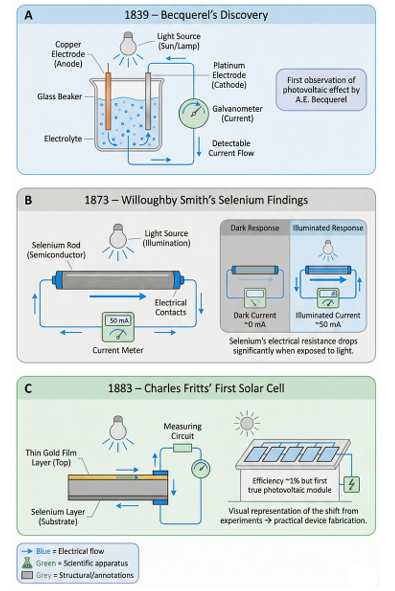
The story of solar power begins in 1839 with French physicist Alexandre Edmond Becquerel, who made the first recorded observation of what we now call the photovoltaic effect. While experimenting with an electrochemical cell, Becquerel discovered that illuminating metal electrodes immersed in an electrolyte produced a measurable electric current.
In his experimental setup, copper and platinum electrodes were placed in a glass beaker containing an electrolyte solution. When exposed to sunlight, the system generated an electrical response that could be detected using a galvanometer. Although the current produced was extremely small and far from practical use, the scientific significance was profound: light itself could induce electricity.
At the time, electricity generation was still poorly understood, and the implications of Becquerel’s finding would take decades to unfold. However, this experiment marked the first known link between light energy and electrical energy—an essential principle underlying all modern solar technologies.
1873: Willoughby Smith and the Role of Semiconductors
More than three decades later, progress came from an unexpected direction. In 1873, English electrical engineer Willoughby Smith was investigating selenium’s electrical properties for submarine telegraphy cables. During his tests, Smith observed that selenium’s electrical resistance changed dramatically when exposed to light.
Specifically, selenium exhibited high resistance in the dark but allowed significantly greater current flow under illumination. This phenomenon—later termed photoconductivity—was a crucial step forward. For the first time, a solid material was shown to respond predictably and repeatably to light by altering its electrical behavior.
Smith’s findings shifted scientific attention toward semiconductors, materials whose conductivity lies between that of conductors and insulators. Selenium became the first widely studied semiconductor, opening a new field of research that would eventually give rise to transistors, integrated circuits, and photovoltaic devices.
While Smith’s work was not intended to produce solar power, it provided the missing link between Becquerel’s electrochemical observations and the solid-state physics required for practical solar cells.
1883: Charles Fritts and the First Solar Cell
The transition from laboratory experiments to functional devices occurred in 1883, when American inventor Charles Fritts built the world’s first true solar cell. Fritts used a thin layer of selenium coated with an ultra-thin film of gold to create a solid-state device capable of converting light directly into electricity.
Unlike earlier experiments, Fritts’ design did not rely on liquid electrolytes. Instead, it demonstrated a fully solid photovoltaic structure—much closer in concept to modern solar panels. When exposed to sunlight, the device generated a continuous electrical current that could be measured and used.
However, the efficiency of Fritts’ solar cell was extremely low—estimated at less than 1%. At a time when coal and steam dominated energy systems, such inefficiency made solar power economically unviable. As a result, Fritts’ invention was viewed more as a scientific novelty than a practical energy solution.
Nevertheless, its importance cannot be overstated. Fritts proved that photovoltaic devices could be manufactured, replicated, and operated outside the laboratory. His work represented a clear shift from theoretical science to applied engineering—a defining moment in the history of renewable energy.
From Early Experiments to Modern Solar Power
The early photovoltaic devices developed in the 19th century were limited by material science, manufacturing capabilities, and a lack of commercial demand. It was not until the mid-20th century—particularly with the advent of silicon semiconductors—that solar technology began to achieve meaningful efficiencies.
In 1954, Bell Laboratories introduced the first practical silicon solar cell, achieving efficiencies above 6%. This breakthrough, combined with growing applications in space exploration, marked the beginning of modern photovoltaics. Over subsequent decades, advances in crystal growth, doping techniques, thin-film technologies, and power electronics dramatically reduced costs while increasing performance.
Today, commercial solar panels routinely exceed 20% efficiency, and utility-scale solar power is among the cheapest sources of electricity in many parts of the world. None of this progress would have been possible without the foundational discoveries of Becquerel, Smith, and Fritts.
Why This History Matters Today
Understanding the origins of photovoltaic technology is more than an academic exercise—it provides valuable perspective on today’s energy transition. The path from discovery to deployment was long, incremental, and uncertain. Early researchers could not foresee climate change, energy security challenges, or global sustainability goals, yet their curiosity-driven work enabled solutions to these modern challenges.
For organizations like Firstgreen, this history reinforces an essential truth: innovation in clean energy depends on sustained research, long-term thinking, and the willingness to invest in technologies before they are fully mature. Just as early solar pioneers worked with limited tools and knowledge, today’s renewable energy leaders must continue pushing boundaries in storage, grid integration, and next-generation materials.
Conclusion: A Legacy Powering the Future
From a simple electrochemical experiment in 1839 to the first functional solar cell in 1883, the early evolution of photovoltaics laid the intellectual and technical foundation for one of the most transformative energy technologies of our time. These breakthroughs remind us that every solar panel installed today carries the legacy of nearly 200 years of scientific progress.
As the world accelerates toward a low-carbon future, solar energy stands as a testament to how fundamental research can evolve into scalable, impactful solutions. At Firstgreen, embracing this legacy means continuing to support innovation that not only meets today’s energy needs but also builds a resilient and sustainable future for generations to come.