
The Rise of Solar Power: From Silicon Breakthroughs to Advanced Photovoltaic Technologies
The evolution of solar photovoltaic (PV) technology is a story of steady innovation, driven by scientific advancement, manufacturing scale, and global demand for clean energy. While the foundational principles of solar power were established in the 19th century, it was the second half of the 20th century that transformed photovoltaics from experimental devices into a commercially viable and rapidly expanding energy solution.
This article explores the major phases in the modern development of solar PV—from the birth of silicon solar cells in the 1950s to today’s era of advanced, high-efficiency photovoltaic technologies.
1954: The Birth of the Silicon Solar Cell
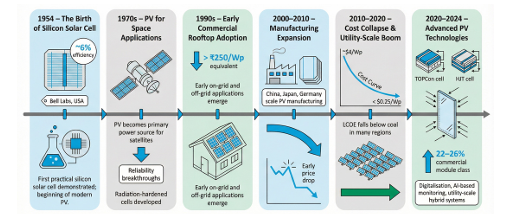
The modern solar industry began in 1954 at Bell Laboratories in the United States, where scientists developed the first practical silicon-based solar cell. Unlike earlier selenium cells, silicon devices achieved efficiencies of approximately 6%, making them capable of generating usable electrical power for real-world applications.
This breakthrough marked the start of modern photovoltaics. Silicon proved to be an ideal semiconductor due to its stability, abundance, and favorable electrical properties. The Bell Labs solar cell demonstrated that sunlight could be converted directly into electricity with sufficient efficiency to power small devices.
Although production costs were extremely high at the time, the invention laid the technological foundation that still underpins most of today’s solar panels.
1970s: Solar Power for Space Applications
During the 1970s, solar PV found its first large-scale and mission-critical application in space technology. Satellites and space missions required reliable, long-lasting power sources that could operate independently of fuel supplies. Solar panels became the preferred solution.
Photovoltaic systems were used to power communication satellites, space stations, and remote sensing equipment. These applications prioritized reliability, radiation resistance, and longevity over cost, allowing PV technology to mature in demanding environments.
The success of solar power in space validated its long-term performance and accelerated research into improving efficiency and durability—benefits that later translated into terrestrial applications.
1990s: Early Commercial and Rooftop Adoption
The 1990s marked a critical transition as solar PV moved beyond specialized uses into early commercial and rooftop installations. Declining module costs, combined with growing environmental awareness and supportive government policies, enabled solar power to enter niche markets.
During this period, photovoltaic systems were commonly used for:
- Off-grid rural electrification
- Telecom towers and signaling equipment
- Residential rooftops in remote or environmentally conscious communities
Typical system sizes ranged around a few kilowatts, with costs remaining relatively high—often exceeding USD 250 per watt. Despite this, the decade established the technical and economic models for grid-connected solar systems and net metering concepts.
2000–2010: Manufacturing Expansion and Cost Reduction
The first decade of the 21st century witnessed a major expansion in solar manufacturing capacity, particularly in Asia. Countries such as China, Japan, and Germany invested heavily in PV manufacturing, automation, and supply chains.
Key developments during this phase included:
- Large-scale silicon wafer and cell production
- Improved manufacturing yields
- Standardization of module sizes and components
- Significant reductions in module prices
As manufacturing volumes increased, solar PV experienced its first major cost decline, making it increasingly competitive with conventional power sources in select markets. This period set the stage for global solar deployment at scale.
2010–2020: Utility-Scale and Cost-Competitive Solar
Between 2010 and 2020, solar PV entered a phase of rapid global deployment. Module costs fell dramatically—dropping below USD 0.25 per watt in many markets—while system efficiencies and reliability continued to improve.
This decade saw:
- The rise of utility-scale solar power plants
- Large grid-connected installations across Asia, Europe, and North America
- Strong policy support through feed-in tariffs, auctions, and renewable energy targets
Crystalline silicon modules became the industry standard, with efficiencies reaching 18–22% for commercial products. Solar power transitioned from an alternative energy source to a mainstream contributor to national electricity grids.
2020–2024: Advanced Photovoltaic Technologies
The most recent phase of solar evolution is defined by advanced PV technologies focused on higher efficiency, better performance in real-world conditions, and improved integration with digital systems.
Key innovations include:
- TOPCon (Tunnel Oxide Passivated Contact) cells
- Heterojunction (HJT) technology
- Bifacial solar modules that generate power from both sides
- Commercial module efficiencies exceeding 22–24%
In parallel, digitalization has transformed solar operations. Smart inverters, AI-based performance monitoring, and hybrid systems combining solar with battery storage are now standard features of modern PV plants.
These advancements are enabling higher energy yields, reduced land use, and improved grid stability—critical factors for achieving large-scale decarbonization.
The Bigger Picture: Why Solar’s Evolution Matters
The steady progression of photovoltaic technology demonstrates how sustained innovation can reshape the global energy landscape. What began as an expensive, niche technology has become one of the most affordable and scalable sources of electricity worldwide.
For organizations like Firstgreen, this evolution highlights the importance of:
- Long-term investment in clean technologies
- Continuous improvement in efficiency and reliability
- Integration of renewable energy with digital and storage solutions
Solar PV is no longer just about power generation—it is a key enabler of energy security, climate resilience, and sustainable economic growth.
Conclusion: Powering the Future with Proven Innovation
From the first silicon solar cell in 1954 to today’s high-efficiency, digitally integrated PV systems, solar energy has undergone a remarkable transformation. Each decade has contributed critical advancements, enabling solar power to become a cornerstone of the global clean energy transition.
As technology continues to evolve, solar PV will play an even greater role in shaping a low-carbon future. At Firstgreen, embracing this journey means supporting solutions that combine proven engineering with forward-looking innovation—ensuring that solar energy continues to power progress for decades to come.