
Early Applications of Solar Power: How Photovoltaics Proved Their Value Before the Mainstream
Before solar photovoltaics became a familiar sight on rooftops and utility-scale power plants, the technology quietly proved its reliability in some of the world’s most challenging and remote environments. Long before large grids, incentives, and falling costs drove widespread adoption, solar power was already solving real problems where conventional electricity could not reach.
From telecommunications infrastructure to rural electrification and early rooftop experiments, the period between the 1960s and 1990s played a crucial role in validating photovoltaic (PV) technology. These early applications demonstrated that solar energy was not just scientifically sound—but practically dependable.
1960s–1980s: Powering Telecommunications and Remote Electronics
One of the earliest and most important applications of solar PV emerged in the telecommunications sector. During the 1960s through the 1980s, communication towers, repeaters, navigation beacons, and remote monitoring stations were often located far from centralized power grids.
Solar PV offered a compelling solution.
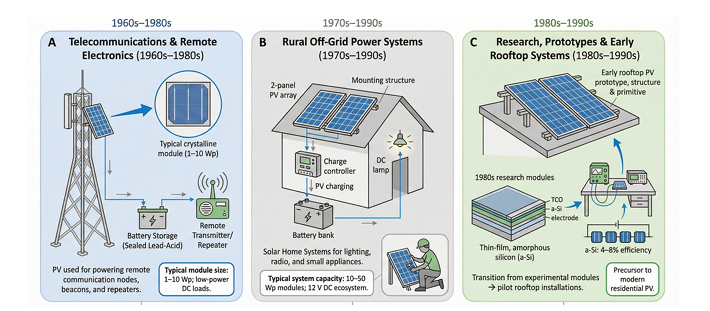
Small crystalline silicon modules—typically ranging from 1 to 10 watts—were deployed to power:
- Remote radio transmitters and receivers
- Telecommunication repeaters
- Navigation and aviation beacons
- Weather and monitoring stations
These systems were usually paired with sealed lead-acid batteries, enabling continuous operation during nighttime and cloudy conditions. Although the power output was modest, reliability was the primary requirement—and solar PV delivered it consistently.
For telecom operators and government agencies, the alternative was costly diesel generators or frequent battery replacement. Solar power reduced maintenance needs, operating costs, and logistical complexity, proving its value in mission-critical applications.
1970s–1990s: Rural Off-Grid Power Systems
As solar module technology matured, its use expanded beyond industrial infrastructure into rural and off-grid electrification, particularly during the 1970s to 1990s. Millions of households around the world lived far from electrical grids, making conventional electrification economically unfeasible.
Small off-grid PV systems began to fill this gap.
Typical rural solar systems consisted of:
- A 2-panel PV array mounted on a simple structure
- A charge controller to regulate battery charging
- A battery bank for energy storage
- A 12 V DC electrical system
System capacities commonly ranged from 10 to 50 watts, sufficient to power:
- DC lighting
- Radios and small communication devices
- Basic appliances and charging needs
These systems transformed daily life in off-grid communities. Even limited access to lighting and communication significantly improved education outcomes, safety, and economic productivity.
Importantly, these deployments proved that solar PV could operate reliably in diverse climatic conditions—from deserts to tropical regions—further strengthening confidence in the technology.
1980s–1990s: Research, Prototypes, and Early Rooftop Systems
While off-grid applications demonstrated solar’s practicality, the 1980s and 1990s marked the beginning of solar PV’s transition toward the built environment. Universities, research institutions, and early adopters began experimenting with rooftop-mounted solar systems.
These early rooftop installations were largely experimental, characterized by:
- Prototype PV modules
- Basic mounting structures
- Primitive power electronics and inverters
- Limited grid integration
Thin-film technologies, such as amorphous silicon (a-Si), were also explored during this period. Although these modules offered lower efficiency compared to crystalline silicon, they were cheaper to produce and useful for research and niche applications.
Despite technical limitations, these projects were critical learning platforms. They allowed engineers and researchers to study:
- Long-term module performance
- Roof integration challenges
- Electrical safety and interconnection issues
- User interaction with solar systems
These lessons directly informed the design standards, mounting systems, and electrical codes used in modern residential solar installations.
Why These Early Applications Were So Important
The early adoption of solar PV in telecommunications, rural electrification, and research settings served a purpose far greater than the scale of power they generated. These applications provided real-world validation at a time when solar energy was still expensive and misunderstood.
Key contributions of this era include:
- Proof of long-term reliability
- Demonstration of low-maintenance operation
- Development of battery-based energy systems
- Early understanding of system integration
Crucially, these deployments built trust among engineers, policymakers, and investors—laying the groundwork for later commercial expansion.
From Niche Use to Global Energy Solution
By the late 1990s, solar PV had already accumulated decades of operational experience. Although costs remained high, the technology was no longer experimental. It was a proven solution with a track record of success in harsh, remote, and resource-constrained environments.
This foundation enabled the rapid growth that followed in the 2000s and beyond:
- Improved manufacturing processes
- Grid-connected rooftop systems
- Utility-scale solar power plants
- Dramatic reductions in cost per watt
The early applications shown in this image represent the quiet but essential phase of solar’s evolution—where reliability mattered more than scale, and performance mattered more than profitability.
Relevance for Today’s Energy Transition
As the world accelerates toward renewable energy adoption, these early solar systems offer valuable lessons. They remind us that innovation often begins with small, focused solutions that address specific needs before scaling globally.
For organizations like Firstgreen, this history reinforces the importance of:
- Designing systems for reliability and durability
- Matching technology to local needs and conditions
- Supporting innovation across both centralized and decentralized energy models
Even today, off-grid and hybrid solar systems continue to play a vital role in rural electrification, disaster resilience, and critical infrastructure.
Conclusion: The Foundations of Solar Success
Long before solar power became mainstream, it quietly earned its reputation in remote towers, rural homes, and research rooftops. These early applications between the 1960s and 1990s demonstrated that photovoltaic technology was dependable, adaptable, and capable of improving lives—even at small scales.
They formed the practical foundation upon which today’s global solar industry is built. As solar energy continues to expand its role in the clean energy transition, acknowledging these early successes helps us appreciate how far the technology has come—and how much potential still lies ahead.
At Firstgreen, this legacy inspires a continued commitment to practical, resilient, and future-ready solar solutions that serve both people and the planet.