
Optimizing Row Spacing and Orientation in Rooftop Solar PV Design
Proper module orientation and row spacing are fundamental to the performance, safety, and maintainability of rooftop solar PV systems. Beyond maximizing energy yield, an optimized layout reduces wind loads, improves airflow, and ensures long-term operational access.
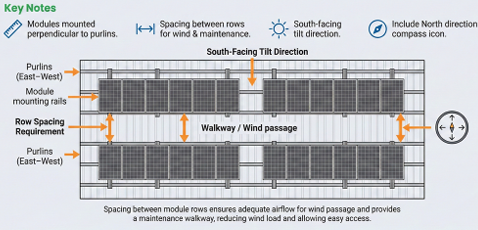
This article explains the key design principles illustrated in the rooftop PV row-spacing and walkway layout.
1. South-Facing Orientation for Maximum Energy Yield
For installations in the northern hemisphere, south-facing module orientation ensures optimal solar exposure throughout the day. Correct azimuth alignment:
- Maximizes annual energy generation
- Improves system performance consistency
- Reduces mismatch losses across PV strings
Compass-based alignment during layout planning is essential for accuracy.
2. East–West Purlin and Mounting Rail Configuration
Modules are mounted perpendicular to east–west purlins using standardized mounting rails. This configuration:
- Ensures uniform load transfer to the roof structure
- Improves resistance to wind uplift forces
- Provides mechanical stability across long module rows
Structural coordination with civil drawings is critical at this stage.
3. Row Spacing for Wind Passage and Maintenance
Adequate spacing between PV rows serves multiple functions:
- Allows wind to pass through, reducing uplift pressure
- Prevents heat buildup beneath modules
- Enables safe access for inspection and cleaning
The defined row spacing requirement balances rooftop capacity with safety and durability.
4. Walkways as Dual-Purpose Design Elements
The central walkway / wind passage is a critical feature of good PV design. It:
- Acts as a maintenance access corridor
- Functions as a wind relief path
- Reduces concentrated wind loads on module surfaces
Such walkways are often required under fire and safety codes for commercial rooftops.
5. Improved Structural and Operational Performance
By maintaining uniform spacing between modules and rows:
- Roof loading is distributed more evenly
- Long-term structural fatigue is minimized
- Maintenance activities can be conducted without disturbing the array
This approach significantly enhances system reliability over its lifecycle.
Conclusion
Effective rooftop PV design is a balance between energy optimization, structural safety, and accessibility. Proper south-facing orientation, controlled row spacing, and integrated walkways ensure that the system performs efficiently while meeting safety and compliance requirements—particularly important for large commercial and LEED-certified projects.