Stage 1: The Engine Room – DC Generation (PV Array)
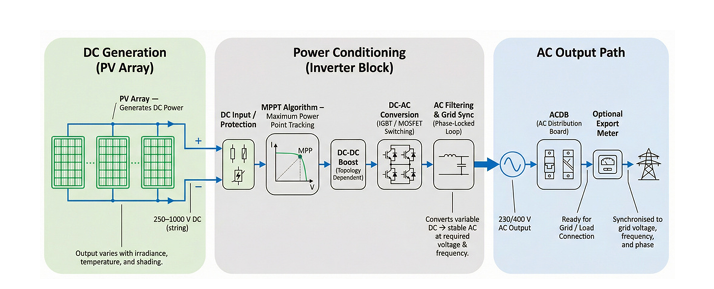
The journey begins in the “Green Zone” of our diagram: the DC Generation stage. This is the physical hardware sitting on your roof or in a field.
The PV Array and String Voltage
Solar panels (photovoltaic modules) are the heart of the system. However, a single panel rarely generates enough voltage to push electricity efficiently through the system. To solve this, panels are wired together in series, forming what is known as a String.
As shown in the diagram, this creates a high-voltage DC (Direct Current) output, typically ranging between 250V and 1000V DC. This high voltage is necessary to minimize transmission losses as the power travels from the roof down to the inverter.
The Variable Nature of Solar
The diagram notes a critical reality of solar energy: Output varies with irradiance, temperature, and shading.
- Irradiance: The intensity of the sunlight. A passing cloud drops current ($I$) instantly.
- Temperature: Surprisingly, solar panels hate heat. As temperature rises, voltage ($V$) actually drops, reducing overall power.
- Shading: If even one panel in a string is shaded by a chimney or tree, it acts like a kink in a hose, restricting the flow of the entire string.
Because the “raw” electricity coming from the array is wild and fluctuating, it cannot be fed directly into your home. It needs to be tamed.
Stage 2: The Brain – Power Conditioning (Inverter Block)
The “Grey Zone” in the diagram represents the Inverter Block. While often just a grey box on the wall, this is a sophisticated computer handling power electronics. Its job is Power Conditioning: taking the raw, variable DC and turning it into stable, usable AC.
1. DC Input and Protection
Before the power reaches the sensitive electronics, it passes through DC Input/Protection.
- Fuses: These protect the wires from melting if there is a short circuit.
- Surge Protection Devices (SPD): These protect the inverter from lightning strikes or voltage spikes coming from the array.
2. The MPPT Algorithm (Maximum Power Point Tracking)
This is the “smartest” part of the inverter.
The diagram illustrates an I-V curve (Current vs. Voltage). Solar panels have a specific “sweet spot”—a precise combination of voltage and current where they produce the maximum possible wattage. This is called the Maximum Power Point (MPP).
Because the sun moves and clouds pass by, this sweet spot is constantly moving. The MPPT Algorithm constantly adjusts the electrical load (every split second) to hunt for that peak, ensuring you harvest every possible watt of energy, regardless of the weather conditions.
3. DC-DC Boost
Sometimes, the voltage coming from the roof isn’t high enough to be converted into the 230V or 400V required by the grid. The DC-DC Boost converter steps up the voltage internally. It acts like a pump, increasing the pressure (voltage) so the next stage can operate efficiently.
4. DC-AC Conversion (The Switching)
This is the core function of the inverter. We need to turn Direct Current (flowing in one direction) into Alternating Current (flowing back and forth).
The diagram points to IGBT / MOSFET Switching. These are high-speed transistors that switch on and off thousands of times per second. They chop the DC signal into a rough approximation of a sine wave.
5. AC Filtering and Grid Sync
The “chopped” signal from the switches is jagged and “dirty.” It passes through an LC Filter (Inductor-Capacitor circuit) which smooths out the jagged edges, resulting in a clean, pure sine wave.
Simultaneously, the Phase-Locked Loop (PLL) is at work. The inverter cannot just push power out blindly; it must match the utility grid perfectly. The PLL monitors the grid’s heartbeat (frequency and phase) and synchronizes the solar output to match it exactly.
Stage 3: The Delivery – AC Output Path
Finally, we reach the “Blue Zone.” The electricity is now stable AC, typically at 230V (single-phase) or 400V (three-phase), and is ready for consumption.
The AC Distribution Board (ACDB)
The power leaves the inverter and enters the ACDB. This is your final safety checkpoint. It typically contains:
- MCB (Miniature Circuit Breaker): To prevent overcurrent.
- Isolators: To physically disconnect the system for maintenance.
The Import/Export Meter
The diagram shows an Optional Export Meter. In a grid-tied system, this is where the financial magic happens.
- Self-Consumption: First, the solar energy flows to your home’s loads (lights, fridge, TV).
- Export: If you are generating more than you are using, the excess flows through this meter out to the grid.
- Import: At night, when the solar system is off, electricity flows in from the grid.
Grid Synchronization
The final arrow points to the transmission tower. Because the inverter used its PLL to synchronize voltage, frequency, and phase, the electricity generated on your roof mixes seamlessly with the electricity generated by massive power plants miles away.
Why Understanding This Flow Matters
Understanding this diagram moves you from a passive user to an informed owner. It highlights why shading matters (DC Generation), why high-quality inverters are worth the cost (MPPT and Filtering), and how safety is integrated at every step (Protection blocks).
This system is a marvel of modern engineering—a silent, static generator that relies on high-speed computing to power our lives.
Summary of the Energy Flow
| Stage | Input | Action | Output |
| 1. DC Generation | Sunlight (Photons) | Conversion via Silicon Cells | Variable High-Voltage DC |
| 2. Power Conditioning | Variable DC | MPPT, Boosting, Switching, & Filtering | Stable, Synchronized AC |
| 3. AC Output | Stable AC | Distribution & Metering | Grid/Load Connection |