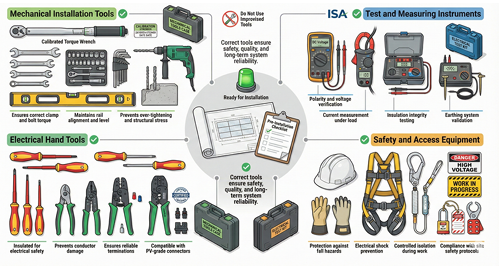
Successful solar photovoltaic (PV) installations depend not only on system design and component quality, but also on the tools, instruments, and safety equipment used on site. The image highlights a comprehensive toolkit required for professional solar work, covering mechanical installation tools, electrical hand tools, test and measuring instruments, and safety and access equipment. Together, these tools ensure accuracy, compliance, safety, and long-term system reliability.
Mechanical Installation Tools
Mechanical tools form the structural foundation of a solar PV system. Calibrated torque wrenches are critical to ensure that bolts, clamps, and fasteners are tightened to manufacturer-recommended torque values. Under-tightening can lead to loose modules and vibration, while over-tightening can damage frames, rails, or roof structures.
Spanners, socket sets, and power drills support efficient assembly of mounting structures and rail systems. Proper drill bits and drivers reduce the risk of stripped threads and misaligned fixings. Maintaining these tools in good condition ensures consistent performance and prevents rework caused by poor fastening quality.
Accurate mechanical installation directly impacts system durability, resistance to wind loads, and long-term structural integrity.
Electrical Hand Tools
Electrical hand tools are essential for safe and reliable wiring. Insulated screwdrivers protect technicians from accidental contact with live conductors. Cable cutters, wire strippers, and crimping tools ensure clean and secure terminations for DC and AC circuits.
Using connector-specific crimping tools is especially important for MC4 and similar PV connectors. Improper crimping can result in high contact resistance, overheating, and potential fire risks. High-quality electrical tools also improve productivity and reduce the likelihood of electrical faults during operation.
Proper tool selection supports compliance with electrical standards and improves overall system safety.
Test and Measuring Instruments
Testing and measurement are central to quality assurance and commissioning. The image highlights industry-standard test instruments used to verify system integrity before energization.
Multimeters are used for voltage, polarity, and continuity checks. Clamp meters measure current flow without disconnecting cables, supporting safe diagnostics. Insulation resistance testers confirm cable insulation health and identify hidden faults that could lead to leakage currents or failures.
Earth resistance testers verify the effectiveness of grounding systems, ensuring protection against electrical faults and lightning. Accurate testing confirms that the installation meets design intent, regulatory requirements, and manufacturer guidelines.
Without proper testing instruments, systems may be energized with undetected defects, increasing operational risk and maintenance costs.
Safety and Access Equipment
Safety equipment is non-negotiable in solar PV installations. Technicians often work at height and handle live electrical systems. Helmets, gloves, and protective footwear provide basic personal protection. Harnesses, lifelines, and anchorage systems are essential for fall protection on rooftops and elevated structures.
Electrical safety equipment such as insulated gloves and lockout–tagout devices prevent accidental energization during installation and maintenance. Warning signage and controlled access barriers improve site safety and protect other workers and building occupants.
A strong safety culture supported by proper equipment reduces accidents, protects workers, and ensures compliance with occupational health and safety regulations.
Calibration and Tool Management
Beyond having the right tools, proper calibration and management are equally important. Torque wrenches and test instruments must be periodically calibrated to ensure accuracy. Poor calibration can lead to incorrect torque application or inaccurate test results, undermining installation quality.
Organized storage and tool control systems help prevent loss, damage, and misuse. Clean, well-maintained tools improve efficiency and reflect professional work practices.
Impact on Quality and Performance
The tools used on site directly influence installation quality, system reliability, and long-term performance. Correct torque prevents mechanical failures, proper electrical tools ensure low-resistance connections, and accurate testing prevents latent defects.
Investing in professional-grade tools and safety equipment reduces rework, improves compliance, and protects both people and assets. Over the life of a solar PV system, this translates into fewer failures, lower maintenance costs, and better energy yield.
Conclusion
A solar PV system is only as good as the workmanship behind it—and workmanship is enabled by the right tools. Mechanical tools, electrical hand tools, test instruments, and safety equipment together form the backbone of professional solar installation practice. By equipping teams properly and maintaining high standards of tool usage, project owners and EPCs can ensure safe, compliant, and high-performing solar PV systems that deliver reliable energy for decades