As solar photovoltaic (PV) projects scale across commercial and industrial rooftops, the difference between a successful, long-lasting installation and one plagued by defects often comes down to process discipline. From how modules are stored on day one to how final technical approvals are granted before installation, every step plays a role in system performance, safety, and compliance.
This article outlines a practical, field-tested framework covering four critical areas: material storage and protection, tools and testing readiness, rooftop safety management, and the technical review and approval workflow. Together, these elements form the backbone of high-quality solar project execution.
1. Proper Material Storage and Protection
Improper storage is a leading cause of hidden defects in solar projects. Microcracks in modules, corrosion of mounting structures, moisture ingress in cables, and damage to inverters can all originate long before installation begins.
PV Module Storage
Solar modules must be stored vertically on stable racks or pallets and protected from direct sunlight, rain, and mechanical impact. Vertical storage minimizes stress on the glass and frame, reducing the risk of microcracks that may not be visible during installation but can significantly degrade long-term energy yield. Protective covers and controlled handling procedures further reduce breakage and edge damage.
Mounting Structure Storage
Mounting structures—whether aluminum or galvanized steel—should be elevated off the ground and segregated by size and type. Keeping materials off bare soil or wet surfaces prevents corrosion and contamination. Clear labeling and stacking discipline also improve installation efficiency and reduce handling damage.
Cable and Connector Storage
Cables, MC4 connectors, and junction components must be stored in sealed, labeled containers. Dust, moisture, and UV exposure can compromise insulation integrity and connector performance. Proper segregation by cable size and voltage rating reduces the risk of installation errors and rework.
Inverter and Electrical Equipment Storage
Inverters, combiner boxes, and protection devices should be stored indoors in a dry, temperature-controlled environment. Dust and humidity are major contributors to premature electronics failure. Manufacturers’ stacking limits must be respected to avoid mechanical stress and hidden damage.
Tools and Test Equipment Storage
Tools and test instruments should be stored in dedicated cabinets, protected from impact and environmental exposure. Calibration status should be clearly labeled, and damaged or expired instruments must be removed from service immediately.
2. Installation Tools, Testing Instruments, and PPE
Quality installation depends on having the right tools, properly maintained and calibrated, along with appropriate personal protective equipment (PPE).
Mechanical Installation Tools
Calibrated torque wrenches, drill machines, spanners, and alignment tools are essential for ensuring correct tightening of module clamps and structural fasteners. Incorrect torque can lead to loose connections, wind-related failures, or structural deformation. Regular calibration ensures torque values meet manufacturer specifications.
Electrical Hand Tools
Insulated screwdrivers, cable strippers, crimping tools, and cutting tools are critical for safe and reliable electrical terminations. Proper crimping is particularly important for DC connectors, as poor terminations can lead to overheating, arcing, and fire risk.
Test and Measuring Instruments
Key instruments include:
- Multimeters for voltage, current, and continuity checks
- Insulation resistance testers (meggers) for verifying cable insulation integrity
- Earth resistance testers for grounding and bonding verification
These instruments support commissioning, troubleshooting, and compliance verification, ensuring that the system meets electrical safety and performance standards.
Safety and Access Equipment
PPE such as helmets, insulated gloves, safety shoes, and eye protection are baseline requirements. For rooftop work, full-body harnesses, shock-absorbing lanyards, and certified anchor systems are mandatory. Lockout/tagout devices and warning signage further reduce the risk of electrical and operational hazards.
3. Rooftop Fall Protection and Safe Working Zones
Working at height is one of the highest-risk activities in solar installation. A structured fall protection strategy is essential for protecting workers and ensuring regulatory compliance.
Designated Safe Working Zones
Clearly marked safe zones help organize materials and tools away from roof edges and high-risk areas. Only permitted work and authorized tools should be allowed in these zones to reduce clutter and trip hazards.
Restricted Roof-Edge Zones
Roof edges are inherently high-risk. Access to these areas should be controlled, and work should only proceed with active fall protection measures in place.
Horizontal Lifeline Systems
Horizontal lifelines allow continuous fall protection while enabling installers to move freely along the roof. These systems maintain clearance from edges while supporting productivity.
Certified Anchor Points
Anchor points must be tested, certified, and rated for fall arrest loads. Temporary or uncertified anchors are a major safety violation and a leading cause of serious accidents.
Full-Body Harness and Shock-Absorbing Lanyards
Harness systems distribute fall forces across the body and reduce injury risk. Shock absorbers limit impact forces in the event of a fall, improving survival and reducing trauma.
Permit-to-Work and Safety Signage
Permit-to-work systems ensure that hazards are assessed, responsibilities are defined, and work is authorized before rooftop activities begin. Safety signage communicates risks and reinforces compliance.
4. Technical Review and Final Approval Workflow
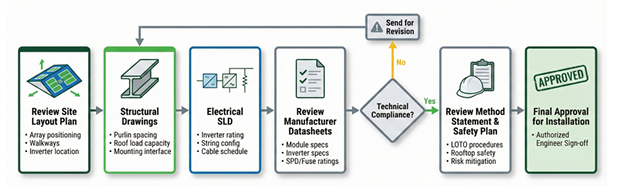
A disciplined technical review process ensures that installation begins only after all engineering, safety, and compliance requirements are met.
Site Layout Review
The process starts with reviewing the array layout plan, including module placement, walkways, setbacks, and inverter locations. This ensures optimal energy yield while maintaining access and safety clearances.
Structural Review
Structural drawings are reviewed to confirm roof load capacity, mounting interfaces, and wind and seismic considerations. This step protects both the building and the PV system.
Electrical SLD Review
Single-line diagrams (SLDs) are verified for string configuration, inverter sizing, protection devices, and cable schedules. This ensures electrical safety, code compliance, and operational reliability.
Manufacturer Datasheet Review
Module, inverter, and balance-of-system datasheets are reviewed to confirm specifications, ratings, and compatibility. This step ensures that installed equipment meets design assumptions.
Technical Compliance Check
A formal compliance gate determines whether the design meets all technical and regulatory requirements. If gaps are identified, the package is sent for revision before proceeding.
Method Statement and Safety Plan Review
Installation methods, access plans, and risk mitigation strategies are reviewed to ensure that work will be executed safely and efficiently.
Final Approval for Installation
Only after all previous steps are approved does the authorized engineer provide final sign-off, allowing installation to begin.
Conclusion
High-quality solar PV installations are not the result of good intentions—they are the outcome of disciplined processes. Proper material storage prevents hidden defects. The right tools and test equipment ensure installation accuracy. Robust rooftop safety systems protect workers and organizations. And a structured technical review workflow ensures that every project starts on a solid engineering foundation.
By standardizing these practices, project owners, EPC contractors, and O&M teams can reduce rework, improve safety performance, extend system life, and protect long-term energy yield. In an industry where margins are tight and reputations matter, process excellence is not optional—it is a competitive advantage