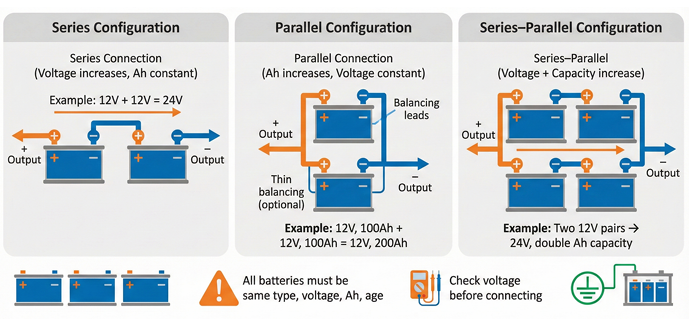
Designing a reliable solar PV system depends heavily on how the battery bank is configured. Battery connections directly determine system voltage, storage capacity, performance, safety, and lifespan. The three most common configurations—Series, Parallel, and Series–Parallel—serve different technical objectives and must be selected with precision. This article explains each configuration in detail, clarifies when it should be used, and highlights critical design precautions.
1. Series Configuration
In a series configuration, batteries are connected positive-to-negative in a chain. This arrangement increases voltage while keeping ampere-hour (Ah) capacity constant.
Example:
12V + 12V = 24V (Ah remains unchanged)
Key Characteristics
- System voltage increases
- Current (Ah capacity) remains the same
- Commonly used to match inverter or charge controller voltage requirements
Applications
- Grid-tied and off-grid inverters requiring higher DC input voltages (24V, 48V)
- Long cable runs where higher voltage reduces current and cable losses
Advantages
- Lower current flow reduces conductor size and losses
- Simple wiring and predictable performance
Limitations
- Failure of one battery can affect the entire string
- Batteries must be identical in type, capacity, age, and condition
2. Parallel Configuration
In a parallel configuration, all positive terminals are connected together, and all negative terminals are connected together. This setup increases capacity (Ah) while maintaining the same voltage.
Example:
12V, 100Ah + 12V, 100Ah = 12V, 200Ah
Key Characteristics
- Voltage remains constant
- Energy storage capacity increases
- Higher current availability
Applications
- Systems needing longer backup duration
- Low-voltage systems with high load demand
Advantages
- Extended runtime
- Redundancy—failure of one battery does not immediately collapse system voltage
Limitations
- Unequal current sharing if cabling is not properly balanced
- Requires careful layout and equal-length cables to prevent battery stress
3. Series–Parallel Configuration
A series–parallel configuration combines both methods to increase voltage and capacity simultaneously. Batteries are first connected in series to reach the required voltage, then multiple strings are connected in parallel to increase Ah capacity.
Example:
Two series pairs of 12V batteries → 24V
Parallel connection of pairs → Higher Ah capacity at 24V
Key Characteristics
- Flexible design for large systems
- Most commonly used in medium and large solar installations
Applications
- Commercial and residential off-grid systems
- Hybrid systems with significant backup requirements
Advantages
- Scalable and adaptable
- Optimized balance between voltage and storage
Limitations
- More complex wiring
- Requires strict adherence to balancing, protection, and maintenance practices
Critical Design and Safety Considerations
- Battery Uniformity: All batteries must be the same type, voltage, Ah rating, manufacturer, and age.
- Voltage Verification: Always confirm total system voltage before connecting to inverters or controllers.
- Balanced Cabling: Especially in parallel connections, equal-length cables are essential.
- Protection Devices: Use DC fuses, MCBs, and isolators for each string.
- Earthing and Ventilation: Ensure proper grounding and adequate ventilation for battery safety.
Conclusion
Selecting the correct battery configuration is not merely a wiring choice—it is a core system design decision. Series configurations suit voltage requirements, parallel configurations extend backup duration, and series–parallel arrangements provide scalable performance. When executed correctly, these configurations ensure system reliability, safety, and long-term efficiency