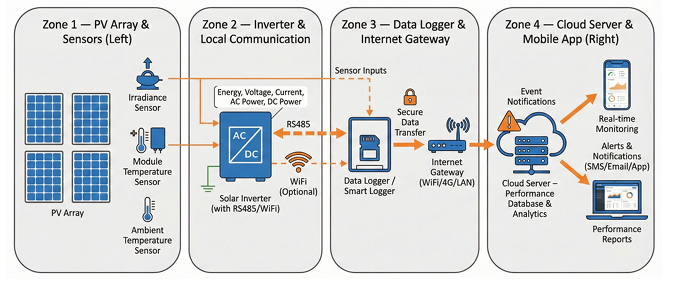
As solar photovoltaic (PV) systems scale in size and complexity, monitoring has become a core engineering requirement rather than an optional add-on. Effective monitoring ensures performance transparency, faster fault detection, and data-backed decision-making for EPCs, O&M teams, and asset owners. The diagram presents a four-zone solar PV monitoring architecture, clearly illustrating how data travels from the PV array in the field to cloud-based dashboards and mobile applications.
1. Why Monitoring Is Critical in Solar PV Systems
Solar PV generation is influenced by weather, equipment health, grid conditions, and system design. Without monitoring:
- Energy losses may remain undetected
- Equipment faults may escalate
- Performance guarantees become difficult to verify
A structured monitoring system converts raw electrical signals into actionable intelligence, improving both operational reliability and financial outcomes.
2. Zone 1 – PV Array and Environmental Sensors
The first zone represents field-level data sources, which provide context to power generation:
- PV Array
Generates DC power, whose output depends heavily on environmental conditions. - Irradiance Sensor
Measures incoming solar radiation, serving as the reference input for performance ratio (PR) and yield analysis. - Module Temperature Sensor
Captures the operating temperature of PV modules, critical because higher temperatures reduce voltage and power output. - Ambient Temperature Sensor
Provides surrounding environmental data for correlation and diagnostics.
Together, these sensors enable engineers to distinguish between weather-related performance variation and actual system issues.
3. Zone 2 – Inverter and Local Communication
The inverter is both a power conversion unit and a primary data hub:
- Electrical Parameters Captured
- DC voltage and current
- AC voltage, current, and power
- Energy generation data
- Communication Interfaces
- RS485 for reliable, long-distance industrial communication
- Wi-Fi (optional) for local connectivity and commissioning
This zone forms the backbone of monitoring, as inverter data reflects the real-time electrical health of the system.
4. Zone 3 – Data Logger and Internet Gateway
Zone 3 acts as the bridge between the site and the cloud:
- Data Logger / Smart Logger
Aggregates data from one or multiple inverters and sensors. - Secure Data Transfer
Encryption and authentication protect data integrity and prevent unauthorized access. - Internet Gateway
Connectivity via Wi-Fi, 4G, or LAN ensures continuous data transmission, even for remote sites.
This layer is especially important for commercial and utility-scale plants where centralized monitoring is required.
5. Zone 4 – Cloud Server and User Interfaces
The final zone enables remote visibility and analytics:
- Cloud Server
Stores time-series data, events, and alarms. - Analytics Engine
Performs:- Performance ratio and yield analysis
- Trend comparison
- Fault diagnostics
- User Access Platforms
- Web dashboards
- Mobile applications
Operators receive real-time alerts and notifications via SMS, email, or app notifications for inverter trips, communication loss, or abnormal generation.
6. Data Flow and Cybersecurity
The diagram highlights secure data flow from field devices to the cloud. Key considerations include:
- Encrypted communication protocols
- Controlled user access levels
- Secure cloud infrastructure
As solar plants become part of digital energy networks, cybersecurity is a growing design priority.
7. Benefits for Operations and Maintenance (O&M)
A comprehensive monitoring system enables:
- Faster fault identification
- Reduced downtime
- Predictive maintenance planning
- Improved system availability
O&M teams can shift from reactive troubleshooting to proactive performance management.
8. Asset Owner and Investor Perspective
For asset owners, monitoring provides:
- Transparent performance tracking
- Verification of EPC and O&M commitments
- Portfolio-level visibility across multiple sites
- Automated performance and compliance reports
Monitoring directly supports financial assurance and risk management.
9. Scalability and Future Integration
The zonal architecture supports:
- Addition of new sensors
- Integration with energy management systems
- Portfolio-level aggregation
- Advanced analytics and AI-based optimization
This makes the monitoring system future-ready and adaptable.
Conclusion
A well-designed solar PV monitoring architecture integrates sensors, inverters, communication networks, and cloud analytics into a unified system. By structuring monitoring into clear zones, stakeholders gain accurate performance insight, faster fault response, and long-term operational confidence. In modern solar PV plants, monitoring is not just about data—it is about control, optimization, and value protection