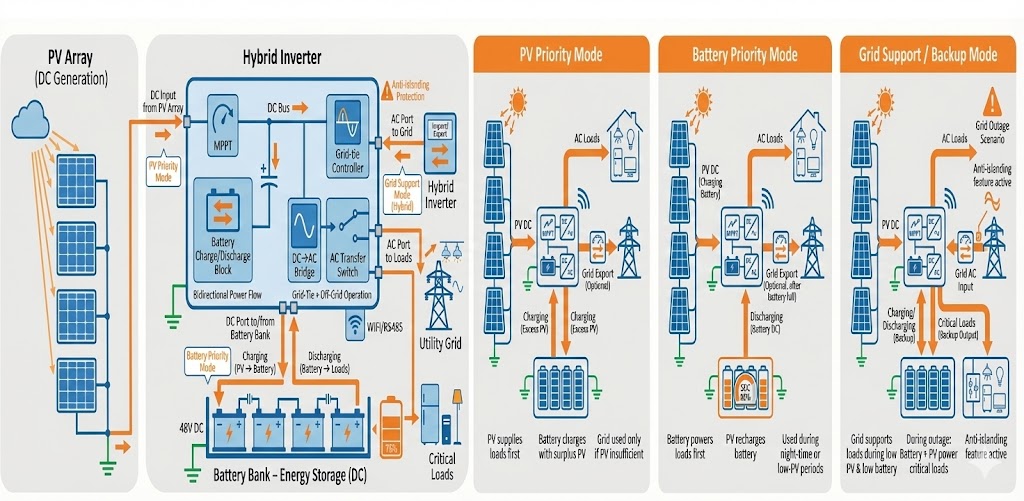
Hybrid solar inverter systems are increasingly becoming the preferred architecture for residential and commercial solar installations because they intelligently manage solar generation, battery storage, and grid interaction. The illustrated system diagram clearly demonstrates how power flows from the PV array through a hybrid inverter to loads, batteries, and the utility grid under different operating modes. Understanding these modes is essential for designing systems that balance energy savings, backup reliability, and grid compliance.
Overview of a Hybrid Solar Inverter System
A hybrid inverter integrates multiple functions into a single platform. It includes an MPPT charge controller to extract maximum power from the PV array, a battery charge/discharge block to manage energy storage, and a DC–AC inverter bridge to supply AC power to loads or export energy to the grid. The system also incorporates safety and compliance features such as anti-islanding protection, bidirectional power flow control, and seamless AC transfer switching between grid-connected and off-grid operation.
Power generated by the PV array is first optimized by the MPPT stage and then routed based on the selected priority mode. Depending on system configuration, energy can be consumed by on-site loads, stored in batteries, exported to the grid, or reserved for backup during outages.
PV Priority Mode (Solar-First Operation)
In PV Priority Mode, solar energy is given the highest preference. The PV array supplies power directly to AC loads through the inverter. Any excess solar generation, after meeting instantaneous load demand, is used to charge the battery bank. If the batteries reach their set state-of-charge (SOC) limit, surplus energy may be exported to the utility grid, subject to grid regulations and export permissions.
When solar generation is insufficient—such as during cloudy periods or early morning—the system draws supplementary power from the grid to support loads. Batteries are typically preserved and only charged from PV in this mode.
Key benefits of PV Priority Mode include:
- Maximum utilization of renewable solar energy
- Reduced grid electricity consumption
- Lower operational electricity costs
This mode is ideal for daytime load-dominant facilities such as offices, educational institutions, and commercial buildings aiming to maximize self-consumption of solar power.
Battery Priority Mode (Energy Storage–First Operation)
In Battery Priority Mode, the system prioritizes charging and maintaining the battery bank. Solar energy is first directed toward charging batteries, ensuring adequate stored energy is available for later use. Once battery charging requirements are satisfied, remaining solar power is used to supply loads or exported to the grid.
During periods of low or no solar generation, the battery bank discharges to supply loads before any grid power is imported. This mode is particularly useful where time-of-use tariffs, unreliable grids, or frequent outages exist.
Advantages of Battery Priority Mode:
- Ensures high battery availability for backup
- Enables load shifting and peak shaving
- Reduces dependence on the grid during peak tariff hours
This operating strategy is commonly applied in residential systems, remote facilities, and critical installations that require energy resilience.
Grid Support and Backup Mode
Grid Support / Backup Mode is designed for continuity of power during grid disturbances. Under normal grid conditions, the system operates in a grid-connected state, with PV and batteries supporting loads as configured. When a grid outage occurs, the inverter’s anti-islanding protection immediately isolates the system from the utility grid and transitions to off-grid operation.
In this mode, critical loads are powered using available PV generation and battery energy. Non-essential loads may be disconnected to preserve backup capacity. When grid power is restored, the inverter synchronizes and reconnects automatically, resuming normal operation.
Key features of this mode include:
- Seamless transition during grid failures
- Protection of utility personnel through anti-islanding
- Reliable backup for essential loads
Grid support mode is essential for hospitals, data centers, residential backup systems, and any site where power continuity is critical.
Role of Battery Bank and Critical Loads
The battery bank operates typically at a defined DC voltage (e.g., 48V DC) and is connected through dedicated protection devices. Critical loads are supplied via a separate output to ensure uninterrupted power during outages. Intelligent energy management logic ensures batteries are neither overcharged nor deeply discharged, preserving battery health and system longevity.
System Design and Compliance Considerations
- Anti-islanding compliance is mandatory for grid-connected systems
- Proper sizing of batteries and inverter capacity is critical
- Grid export limits and local utility regulations must be respected
- Clear segregation of critical and non-critical loads is recommended
Conclusion
Hybrid solar inverter systems provide unmatched flexibility by dynamically managing PV generation, battery storage, and grid interaction. By selecting the appropriate operating mode—PV Priority, Battery Priority, or Grid Support—system owners can optimize energy costs, improve resilience, and maximize the value of their solar investment. Proper configuration and understanding of these modes are fundamental to achieving a reliable, efficient, and compliant solar power system.