Series vs Parallel Solar Panel Connections: Understanding Voltage, Current, and System Performance
The performance of a solar photovoltaic (PV) system depends not only on the quality of its components but also on how those components are electrically connected. One of the most fundamental design decisions in any solar installation is whether PV modules are connected in series, parallel, or a combination of both.
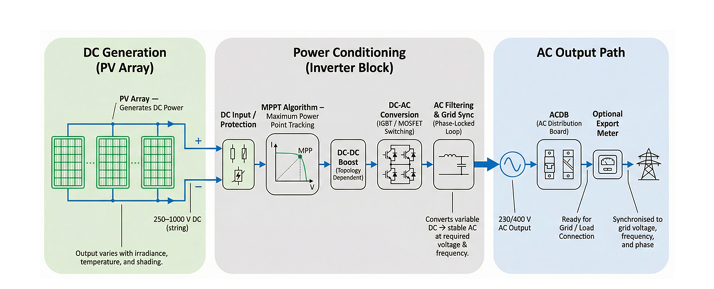
Understanding the difference between series and parallel PV configurations is essential for system designers, installers, and asset owners alike. The attached illustration clearly shows how each configuration affects voltage, current, and overall system behavior. This article explains these concepts and their practical implications in real-world solar projects.
Why PV Module Configuration Matters
A single solar module produces a limited voltage and current. To achieve the electrical characteristics required by inverters, charge controllers, or battery systems, multiple modules must be connected together.
The way modules are interconnected determines:
- System voltage and current
- Compatibility with inverters and controllers
- Cable sizing and electrical losses
- Performance under shading or mismatch conditions
Choosing the correct configuration is critical for safety, efficiency, and long-term reliability.
Series PV Module Configuration
In a series configuration, the positive terminal of one module is connected to the negative terminal of the next module, forming a continuous electrical path.
Electrical Characteristics
When modules are connected in series:
- Voltage adds up
- Current remains the same as a single module
Mathematically:
- Total voltage (Vₜₒₜₐₗ) = V₁ + V₂ + V₃ + …
- Total current (Iₜₒₜₐₗ) = Iₘₒdᵤₗₑ
For example, three modules each rated at 40 V and 10 A will produce:
- Total voltage = 120 V
- Total current = 10 A
This configuration is commonly used to reach the minimum operating voltage required by grid-tied inverters.
Advantages of Series Connections
- Higher Voltage, Lower Current
Higher voltage reduces current for the same power level, which lowers resistive losses in cables and allows the use of smaller conductor sizes. - Inverter Compatibility
Most modern string inverters require a minimum DC voltage to operate efficiently. Series strings help achieve this voltage range. - Simpler Wiring
Series connections often result in fewer parallel conductors, simplifying system layout.
Limitations of Series Connections
The primary drawback of series configurations is mismatch sensitivity.
If one module in a series string is shaded, damaged, or underperforming:
- The current of the entire string is limited by the weakest module
- Overall power output is reduced
While bypass diodes help mitigate extreme losses, series strings remain sensitive to shading and module mismatch.
Parallel PV Module Configuration
In a parallel configuration, all positive terminals are connected together, and all negative terminals are connected together.
Electrical Characteristics
When modules are connected in parallel:
- Current adds up
- Voltage remains the same as a single module
Mathematically:
- Total voltage (Vₜₒₜₐₗ) = Vₘₒdᵤₗₑ
- Total current (Iₜₒₜₐₗ) = I₁ + I₂ + I₃ + …
For example, three modules each rated at 40 V and 10 A will produce:
- Total voltage = 40 V
- Total current = 30 A
Parallel connections are commonly used in battery-based and off-grid systems where current requirements are high.
Advantages of Parallel Connections
- Reduced Impact of Mismatch
If one module underperforms, the remaining modules continue to operate at full capacity, minimizing total power loss. - Improved Shading Tolerance
Parallel systems perform better in environments with partial shading or uneven soiling. - Lower Voltage Levels
Lower system voltage can simplify safety requirements in small off-grid systems.
Limitations of Parallel Connections
- Higher Current, Higher Losses
Increased current leads to higher resistive losses and requires larger cable sizes. - Additional Protection Requirements
Parallel strings require fuses or circuit breakers to protect against reverse currents. - Voltage Constraints
Parallel-only configurations may not reach the voltage required for certain inverters.
Series vs Parallel: Key Design Considerations
In real-world installations, most solar PV systems use a combination of series and parallel connections to balance voltage and current.
Key factors influencing configuration choice include:
- Inverter voltage and current limits
- Site shading conditions
- Cable length and routing
- System size and layout
- Safety and code compliance
For example:
- Grid-connected rooftop systems typically use long series strings
- Off-grid battery systems often use more parallel connections
- Utility-scale plants combine multiple series strings in parallel arrays
Managing Mismatch and Performance Losses
The image highlights an important concept: mismatch losses.
- In series strings, mismatch reduces total output significantly
- In parallel configurations, mismatch impact is distributed
Modern solutions to address mismatch include:
- Module-level power electronics (MLPE)
- DC optimizers
- Microinverters
These technologies allow each module to operate independently, improving performance in complex layouts.
Practical Implications for Solar Projects
Understanding series and parallel configurations helps stakeholders:
- Optimize system efficiency
- Reduce electrical losses
- Improve long-term reliability
- Design safer systems
For organizations like Firstgreen, correct configuration design ensures that solar installations deliver predictable, bankable energy yields over their operational life.
Conclusion: Designing Smarter Solar Systems
Series and parallel PV module configurations form the electrical backbone of every solar power system. While series connections increase voltage and parallel connections increase current, the optimal design balances both to meet system requirements while minimizing losses and risk.
By carefully considering site conditions, equipment specifications, and performance trade-offs, solar systems can be engineered to operate efficiently, safely, and reliably. At Firstgreen, this technical rigor underpins the delivery of high-quality solar solutions that maximize value for clients and contribute meaningfully to the clean energy transition.
0 Comments