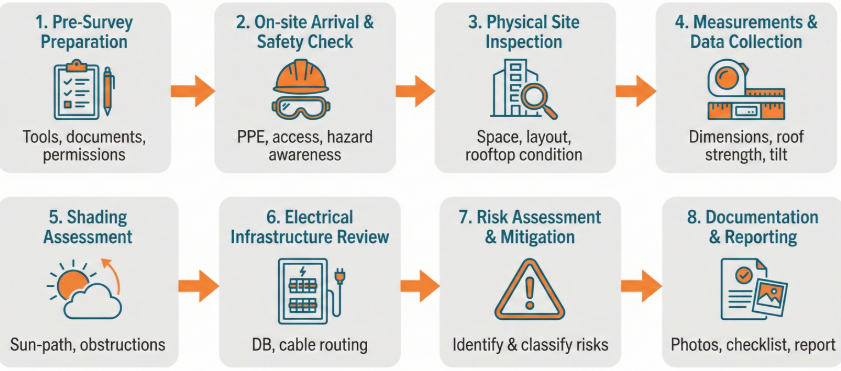
A successful solar photovoltaic (PV) installation begins long before panels are mounted or inverters are commissioned. The foundation of an efficient, safe, and compliant solar project lies in a comprehensive site survey. The illustrated workflow highlights the eight critical stages of a professional solar PV site assessment, ensuring that technical feasibility, safety, and performance risks are addressed early. This blog explains each step in detail and demonstrates why a structured site survey is essential for both residential and commercial solar projects.
1. Pre-Survey Preparation
The site survey starts with thorough preparation. This phase involves reviewing project scope, collecting site drawings, electrical layouts, and utility bills, and identifying applicable regulations and permits. Surveyors ensure that all required tools—measuring devices, cameras, PPE, and testing instruments—are ready before visiting the site. Proper preparation reduces on-site delays and improves data accuracy.
2. On-site Arrival and Safety Check
Safety is the highest priority once the team arrives on site. A safety briefing is conducted, and personal protective equipment (PPE) such as helmets, gloves, safety shoes, and harnesses is used where required. Access routes, emergency exits, and potential hazards (live panels, fragile roofs, height risks) are identified. This step ensures compliance with occupational health and safety standards.
3. Physical Site Inspection
A detailed physical inspection follows. Surveyors evaluate available space, rooftop or ground conditions, structural integrity, and mounting feasibility. Roof type (RCC, metal, sheet), age, waterproofing condition, and load-bearing capacity are examined to confirm suitability for solar installation. This step prevents structural failures and redesigns at later stages.
4. Measurements and Data Collection
Accurate measurements are essential for system design. Roof dimensions, usable area, tilt angles, parapet heights, and structural obstructions are recorded. Roof strength and orientation are assessed to determine optimal module placement. This data directly influences system capacity, layout design, and generation estimates.
5. Shading Assessment
Shading analysis is a critical performance factor. Surveyors study sun paths, surrounding buildings, trees, water tanks, and other obstructions that may cast shadows on the PV array. Even partial shading can significantly reduce energy output. Tools such as shade analysis apps or solar pathfinders are often used during this stage.
6. Electrical Infrastructure Review
Existing electrical infrastructure is reviewed in detail. This includes inspection of distribution boards (DBs), available breaker capacity, earthing systems, cable routing paths, and inverter placement options. Grid connectivity, metering location, and distance from the point of interconnection are also assessed to ensure electrical safety and code compliance.
7. Risk Assessment and Mitigation
All identified technical, structural, electrical, and safety risks are analyzed and classified. Potential issues such as weak structures, water leakage, fire risk, access challenges, or regulatory constraints are documented. Mitigation strategies—such as structural reinforcement, rerouting cables, or alternative layouts—are proposed to minimize project risks.
8. Documentation and Reporting
The final stage consolidates all findings into a structured site survey report. This includes photographs, checklists, drawings, measurements, shading analysis, and risk observations. The report serves as a reference document for designers, installers, project managers, and approval authorities, ensuring clarity and accountability throughout the project lifecycle.
Conclusion
A systematic solar PV site survey is not just a preliminary activity—it is a critical engineering process that determines project success. By following a structured eight-step methodology, solar professionals can ensure accurate design, regulatory compliance, safety assurance, and optimal energy performance. Investing time in a detailed site survey ultimately reduces costs, avoids rework, and enhances long-term system reliability.
0 Comments