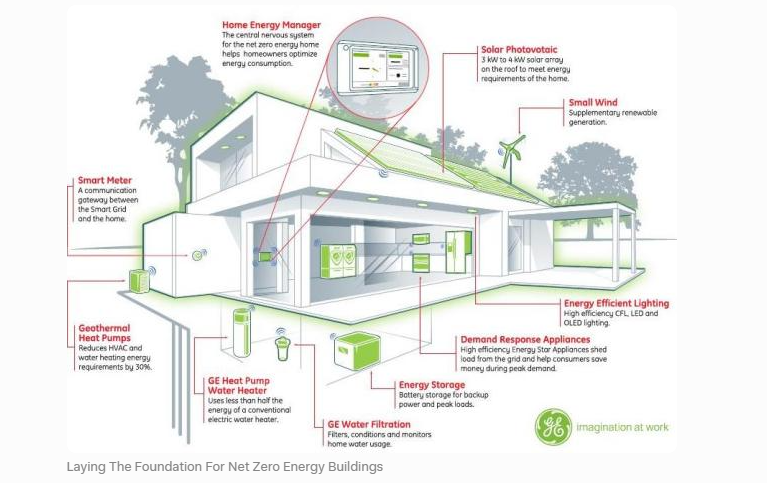
In a world where buildings are evolving from passive structures to dynamic engines of productivity and resilience, the future of architecture is designed, not consumed. From bustling cities like Delhi and Dubai to emerging hubs like Dar es Salaam, energy-smart buildings are transforming urban landscapes into vibrant, regenerative ecosystems. At Firstgreen Consulting, we’re at the forefront of this shift, empowering corporates to achieve net-zero goals through intentional design and innovative strategies. The intelligent envelope serves as the building’s skin and brain, where roofs, walls, and façades breathe, shade, and generate energy in a net-zero future. Guided by the Energy Conservation and Sustainable Building Code (ECSBC) 2024, we optimize elements such as a Solar Reflectance Index greater than 78, low U-values like 0.20 W/m²·K for roofs, and Window-to-Wall Ratios under 40% on southern exposures to achieve up to 5% annual energy savings through the Envelope Performance Factor (EPF). Smart systems and controls act as the hidden architects of comfort, employing algorithms and feedback loops to replace guesswork with precision, where even a 1°C adjustment can reduce energy use by 10%, with performance dashboards that sense, analyze, optimize, and adapt in real-time. Light is treated as a fundamental building material, where each lumen saved translates to a watt earned, integrating daylighting with high-efficacy LEDs at least 120 lm/W, occupancy sensors compliant with ASHRAE 90.1 and ECBC 2024, and adaptive tunable white lighting to minimize consumption while boosting occupant well-being. Renewable energy integration turns buildings from power consumers into producers, incorporating 100 kWp solar PV arrays generating around 150 MWh annually, wind turbines, and smart net metering for zero bills, creating on-site microgrids that balance demand and supply for true net-zero operation. Water and material synergy emphasizes regeneration over mere efficiency, harvesting rainwater, reclaiming greywater, and recharging aquifers while using low-embodied-carbon concrete and sustainable bamboo cladding to form circular systems where waste becomes a resource, healing the environment rather than depleting it. Beyond these, digital twins enable pre-build simulations to predict performance, and the human factor prioritizes well-being as the ultimate net-zero metric, elevating Indoor Environmental Quality through biophilic designs that harmonize thermal, visual, acoustic, and air parameters for thriving communities. Aligned with LEED Zero certification’s four pillars—energy, carbon, water, and waste—our solutions deliver measurable regenerative performance. As Dr. Sanjay Vashishtha, CEO of Firstgreen Consulting, notes, “At Firstgreen, we believe that every kilowatt-hour saved and every litre harvested is design intelligence made visible.” With over 1 GW of solar projects, 80 million ft² of certified green buildings, and more than 100 LEED/IGBC/GRIHA certifications, we’re your partner in designing, decarbonizing, and delivering a net-zero future—contact us at info@grey-caribou-826054.hostingersite.com to begin.
2025-12-06
The Architecture of Zero: Five Strategies for Energy-Smart Buildings